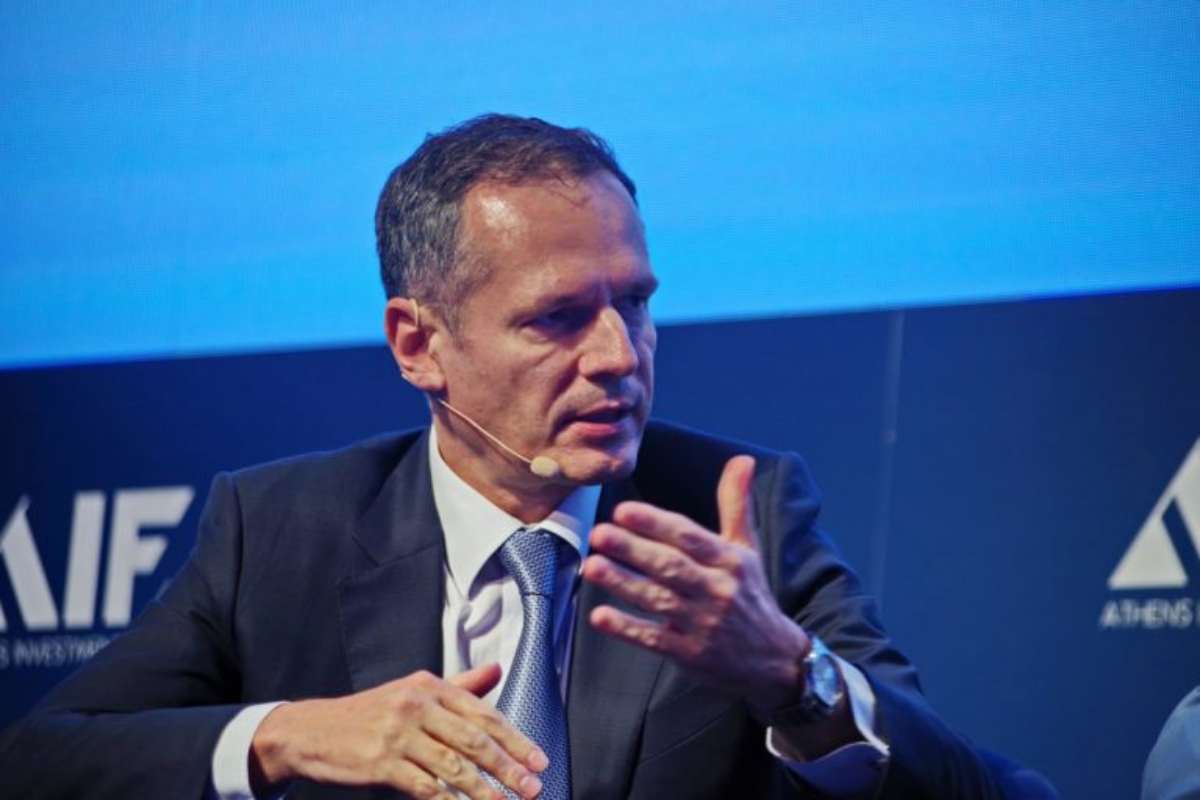
ADMIE is no longer simply laying cables.
Behind the electricity interconnectors stretching across the Aegean and increasingly towards the Eastern Mediterranean lies a much larger strategy: moving Greece from the geographical edge of Europe’s electricity market towards the centre of an emerging energy corridor connecting the Balkans, Italy and the Eastern Mediterranean.
Under Chairman and CEO Manos Manousakis, Greece’s Independent Power Transmission Operator is overseeing a multi-billion-euro investment cycle that could fundamentally alter both the domestic electricity system and Greece’s position on the regional energy map.
The significance goes far beyond ADMIE itself.
The investments affect electricity bills, the energy security of Greek islands, the integration of renewable generation, carbon emissions and — increasingly — Greece’s geopolitical weight.


€3.7 billion: The direct benefit for consumers
Perhaps the most important number behind the investment programme is €3.7 billion.
According to figures presented by ADMIE on February 24, 2026, that is the estimated net benefit to electricity consumers between 2026 and 2034 from connecting Greece’s Non-Interconnected Islands to the mainland grid.
The average net economic benefit is estimated at approximately €416 million annually.
With the Cyclades fully connected and Crete linked to both Attica and the Peloponnese, savings on Public Service Obligation costs are estimated to average approximately €550 million annually until 2030.
Once the Dodecanese and North Aegean islands are also connected to the mainland system, annual PSO savings are expected to approach €1 billion.
Cumulative PSO savings through 2034 are estimated at approximately €7 billion.
Those numbers explain why Greece’s submarine cables should not be viewed simply as engineering projects.
They have a measurable impact on the economics of the electricity system.
Why consumers stand to benefit
The mechanism is relatively straightforward.
For decades, many Greek islands depended on autonomous power stations burning expensive imported fossil fuels.
The additional cost of supplying those islands was ultimately recovered through Public Service Obligation charges paid by electricity consumers.
Interconnection changes that model.
Once an island becomes part of the mainland electricity system, dependence on expensive local oil-fired generation can be drastically reduced.
There is another important factor.
ADMIE has calculated that, had the islands remained electrically isolated, environmental requirements forcing a transition from heavy fuel oil towards substantially more expensive diesel would have created additional costs — ultimately feeding through into electricity bills.
The cables therefore do not merely modernise the grid.
They eliminate structural costs embedded in the old island electricity model.


Crete-Attica: The project that shows what interconnection can deliver
Crete provides perhaps the clearest case study.
On March 13, 2026, Manos Manousakis described the Crete-Attica interconnection as one of the projects bringing the island into a new energy era.
The numbers explain the scale of that change.
Crete’s dual interconnection is expected to generate approximately €5 billion in savings on electricity bills over the coming decade.
At the same time, annual carbon dioxide emissions are expected to fall by roughly 1.5 million tonnes.
There is also a third benefit that is harder to capture in a single financial figure: security of supply.
Crete now has access to a substantially stronger and more reliable electricity system — particularly important for an island whose demand rises sharply during the tourism season.
An electricity cable therefore becomes more than an energy asset.
It becomes infrastructure supporting tourism, investment and the broader regional economy.
19 GW of renewables: Greece’s next challenge is moving the electricity
Greece’s energy transition has already reached a critical point.
Speaking at The Economist’s 30th Annual Government Roundtable on July 9, 2026, Manousakis said installed renewable capacity in the Greek electricity system had reached 19 GW.
Another 13 GW of projects have secured connection terms and, according to the ADMIE chief, the overwhelming majority are already under construction.
That creates a very different challenge from the one Greece faced a decade ago.
The issue is no longer simply how to build more solar and wind capacity.
The system also needs sufficient transmission infrastructure to move that electricity to where demand exists — both inside Greece and across its borders.
That is where international interconnectors become increasingly important.


Italy and the export of Greece’s green surplus
The planned new Greece-Italy interconnection is one of the most important projects in ADMIE’s next investment cycle.
The project is expected to triple the electricity transmission capacity currently available between the two countries.
Manousakis has directly linked the project to Greece’s ability to export surplus renewable electricity.
This is critical to the economics of the energy transition.
Producing more green electricity is not enough.
Greece must also be able to sell that electricity into neighbouring markets when domestic demand cannot absorb the available production.
Interconnectors, in that sense, become export highways.
They can transform renewable resources into a tradable economic advantage.
August 13: Cyprus-Israel and the next stage of the Great Sea Interconnector
The latest major development came on August 13, 2026.
ADMIE, as project promoter of the Great Sea Interconnector, submitted the investment request for the Cyprus-Israel section to the regulatory authorities of both countries.
Cost-benefit studies conducted ahead of the filing concluded that the project was economically viable under all scenarios examined.
The technical specifications illustrate its scale.
The Great Sea Interconnector is designed for 1,000 MW of transmission capacity using 500 kV HVDC technology.
The Cyprus-Israel submarine section alone would extend for approximately 324 kilometres, reaching water depths of between 2,200 and 2,400 metres.
Electricity flows would be bidirectional.
That distinction matters.
The project is not simply designed as an import or export line.
It would create an electricity corridor capable of moving power in either direction depending on market conditions and energy requirements.

Meridiam brings international capital into the GSI
Another development adds a financial dimension to the project.
A week before the Cyprus-Israel investment filing, ADMIE and French infrastructure investor Meridiam signed an agreement at the Greek Prime Minister’s office for Meridiam to enter the Great Sea Interconnector project company as majority shareholder.
ADMIE is also seeking additional investors for the Cyprus-Israel section.
The involvement of international infrastructure capital matters for two reasons.
First, it distributes the financing requirements of projects whose scale would otherwise place considerable pressure on a single operator.
Second, international investment can serve as an important market signal regarding the long-term economic and strategic potential of cross-border electricity infrastructure.
From Israel to Egypt — and potentially Saudi Arabia
The map does not end with Cyprus and Israel.
ADMIE is providing technical and advisory support for GREGY, the planned Greece-Egypt electricity interconnector.
At the same time, the Greek operator and Saudi Arabia’s National Grid have been working on a feasibility study for a potential Greece-Saudi Arabia electricity link.
This is where the broader picture becomes visible.
Italy to the west.
The Balkans to the north.
Cyprus and Israel to the southeast.
Egypt — and potentially Saudi Arabia — further south and east.
Greece sits geographically between them.
ADMIE’s strategic challenge is to turn that geography into physical electricity infrastructure.
The €1 billion capital increase and ADMIE’s “change of league”
Projects of this scale require capital.
In June 2026, ADMIE completed a €1 billion capital increase designed to support the acceleration of its next generation of transmission investments.
On June 23, Manousakis used a particularly telling phrase to describe its significance.
“The success of the share capital increase essentially represents a ‘change of league’ for ADMIE,” he said, linking the transaction both to the operator’s development and to the wider trajectory of the Greek economy.
The description reflects the change in investment scale.
ADMIE’s current ten-year development programme through 2034 amounts to approximately €7.5 billion.
That investment programme covers not only domestic grid reinforcement and island connections but also projects capable of giving Greece a much larger role in cross-border electricity trading.

CHAMPIONS LEAGUE 2026-2027 / ˅֓ʉ ӏ։S – Eʠ
Five ways Greece stands to gain
The strategic value of the programme can be measured across five areas.
First comes cost.
Island interconnections can substantially reduce the expensive Public Service Obligation burden created by isolated oil-fired generation.
Second is energy security.
Greek islands become less dependent on standalone thermal power stations and gain access to the resilience of the mainland electricity system.
Third is renewable capacity.
A stronger transmission network allows Greece to integrate substantially larger volumes of solar and wind power.
Fourth is exports.
International interconnectors give the country the ability to sell electricity into neighbouring markets when domestic renewable generation exceeds demand.
And fifth is geopolitics.
The more electricity systems that connect through Greece, the more strategically valuable the country becomes within the European and Mediterranean energy architecture.
ADMIE’s real asset is the position it can give Greece
The biggest mistake would be to view these projects as a collection of unrelated submarine cables.
Crete.
The Cyclades.
The Dodecanese.
The North Aegean.
Italy.
Cyprus and Israel.
Egypt.
Potentially Saudi Arabia.
Place them on the same map and a much larger picture begins to emerge: an electricity architecture with Greece increasingly positioned at its centre.
That is the real strategic bet being pursued by Manos Manousakis and ADMIE.
Not simply to build more cables, but to create a transmission network capable of reducing costs for consumers, integrating more renewable generation, strengthening security of supply and allowing Greece to move and export electricity across multiple markets.
The €3.7 billion estimated net benefit for consumers demonstrates the economic case.
The 19 GW of installed renewable capacity demonstrates the country’s generation potential.
And the planned links towards Italy, Cyprus, Israel, Egypt and potentially Saudi Arabia demonstrate the geopolitical opportunity.
ADMIE, in other words, is not merely constructing Greece’s electricity grid for the next decade.
It is building the energy highways that could turn the country’s geography into a tangible economic and strategic advantage — and move Greece closer to becoming a genuine electricity crossroads between Europe and the Eastern Mediterranean.
Source: pagenews.gr