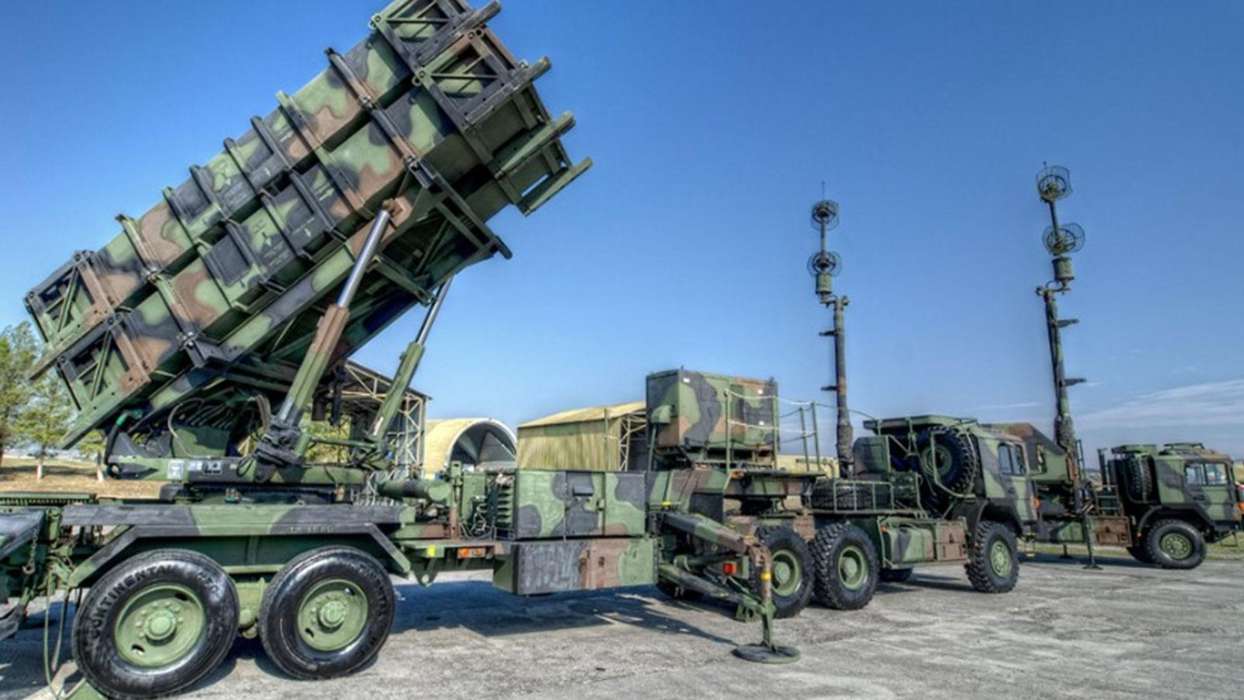
A new operational engagement involving the Greek PATRIOT Guided Missile Battery was recorded in Saudi Arabia during the early hours of Thursday, August 27, marking another sign of the growing pressure on the Kingdom’s air-defense network.
According to military sources, the Greek battery engaged a number of hostile unmanned aerial vehicles, launching three missiles.
The airborne targets were brought down in coordination with Saudi Arabia’s own air-defense systems.
The latest engagement has not yet been reflected in a publicly available online statement by the Hellenic National Defence General Staff. Previous interceptions by the Greek unit in Saudi Arabia, however, have been officially confirmed, demonstrating that the battery is operating in an active combat environment.


Greek Patriots Again Operating Under Real Combat Conditions
The PATRIOT battery forms part of the Hellenic Force deployed in Saudi Arabia and participates in the Integrated Air Missile Defense, or IAMD, framework.
Its core mission is to reinforce the Kingdom’s air defenses and protect strategic infrastructure against missile and airborne threats.
The Greek deployment began in 2021, but its operational significance has increased sharply as the Middle East has entered a period marked by repeated ballistic-missile and UAV attacks.
The most important element of the latest engagement is that the Greek system is no longer serving merely as a deterrent or surveillance asset.
It is actively operating.
And it is doing so in one of the world’s most demanding air-defense environments.
Yanbu in the Spotlight – A Critical Energy Hub
The Yanbu area in western Saudi Arabia carries major strategic importance.
It is one of the Kingdom’s most important industrial and energy hubs, hosting critical oil infrastructure and facilities near the Red Sea.
Protecting such infrastructure is not solely a Saudi concern.
A major strike against refineries or energy installations could have immediate consequences for global oil markets, shipping routes and, ultimately, energy prices in Europe.
Greek Defence Minister Nikos Dendias made that connection after the interception of two Iranian ballistic missiles on March 19.
“In this way, the Greek battery demonstrates its readiness and the experience it has acquired,” he said, linking the protection of energy facilities with the broader economic security of European citizens.
March 19: Greek Patriots Against Iranian Ballistic Missiles
The first major operational test came on March 19.
The Greek battery launched two interceptors and destroyed two ballistic missile targets.
According to the official briefing at the time, the missiles had originated from Iran and were heading toward Saudi energy installations.
Another real-world engagement followed on April 6, when the Greek battery launched one missile and destroyed a UAV in line with the applicable rules of engagement.


July 25: Missiles and Drones From Yemen
A new major test followed on July 25, when the Yanbu area came under attack from threats originating in Yemen.
The Greek battery took part in the interception effort and later destroyed a UAV heading toward the same area.
The repeated engagements over a period of only a few months have significantly changed the character of the Greek mission.
This is no longer simply a symbolic or theoretical contribution to an international air-defense architecture.
It is a force accumulating direct combat experience against different categories of aerial threats.
From Ballistic Missiles to Low-Cost Drones
The latest incident also highlights one of the central dilemmas of modern warfare.
UAVs can cost a fraction of the advanced interceptors used to destroy them.
That creates a growing cost and saturation problem: an attacker can attempt to exhaust expensive air-defense inventories by launching large numbers of comparatively cheap drones.
For that reason, modern air-defense networks are increasingly moving toward layered architectures in which Patriot-class systems operate alongside short-range defenses, sensors, electronic-warfare capabilities and dedicated counter-drone systems.
Why Saudi Arabia Also Matters for Greek Defense
The Greek presence has a second dimension that goes beyond bilateral military ties between Athens and Riyadh.
Greek Air Force personnel are gaining direct operational experience against:
- ballistic missiles,
- UAVs,
- complex attack profiles,
- real-time early-warning procedures,
- integrated air-defense coordination,
- operations under elevated threat conditions.
That experience is particularly valuable as Greece develops its future layered air-defense architecture and considers the modernization of its Patriot systems.
Discussions between Athens and Riyadh over possible upgrades to Greece’s Patriot fleet had already emerged in 2026, as the systems have accumulated significant operational wear after years of sustained readiness in Saudi Arabia.


Greece Enters the Laboratory of the New Air War
The geopolitical value of the Greek deployment lies precisely here.
The Middle East has become one of the world’s most important real-life laboratories for the future of air defense.
Ballistic missiles, cruise missiles, drones and saturation attacks are testing systems that, only a few years ago, were evaluated mainly through exercises and simulations.
The Greek Patriot battery is now acquiring experience that cannot easily be replicated in a training environment.
For Athens, this creates a double strategic benefit.
Greece strengthens its defense relationship with one of the Gulf’s most influential powers while also gaining operational knowledge that can be transferred back into the country’s own air-defense planning.
The next debate surrounding the Patriots, therefore, is not only about where they are deployed.
It is about how the experience gained in Saudi Arabia can be converted into doctrine, technology and readiness for defending Greek airspace against the next generation of missile and unmanned threats.
Source: pagenews.gr