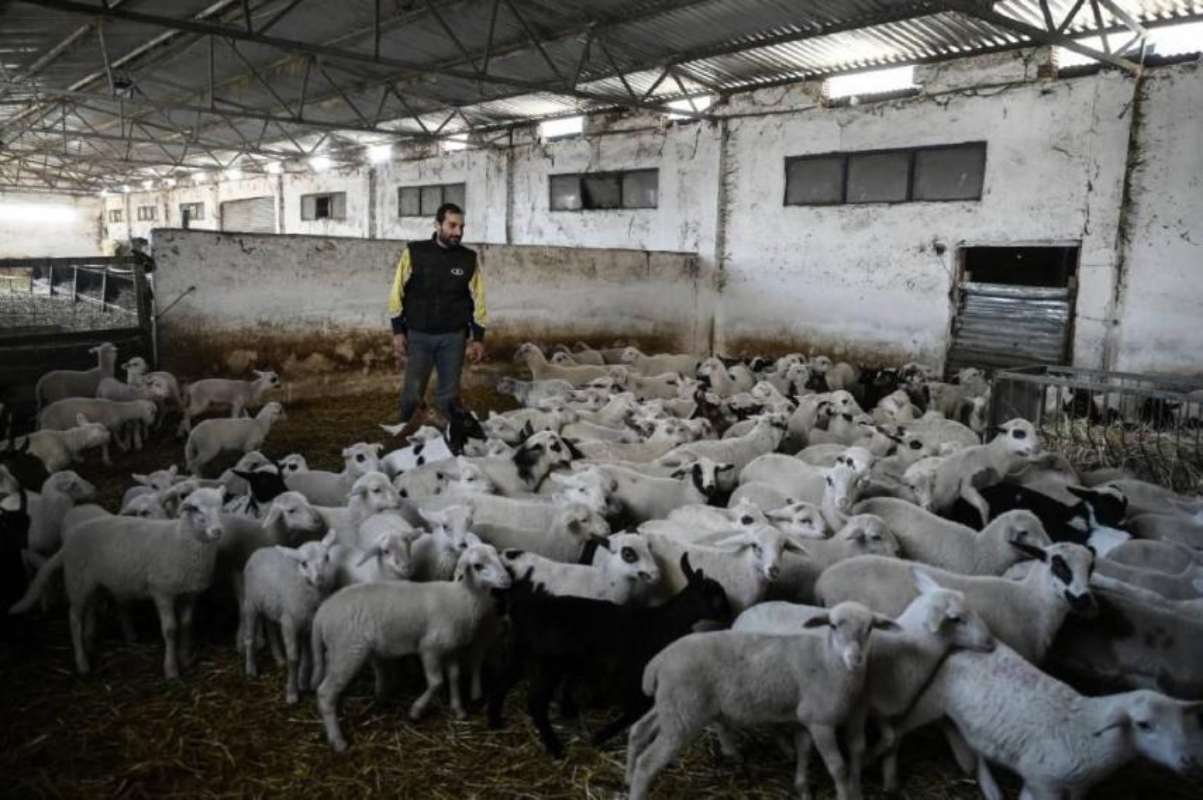
Tractors may provide the most dramatic images on the streets of Thessaloniki, but behind the farmers’ mobilization ahead of the Thessaloniki International Fair lies a much deeper crisis.
For thousands of people working in Greece’s primary sector, the problem is no longer limited to high production costs, delayed subsidies or weak farm-gate prices.
For a significant part of the country’s livestock industry, the question has become far more fundamental:
Will there still be a viable farm for the producer to return to?
Sheep and goat pox, peste des petits ruminants and foot-and-mouth disease have created one of the most serious animal-health and economic crises Greek livestock farming has faced in years.
And just one week before the opening of the Thessaloniki International Fair, the government and the farming community are entering a highly sensitive political period.
Another €16.8 million payment just before TIF
On August 27, the Ministry of Rural Development and Food announced a new compensation package worth €16.84 million for 2,806 livestock farms, covering income losses during the first half of 2026.
The farms concerned were affected by sheep and goat pox, peste des petits ruminants and foot-and-mouth disease.
According to the ministry, the money is being transferred directly to eligible producers.
A previous payment of approximately €28.5 million had been made in December 2025 to compensate 2,339 farms for income losses.
That brings support under this specific income-loss mechanism to approximately €45.34 million, while the ministry has announced that another payment will follow for the second half of 2026.
The crucial distinction: Losing an animal is not the same as losing an income
This is one of the most important elements of the crisis.
Livestock farmers do not simply lose the market value of animals that authorities order to be culled.
They lose the economic production those animals would have generated.
Milk.
Meat.
Breeding.
Future livestock.
And ultimately months of business activity.
That is why the compensation framework distinguishes between payments for animals that have been culled and additional support for the income farmers lose while they are unable to rebuild their herds.
As the government has acknowledged, behind every animal lost is a farmer who has also lost production and income.
The policy challenge therefore extends far beyond paying compensation for the immediate destruction of livestock.


€70 per adult sheep or goat for lost income
The compensation framework adopted in August reveals the scale of the income-support mechanism.
For income losses resulting from farmers being unable to restock their holdings, the scheme provides, among other amounts:
- €70 per culled sheep or goat older than six months.
- €35 for lambs and kids up to six months old and certain breeding animals.
- €200 per culled bovine.
There is an important distinction.
These amounts compensate lost income caused by the inability to rebuild livestock holdings.
They are separate from compensation for the value of the animals themselves.
That difference matters enormously when assessing how much support a farm actually receives.
Nearly 489,000 sheep and goats had already been culled
The scale of the animal-health emergency explains why this has moved far beyond a conventional agricultural dispute.
According to official figures covering the period from August 2024 to May 24, 2026, Greece had recorded:
- 2,172 confirmed outbreaks of sheep and goat pox
- 2,681 affected livestock holdings
- 488,754 sheep and goats culled
This represents the destruction of an enormous amount of productive capital.
And for the livestock farmer, the economic damage does not end on the day the herd is destroyed.
In many cases, that is when it begins.
An empty farm cannot restart with a compensation cheque alone
The core problem now is herd reconstruction.
A farmer whose entire herd has been culled cannot simply receive compensation and resume normal production the following morning.
Animals have to be purchased.
Biosecurity requirements must be satisfied.
The holding has to be cleared for restocking.
Feed must be financed.
Working capital is required.
And, critically, the producer must be confident enough about the future to invest again.
That last point may prove decisive.
Because the biggest threat to Greek livestock farming is not only the number of animals being lost.
It is the possibility that farmers who lose their herds decide never to return.


Western Achaia shows what the crisis looks like on the ground
Western Achaia provides a striking example.
Figures released during August pointed to approximately 25,000 animals culled and around 250 livestock farms left empty in the area.
This is what “herd reconstruction” means in practice.
It is not an abstract agricultural-policy term.
It means hundreds of businesses temporarily producing nothing, while families wait to discover when — and under what financial conditions — they can start again.
If a significant share never does, the damage becomes structural rather than temporary.
Málgara becomes the farmers’ command center before TIF
At the same time, farmers are preparing to return to the streets.
Representatives from across Greece are meeting in Málgara on Saturday, August 29, to coordinate their strategy ahead of the major agricultural demonstration planned for September 5, the opening day of the Thessaloniki International Fair.
The message from farmers’ organizations is increasingly uncompromising.
“We are determined to fight for our survival and for a change in the situation facing the primary sector until the end,”said Kostas Sefis, president of the Kymina-Málgara Agricultural Association.
The word “survival” is significant.
According to Sefis, at least 60 farming families in Chalastra have already abandoned cultivation, leaving approximately 2,000 stremmas of land uncultivated.
That points to a problem extending beyond livestock disease.
It is about the demographic and economic viability of agricultural production itself.
The second front: Subsidies and liquidity
Animal disease is only one source of pressure.
Farmers are also complaining about delayed subsidy payments, problems surrounding agricultural declarations and a growing shortage of liquidity.
Their argument is that production is being squeezed simultaneously from several directions.
Higher input costs.
Lost production.
Animal disease.
Delayed payments.
Difficulty restarting businesses.
Taken together, these pressures can become more dangerous than any one problem in isolation.
Because once a farm runs out of working capital, the question is no longer profitability.
It is whether production continues at all.
The real metric is not how much was paid — but how many farmers return
This is where the agricultural-policy debate becomes much more important.
The government can point to significant compensation payments.
Livestock farmers can reasonably argue that the economic value of a destroyed farming operation cannot be measured solely by the market value of its animals.
Both sides have numbers.
But there is one indicator that will ultimately determine whether the policy worked:
How many farms that lost their herds will be operating again a year from now?
If a livestock producer receives compensation but permanently leaves the industry, the state may have covered part of the financial loss.
But Greece will still have lost productive capacity.
From the farm to the supermarket shelf
And this is not only a farmers’ problem.
It is an economic problem.
Fewer herds mean lower domestic production of milk and meat.
Lower production can increase pressure on processors, raise dependence on imports and eventually feed into higher food prices.
There is also feta.
Greek sheep and goat farming is not merely a socially sensitive activity concentrated in rural regions.
It is the foundation of an entire value chain extending from farms and dairies to exports and Greece’s internationally recognized PDO products.
Protecting livestock production is therefore simultaneously agricultural policy, food-security policy and industrial policy.
The hidden risk: Greece could pay compensation while losing production
This is the danger policymakers must now address.
Compensation is necessary.
But compensation alone is defensive policy.
The next phase must be about reconstruction.
That means moving from:
compensation → herd reconstruction → production restart → sustainable farm income.
If the chain stops at the first stage, Greece could spend tens of millions of euros compensating livestock farmers while continuing to lose farms, animals and domestic food-production capacity.
And once productive capacity disappears, rebuilding it can be considerably more expensive than protecting it in the first place.
The real TIF battle is about who will still be producing next year
The tractors entering Thessaloniki will provide the political image.
But they are not the deepest problem.
The deeper problem is what happens after the demonstrations are over.
Every livestock holding that fails to reopen means the loss of a producer, part of a local economy and a piece of Greece’s domestic food-production base.
The new €16.8 million payment matters. So does the more than €45 million allocated through the income-loss mechanism.
It is also important that agricultural policy now recognizes a fundamental economic reality: paying for the animal that was culled is not enough when the farmer has also lost months of production.
But the next step is harder.
The real agricultural-policy test at TIF is not how many millions of euros are announced. It is how many farmers who have lost their animals today will still be farmers when the next Thessaloniki International Fair opens.
That is the difference between compensating a crisis and rebuilding an industry.
Source: pagenews.gr