Seven months after the U.S. military intervention in Venezuela and the removal of Nicolás Maduro, Donald Trump is now trying to convert the new political order in Caracas into one of the biggest energy deals in modern history.
The agreement announced by Washington and Caracas covers the development of 17 strategic oil fields containing more than 65 billion barrels of proven reserves — roughly one fifth of Venezuela’s total reserves — with majority U.S. control over the new business structure that will develop them.
Interim President Delcy Rodríguez confirmed the agreement, describing it as “historic” and saying it could attract more than $100 billion in investment while generating more than $209 billion in tax revenues for the Venezuelan state.
But behind the headline numbers lies a much bigger geopolitical story.
The Trump administration is effectively trying to redraw the energy map of the Western Hemisphere.
Trump: “The biggest oil deal in world history”
The U.S. president used characteristically expansive language to present the agreement.
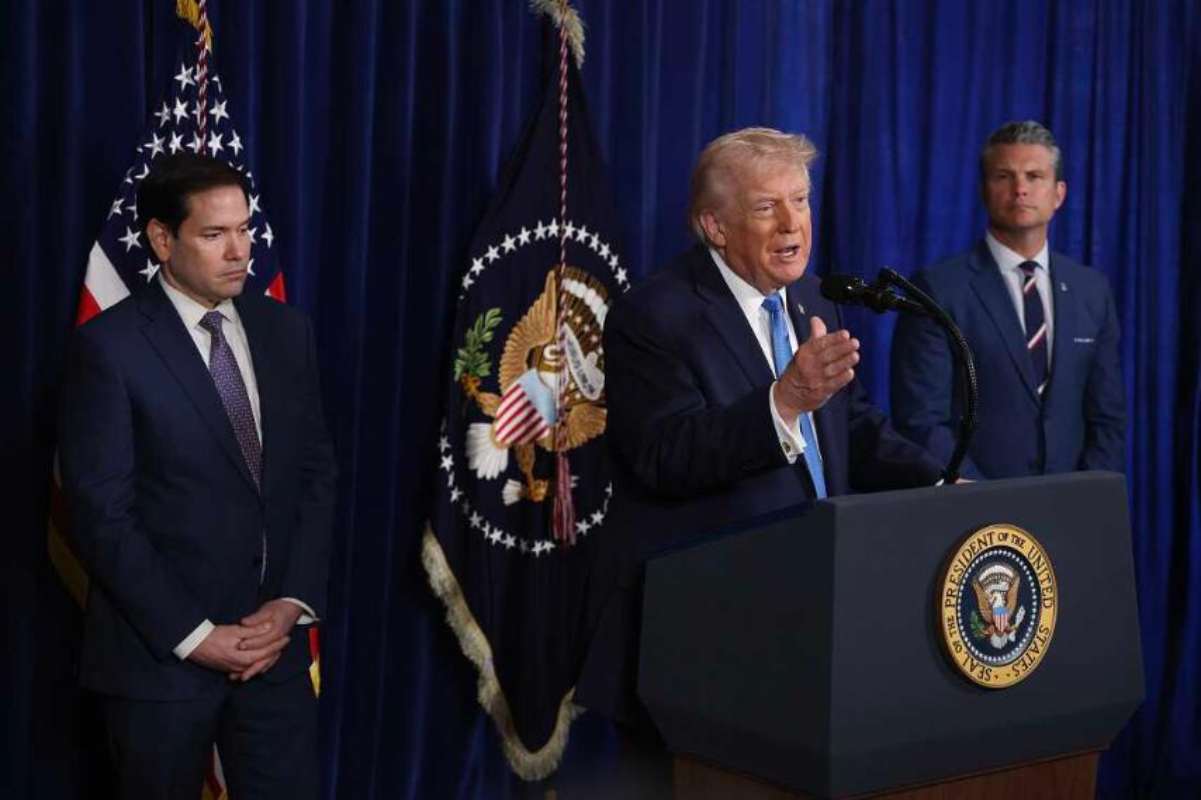
“The United States of America has just entered into an agreement with the country of Venezuela on the biggest oil deal in world history.”
According to Trump, Secretary of State Marco Rubio and Defense Secretary Pete Hegseth, working with Rodríguez and private business, secured “majority U.S. control of more than 65 billion barrels of proven oil reserves in Venezuela.”
There is another critical detail.
The deal is expected to create a new private operating structure involving the United States and private-sector operators, with long-term rights to develop the fields.
If implemented as presented, this is not simply a deal to purchase Venezuelan crude.
It is a long-term U.S. footprint inside the productive core of one of the world’s most important oil states.


17 fields, $100 billion in investment, $209 billion for Caracas
The Venezuelan government is presenting the agreement as an instrument of national economic revival.
Rodríguez said the plan covers 17 strategic oil fields with potential reserves of up to 65 billion barrels and more than $100 billion in investment.
Caracas also projects more than $209 billion in tax revenues for the Venezuelan state over the life of the projects.
“These investments will contribute not only to the recovery and modernization of our industry, but also to the economic growth of our country, the energy security of our hemisphere and greater balance in international markets,” Rodríguez said.
The phrase “energy security of our hemisphere” may ultimately be more important than the headline investment figures.
Venezuela’s great comeback — if the oil can actually be produced
Venezuela holds around 303 billion barrels of proven crude reserves, the largest in the world.
Its problem was never a lack of oil.
Its problem was getting that oil out of the ground.
Years of underinvestment, sanctions, political instability, nationalizations and infrastructure decay severely reduced the production capacity of a country that theoretically controls one of the greatest energy endowments on the planet.
That is why 65 billion barrels do not mean tens of millions of new barrels suddenly arriving on the market.
Restoring infrastructure and developing the fields will require enormous capital spending and years of work.
Trump is effectively betting that American energy companies can revive a deeply damaged oil industry.
The first bet: Cheaper gasoline for Americans
For Trump, there is also a direct domestic political objective.
Energy prices.
The president argues that the deal will significantly increase oil supply and eventually lower gasoline prices for U.S. consumers.
The timing matters.
The war with Iran and disruptions to Middle Eastern energy flows have increased pressure on global markets, while Washington has relied heavily on the Strategic Petroleum Reserve to cushion domestic price shocks.
Large-scale access to Venezuelan heavy crude could eventually be particularly valuable for U.S. Gulf Coast refineries, many of which are technically suited to processing heavier grades.
But there is an important distinction:
reserves are not the same as production.
The effect on fuel prices will therefore depend not on the 65 billion barrels underground, but on how quickly actual output and exports can rise.
The second bet: Bringing U.S. oil majors back
This is where the corporate story begins.
Chevron and other U.S. companies are already positioned to expand their role in Venezuela, while oilfield-service groups could play a major part in restoring production infrastructure.
But not every American company is equally enthusiastic.
The legacy of Venezuela’s past nationalizations still weighs heavily on investment decisions, particularly for groups that suffered asset seizures in earlier decades.
For an oil major, a project may last 20, 30 or 40 years.
So the key question is not only who governs Caracas today.
It is who will govern it in a decade — and whether that government will respect the current deal.
The third and biggest bet: Pushing China and Russia out of America’s backyard
This is where the agreement becomes truly geopolitical.
For two decades, Venezuela was one of Russia and China’s most important political and economic partners in Latin America.
Caracas used Moscow and Beijing for financing, oil deals and diplomatic backing against Washington.
The new U.S. strategy moves in exactly the opposite direction.
Washington is not merely seeking access to oil.
It is trying to pull one of Latin America’s biggest strategic energy assets back into the American economic and security sphere.
And at the same time, it is trying to reduce the room available to China and Russia.
That makes Venezuela part of a much larger struggle over strategic influence in the Western Hemisphere.
A new Monroe Doctrine — powered by oil?
There is a broader pattern here.
Trump’s policy toward Latin America increasingly treats the Western Hemisphere as a strategic space in which U.S. primacy should be actively restored.
Energy, critical minerals, ports, shipping routes, trade and security are all being brought into the same framework.
Venezuela may be the most dramatic example.
A country that spent years as one of Washington’s fiercest adversaries in Latin America could now become a major pillar of U.S. energy security.
That is a geopolitical reversal of extraordinary scale.
But the deal still has major blind spots
Despite the triumphant announcements, key details remain unclear.
The precise legal structure has not been fully disclosed.
It is still not entirely clear which private operators will participate, how majority U.S. control will function in practice, how revenue will be distributed or how quickly investment will be deployed.
There is also the issue of legal and political stability.
Energy investments of more than $100 billion require confidence over decades.
Companies will need guarantees that a future Venezuelan government will not once again rewrite the rules, impose new restrictions or reverse ownership arrangements.
That may prove to be the single biggest commercial risk.
And 65 billion barrels do not hit the market tomorrow
The numbers are spectacular.
The energy reality is harder.
The deal covers huge reserves, not ready-made production.
Turning those reserves into barrels delivered to U.S. refineries will require drilling rigs, pipelines, electricity, processing facilities, export terminals, engineers and billions of dollars.
That means the agreement can have enormous long-term geopolitical importance without causing an equally enormous immediate drop in global oil prices.
Trump is not just buying oil — he is buying geopolitical time
That is the real story.
Trump is trying to solve three problems with one agreement.
Strengthen U.S. energy security.
Create a huge new field of opportunity for American oil and services companies.
And limit Chinese and Russian influence in one of the most strategically important energy states in the Western Hemisphere.
For Venezuela, the potential upside is also enormous: capital, technology, production, jobs and a possible return to the front rank of the global oil market.
But the price is deeper American influence over the country’s most important natural resource.
And that is the central geopolitical paradox: seven months after U.S. military intervention, Washington’s biggest victory in Venezuela may not ultimately be military at all. It may be the 65 billion barrels that are moving into a new strategic orbit.
If the agreement is implemented as announced, Venezuela is not simply returning to the oil market.
It is returning inside a new U.S.-centered energy order in the Western Hemisphere — and that is much bigger than a deal for cheaper gasoline.
Source: pagenews.gr