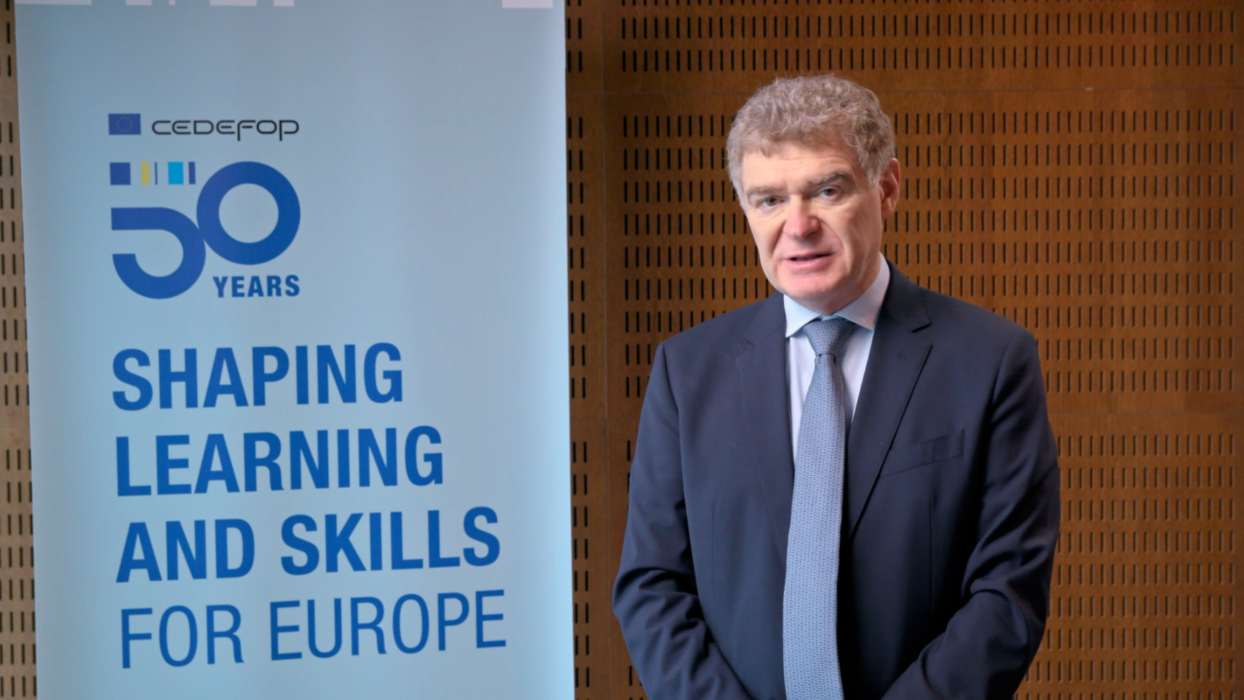
Alexandroupolis has emerged in recent years as one of Greece’s most strategically important geopolitical and energy hubs. Today, Thursday, September 3, however, the European Commission is looking at Eastern Macedonia and Thrace from a different perspective: human capital, employment and social cohesion.
Mario Nava, Director-General of the European Commission’s Directorate-General for Employment, Social Affairs and Inclusion, is visiting Alexandroupolis and Kavala today, with the implementation of European Social Fund Plus (ESF+) programmes in the region at the centre of his agenda.
This is more than a routine visit by a senior Brussels official.
The ESF+ is the European Union’s principal instrument for investing in people, supporting employment, skills, social inclusion and the implementation of the European Pillar of Social Rights.
That places Nava’s visit at the intersection of social and economic policy and raises a broader question for the region:
Can its strategic and investment transformation ultimately translate into jobs, income and opportunities for the people who live there?
The first key meeting in Alexandroupolis
Nava’s programme begins in Alexandroupolis, where at 09:15 he is scheduled to meet Christodoulos Topsidis, Governor of Eastern Macedonia and Thrace, at the Prefecture building.
Their working meeting will focus on the progress of ESF+ actions across the region.
Later in the day, Nava will travel to Kavala, where at 15:25 he is scheduled to meet regional representatives and organisations implementing social entrepreneurship initiatives at the “Nikolaos Martis” hall in the Kavala Administrative Building.
The meetings form part of the European Commission’s broader dialogue with regional and local authorities on employment, social inclusion, vulnerable groups and the effective deployment of European funding.
But behind the official agenda lies a much bigger economic challenge.


From infrastructure to people
For years, the development narrative surrounding Eastern Macedonia and Thrace has been dominated by infrastructure, investment, energy, connectivity and the increasingly strategic position of Alexandroupolis.
Now comes the second half of the equation:
Who will work in the economy being built around those investments?
The green transition, digitalisation, new energy infrastructure and changes in industrial production are creating demand for new skills.
That means investment in infrastructure alone is not enough.
Regions also need workers with the qualifications required by the industries they are trying to attract.
This is precisely where European employment and skills policy becomes an economic competitiveness issue rather than simply a social policy issue.
Thrace’s real challenge goes beyond absorbing EU funds
For Eastern Macedonia and Thrace, success cannot be measured only by how much European money is allocated or absorbed.
The critical question is what that money produces.
How many unemployed people return sustainably to the labour market? How many young people acquire skills businesses actually need? How many social enterprises become economically viable? And can European programmes help reduce the structural inequalities between Greece’s major urban centres and its peripheral regions?
These questions carry particular weight in a border region.
For Eastern Macedonia and Thrace, employment policy is simultaneously economic policy, demographic policy and regional cohesion policy.
If investment generates economic activity but local workers lack the necessary skills — or younger generations continue to leave the region — the development equation remains incomplete.
Brussels is changing the way it looks at skills
Nava’s visit also reflects a wider shift in European economic policy.
Skills are increasingly being treated in Brussels not simply as an education issue but as a core component of European competitiveness.
Vocational training, lifelong learning, stronger links between businesses and educational institutions and the adaptation of workers to technological change have all moved higher on the EU agenda.
The logic is straightforward.
Europe can mobilise billions for new industrial, energy and digital investments. But those investments cannot reach their full potential without a workforce capable of supporting them.
For a region such as Eastern Macedonia and Thrace, that shift could be particularly important.
The next stage of regional development will not be determined only by whether new investments arrive.
It will also depend on whether the region has the human capital to sustain them.
Alexandroupolis: From geopolitical hub to economic test case
Against this backdrop, Alexandroupolis carries powerful symbolism.
The city has become central to discussions about energy security, transport corridors, military mobility and the strategic role of northern Greece.
But geopolitical importance alone does not guarantee local prosperity.
The next test is whether this strategic upgrade can produce a broader economic dividend for the region:
More jobs.
Better skills.
Stronger local entrepreneurship.
And greater capacity to keep younger workers in Eastern Macedonia and Thrace.
Nava’s presence in Alexandroupolis and Kavala today puts precisely this question on the table.


EU money increasingly has to prove its impact
There is also a wider political dimension.
The European Union is entering a period in which it must simultaneously finance defence, competitiveness, the energy transition and social cohesion.
That makes competition for European resources increasingly intense.
In this environment, the political debate over EU funding is gradually shifting from how much money is absorbed to what measurable economic and social results that money delivers.
For the ESF+, that means employment outcomes, skills, inclusion and sustainable participation in the labour market matter more than headline spending figures alone.
And Eastern Macedonia and Thrace represents a particularly interesting test case.
The region has already increased its weight on Europe’s energy and geopolitical map.
The challenge now is to increase its weight on the employment and investment map as well.
Because the ultimate success of regional development is not measured only by the infrastructure that is built.
It is measured by the jobs and opportunities that remain after the investment arrives.
Source: pagenews.gr