Why Turkey Sent a Drone Toward Alexandroupolis — And the Cost Trap for Greece
 ΧΡΟΝΟΣ ΑΝΑΓΝΩΣΗΣ 12 '
Πηγή Φωτογραφίας: eurokinissi//Why Turkey Sent a Drone Toward Alexandroupolis — And the Cost Trap for Greece



This was not just another routine incident over the Aegean.
A Turkish unmanned aerial vehicle entered the Athens FIR and violated Greek national airspace on Friday, August 28, operating between Samothrace and Lemnos and close to the terminal area of Alexandroupolis airport.
At approximately 08:30, Greece activated its air-defense response.
Two Hellenic Air Force F-16s were scrambled to identify and intercept the UAV, which subsequently left the area toward the Istanbul FIR.
But another aircraft was operating in the area at the same time: a civilian Aegean flight.
Air-traffic authorities precautionarily adjusted the civilian aircraft’s flight profile to maintain safe separation while the military incident was being handled.
Greek authorities stressed that the passenger aircraft was never in danger.
The fact that the presence of a Turkish military UAV required an adjustment to civilian air traffic nevertheless makes the incident considerably more sensitive than a standard airspace violation.
And it raises an obvious question:
Why Alexandroupolis?
Alexandroupolis Is Not Just Another Point on the Map
The location matters.
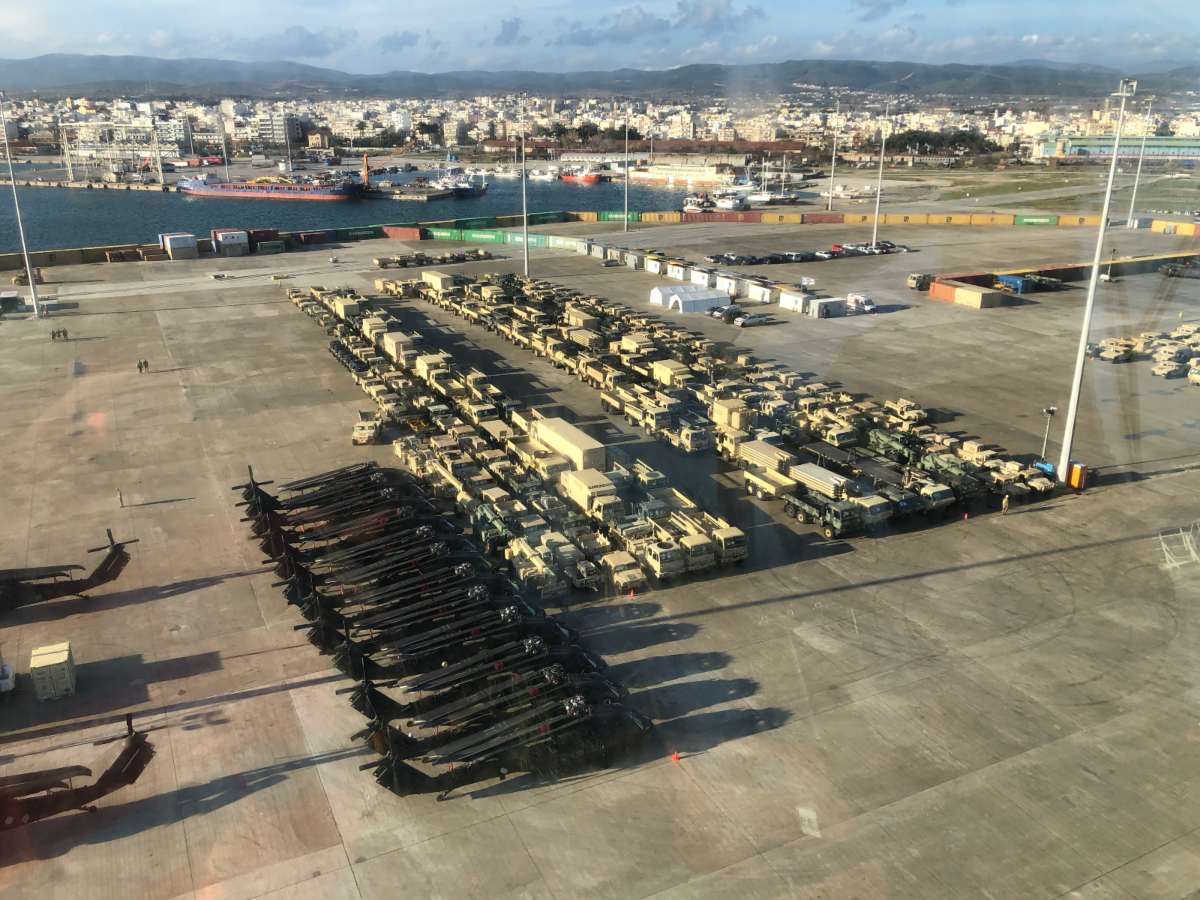
Over the past several years, Alexandroupolis has evolved into a strategically important logistics and energy hub for Greece, the United States and NATO’s southeastern flank.
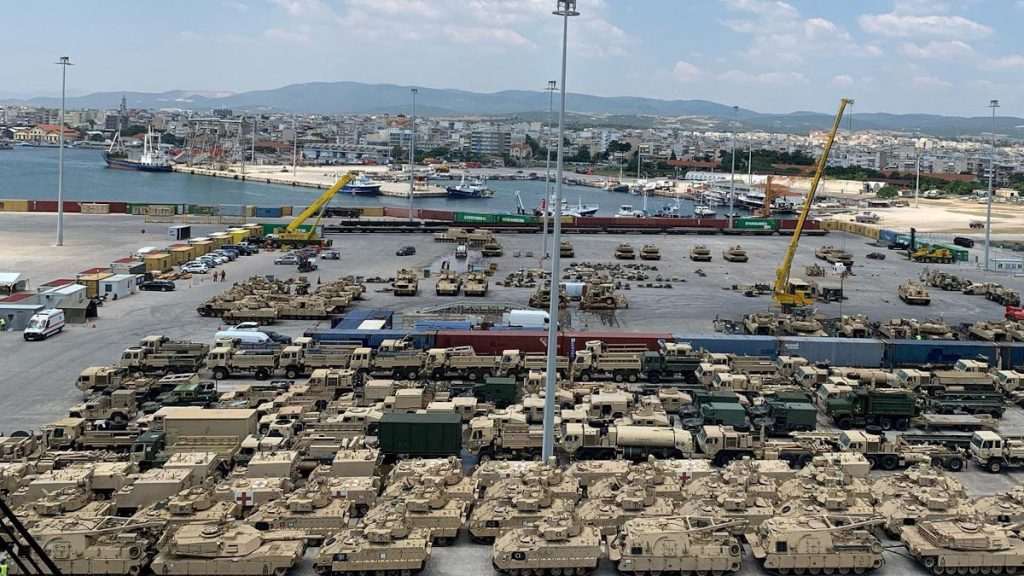
Its port provides an alternative route for moving military equipment toward Bulgaria and Romania without relying on passage through the Turkish Straits.
It has been used extensively for the movement of U.S. and allied military equipment toward Eastern Europe.
Its strategic value increased further after Russia’s invasion of Ukraine.
Alexandroupolis has also become an energy gateway through its LNG infrastructure and connections to southeastern European gas networks.
A Turkish UAV approaching this area is therefore not merely flying close to a regional Greek airport.
It is operating close to infrastructure that has acquired significance for NATO’s wider posture in southeastern Europe.
There is no public evidence that the specific Turkish UAV was conducting intelligence collection against U.S., Greek or NATO facilities.
But the location inevitably makes the incident far more sensitive from both a military and geopolitical perspective.
Twenty-Four Hours Earlier, Ankara Had Warned Greece Over Rhodes
The timing is equally striking.
Just one day before the Alexandroupolis incident, Turkey’s Defense Ministry reacted strongly to reports concerning Greek UAV capabilities on Rhodes.
Ankara revived its longstanding argument concerning the military status of the Dodecanese and warned that establishing a drone base on Rhodes would violate what Turkey describes as the island’s demilitarized status.
The Turkish Defense Ministry warned that such a move:
“would constitute a violation of the demilitarized status of Rhodes and would harm peace and stability in the Aegean, as well as good-neighborly relations.”
Ankara went further:
“Turkey will continue resolutely to protect its rights and interests stemming from international treaties.”
Roughly a day later, a Turkish military UAV entered the Athens FIR, violated Greek national airspace and approached the Alexandroupolis terminal area.
There is currently no public evidence proving that Ankara ordered the flight as direct retaliation for the Rhodes issue.
But the sequence is difficult to ignore.
Athens Says There Is No Permanent “Drone Base” on Rhodes
There is another important element.
Greek defense sources have disputed the Turkish characterization of what is happening on Rhodes.
According to the Greek side, there is no plan to establish a permanent “drone base” on the island in the manner suggested by Ankara.
UAVs can instead be temporarily deployed to existing military facilities according to operational requirements.
This distinction matters.
Turkey has effectively transformed even the possibility of strengthening Greek unmanned capabilities in the Dodecanese into another dispute over the interpretation of international treaties.
That fits a broader Turkish strategy.
Ankara wants to retain political and diplomatic leverage over the type and scale of military capabilities Greece deploys on its eastern Aegean and Dodecanese islands.
The Other Message: “I Can Make You Scramble F-16s”
There is another dimension to the Alexandroupolis incident that may ultimately prove even more important.
Cost.
Turkey can operate a UAV for extended periods without risking a pilot and at substantially lower operating costs than those associated with a modern fighter aircraft.
Greece, however, cannot simply ignore a military UAV violating its national airspace.
It has to detect it, identify it and, when necessary, intercept it.
In the Alexandroupolis incident, two F-16s were scrambled.
Greek defense estimates have placed the operating cost of an F-16 during an interception-type mission at roughly €20,000 per flight hour, depending on aircraft configuration, mission profile and how costs are calculated.
A pair of fighters could therefore represent an operating burden in the region of €40,000 for one hour of activity.
The exact cost of the specific Alexandroupolis sortie has not been publicly disclosed.
But the strategic imbalance is obvious.
Turkey does not have to defeat a Greek fighter in aerial combat to impose costs.
Repeated UAV incursions can force Greece to activate considerably more expensive manned platforms, consume flight hours and increase demands on personnel and aircraft maintenance.
0 – 225 – 433: The Numbers Showing Something Is Changing
The Alexandroupolis incident becomes more significant when viewed against the broader trend.
Greek defense reporting indicates that there were no Turkish airspace violations recorded in 2024.
The figure rose to 225 in 2025.
By late August 2026, 433 violations had already been recorded.
That is almost twice the total for the entire previous year.
And the pattern is no longer limited exclusively to unmanned aircraft.
Turkish fighter activity has also reappeared in incidents requiring Greek interception.
The era of completely “calm waters” in the air therefore appears to be fading.
What may be emerging instead is a return to controlled military pressure — but with UAVs playing a much larger role than in previous Greek-Turkish crises.
The Cheap-Drone, Expensive-Fighter Trap
This is not a uniquely Greek problem.
It is one of the central military lessons emerging from Ukraine, the Red Sea and the wider Middle East.
Using an expensive fighter aircraft or interceptor missile against a comparatively cheap drone can produce an unfavorable cost-exchange ratio.
And cost-exchange ratios are increasingly becoming part of military strategy itself.
An adversary does not necessarily need to destroy your platform.
If it can repeatedly force you to spend far more defending against an attack than it spends conducting it, it can impose cumulative economic and operational attrition.
That is precisely why Greece needs more layers between radar detection and an F-16 scramble.
Greece Already Has an Answer: Centauros
One important part of that answer is Centauros, the Greek-developed electronic warfare and counter-drone system produced by Hellenic Aerospace Industry.
Centauros does not necessarily need to fire a missile to neutralize an unmanned aircraft.
It detects electromagnetic emissions associated with UAV activity and can interfere with communications and navigation links.
Kyriakos Enotiadis, head of HAI’s Electronics Division, has described its economic advantage clearly:
“We are talking about an electronic warfare system capable of detecting the radio waves of a UAV from a very long distance, providing reaction time without consuming ammunition.”
And the most important part:
“It consumes only electrical energy.”
That sentence encapsulates the economics of modern counter-drone warfare.
Instead of spending tens or hundreds of thousands of euros on every interception, electronic warfare can in certain scenarios disrupt a drone at a fraction of the cost.
Centauros is also not simply a laboratory project.
Greek systems have already gained operational experience in the Red Sea environment against Houthi drone threats.
Hyperion Is Designed for the Next Problem: Drone Swarms
Greece is also developing the next layer.
Hyperion is a Counter-UAS system designed to detect and counter individual drones as well as more complex swarm attacks.
It incorporates passive detection, 360-degree coverage and electronic countermeasure capabilities against multiple targets.
One of its explicitly envisaged applications is particularly relevant after the Alexandroupolis incident:
airport and critical-infrastructure protection.
That is precisely the environment in which relying solely on fighter aircraft becomes inefficient.
The objective is to build a layered response.
Detect the drone.
Classify it.
Determine whether it poses a threat.
Jam or disrupt it when possible.
And deploy a fighter or kinetic interceptor only when the threat actually requires one.
The Achilles Shield Could Change the Equation
The broader Greek response is being built around the planned multi-layered Achilles Shield.
Athens is moving toward an integrated air- and missile-defense architecture combining conventional air defense, ballistic-missile defense and counter-UAS capabilities through a common command-and-control structure.
Systems including Barak MX, Spyder and David’s Sling are part of the wider discussion and procurement architecture, alongside non-kinetic counter-drone technologies.
Centauros has already demonstrated integration with Israel Aerospace Industries’ Barak MX at the command-and-control level.
That integration matters.
It gives commanders the possibility of matching the weapon to the threat.
Against a sophisticated missile, use the appropriate interceptor.
Against a relatively cheap UAV, attempt electronic defeat first.
Israel Aerospace Industries President and CEO Boaz Levy has described the strategic logic of cooperation with Athens:
“Together with our close allies and partners in Greece, we are strengthening operational resilience and helping address growing defense needs at the European level.”
The end goal is straightforward.
Greece should not have to answer every Turkish drone with two F-16s.
Turkey Is Watching Greece’s Transformation
This brings the story back to Ankara.
Turkey is not simply watching whether Greece deploys a few drones on Rhodes.
It is watching a much broader transformation of Greek military capabilities.
Athens is building a network combining UAVs, counter-UAS systems, Israeli air-defense technologies, satellite surveillance and increasingly integrated command-and-control capabilities.
Additional V-BAT UAVs and SAR microsatellites are part of that wider effort.
For Greece, this represents a transition away from the traditional model:
“Detect violation — scramble fighter.”
The emerging model is considerably more sophisticated:
“Detect — identify — classify — disrupt — and deploy the cheapest effective response.”
That is precisely what could neutralize the cost asymmetry created by Turkish drones.
Alexandroupolis Was a Message — And Possibly a Test
Without access to Turkey’s operational orders, nobody outside Ankara can state with certainty why this particular UAV was sent on this particular flight path.
But three possible functions deserve attention, and they are not mutually exclusive.
The first is political signaling.
The incident occurred immediately after Turkey’s warning over Greek drone capabilities on Rhodes and at a time when Ankara is again raising the issue of the islands’ military status.
The second is operational probing.
Flights of this type can potentially reveal how quickly an adversary reacts, which assets respond, how air-defense surveillance behaves and how military authorities coordinate when civilian traffic is operating nearby.
That is a general intelligence benefit of probing operations — not proof that intelligence collection was the specific mission of this particular Turkish UAV.
The third is economic attrition.
A comparatively cheap unmanned aircraft can force the other side to activate much more expensive manned platforms.
Repeated dozens or hundreds of times, the burden extends far beyond fuel.
It means engine hours, maintenance cycles, spare parts, personnel requirements and the consumption of finite aircraft life.
That may ultimately be the most important lesson from Alexandroupolis.
Greece handled this particular incident successfully.
The UAV was detected, intercepted and driven away, while civilian aviation remained safe.
But the next Turkish drone should not automatically require two F-16s.
Because in the emerging drone contest over the Aegean, successful interception is only half the equation.
The real victory is stopping the intruder for less than it cost your adversary to send it.
Source: pagenews.gr
Διαβάστε όλες τις τελευταίες Ειδήσεις από την Ελλάδα και τον Κόσμο