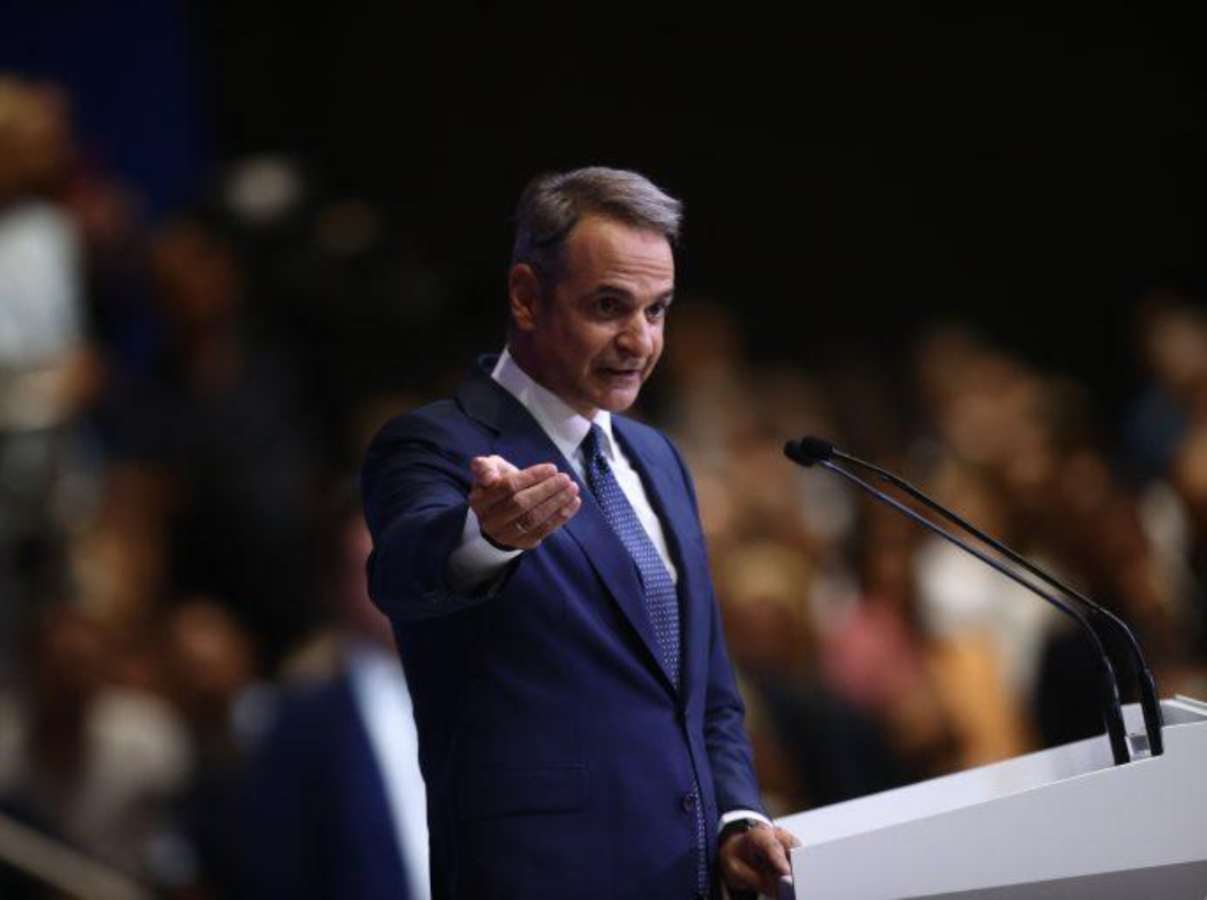
Kyriakos Mitsotakis is expected to use tonight’s address at the 90th Thessaloniki International Fair not simply to announce another annual package of measures, but to lay out a broader political and economic roadmap stretching toward 2030-2031.
The prime minister is scheduled to speak at 8:00 p.m. at the “Ioannis Vellidis” Conference Center, with the speech carrying unusually strong political weight because it is the final Thessaloniki Fair before the next national election cycle.
The central message is expected to be one of continuity, sequencing and delivery.
Instead of presenting isolated measures for 2027, Mitsotakis is preparing to frame the package as the opening chapter of a new four-year governing cycle.
The key word is “horizon”
Government sources say one word will appear repeatedly in the speech:
“horizon.”
The choice is deliberate.
The government wants to move the debate away from the traditional question of “what is being handed out this year?” and toward a longer-term question:
where should Greece be by the end of the decade?
That turns tonight’s address into something closer to a political roadmap than a conventional Fair speech.
From 2019 to 2030: a continuity narrative
The political logic is clear.
Mitsotakis wants to link the government’s first term, 2019-2023, with the current 2023-2027 period and then project a third phase extending toward 2030.
In that sense, the speech is expected to perform two roles at once:
- explain the next round of economic support,
- and begin defining the political proposition for the years after 2027.
That makes this Thessaloniki Fair significantly more electoral in character than previous editions.


The government wants dates attached to promises
A second major feature is expected to be the emphasis on implementation.
Rather than simply announcing measures, Mitsotakis is expected to specify when each intervention will take effect, with the rollout beginning as early as November 2026 and continuing month by month.
This is politically important.
After days of fierce confrontation with the opposition over costing, fiscal credibility and the difference between political promises and written programmes, the government wants to present its own package as:
- costed,
- sequenced,
- time-specific,
- and measurable.
The message is essentially:
not only what — but when.
Why November matters
Starting implementation before the end of 2026 would help the government avoid the impression that tonight’s package is simply a collection of promises for after the election.
The objective is to create visible changes before the new year and connect the Thessaloniki speech directly with household finances.
That means some of the government’s political credibility will depend not merely on the size of the package, but on whether citizens can actually see measures beginning to take effect according to the timetable announced tonight.
A package designed to reach almost every major social group
The third distinctive feature is breadth.
The measures are expected to target:
- employees,
- pensioners,
- self-employed professionals,
- farmers,
- and, with particular emphasis, families.
The government also wants the new interventions to combine with the tax reforms already under way so that the total benefit is larger than the impact of any single measure.
Politically, this is an attempt to avoid the appearance of a narrowly targeted package.
The goal is to create a sense that a broad part of society will see some form of direct benefit.
The real battlefield is the household wallet
The government’s core narrative is that improved public finances should now become more visible in everyday life.
Government sources describe this year’s Fair as one that puts “society at the center,” arguing that stronger fiscal performance should increasingly translate into tangible support against the cost-of-living squeeze.
This is the critical test.
Voters do not experience growth through headline GDP figures.
They experience it through:
rent,
food prices,
electricity bills,
taxes,
mortgage costs,
and the amount of disposable income left at the end of the month.
That is why tonight’s speech will ultimately be judged less by the aggregate value of the package and more by whether households believe their purchasing power is finally improving.
A battle over credibility, not just generosity
The Fair is also becoming the stage for a broader political argument over credibility.
The government wants to contrast its own approach — measures with costings and implementation dates — with opposition proposals that it portrays as either underfunded or insufficiently specified.
This gives the speech a sharper political edge.
The question is no longer simply:
who promises more?
It is:
who can promise something and still explain exactly how and when it will be delivered?
The 2030 narrative enters the election debate early
Perhaps the most important political shift is that Mitsotakis is trying to move the conversation beyond 2027.
By repeatedly pointing toward 2030-2031, the government is effectively asking voters to think in terms of a longer governing horizon.
That means the next election is being framed not only as a judgment on the current term, but as a choice about who can guarantee:
- stability,
- growth,
- fiscal credibility,
- and convergence with the rest of Europe through the end of the decade.
This is, in effect, the first outline of a four-year political contract.
The bigger picture: tonight is meant to be a starting point
The importance of tonight’s address therefore goes beyond the amount of money announced.
It will be judged on whether the government can credibly present:
- a roadmap to 2030,
- a clear implementation calendar,
- fiscal discipline,
- and a measurable improvement in household income.
If it succeeds, Mitsotakis will have transformed the Thessaloniki Fair from a traditional annual package into the opening act of the next electoral cycle.
If it fails, the opposition will argue that the “horizon” is simply a distant political narrative used to postpone delivery.
That is why tonight’s speech matters more than a conventional Fair address.
Mitsotakis is attempting to place the Greece of 2030 on the political table now — and ask voters to judge not only what they receive this year, but who they trust to take them there.
Source: pagenews.gr