Venizelos: Allies Cannot Resolve Greece–Turkey Disputes — A Warning Ahead of Elections
 ΧΡΟΝΟΣ ΑΝΑΓΝΩΣΗΣ 6 '
Πηγή Φωτογραφίας: eurokinissi//Venizelos: Allies Cannot Resolve Greece–Turkey Disputes — A Warning Ahead of Elections



“The pace of international developments does not yield to the domestic political timetable.”
With this warning, Evangelos Venizelos places the pressures of an extended election campaign at the heart of Greece’s foreign policy debate.
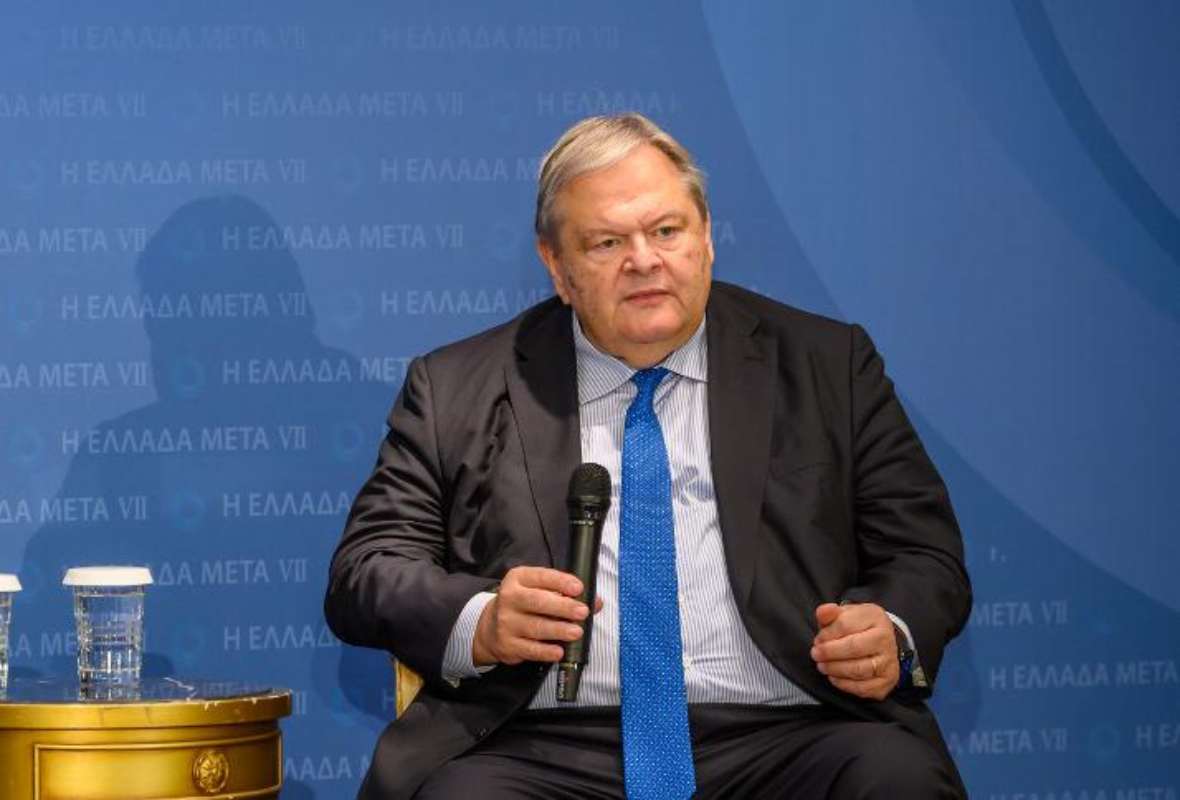
Writing in To Vima’s Sunday edition, the former deputy prime minister and foreign minister argues that Greece must make full use of its alliances while retaining responsibility for the decisions needed to address its disputes with Turkey.
His intervention raises a politically uncomfortable question: can Greece’s political leadership prepare for consequential diplomatic choices when electoral competition makes their potential cost increasingly difficult to discuss?
Israel’s partnership has limits
Venizelos challenges the expectation that bilateral and trilateral partnerships can automatically deliver what decades of NATO membership, EU integration and strategic cooperation with Washington have not secured.
He acknowledges the importance of defence cooperation with Israel, including the planned “Achilles Shield” air defence system, which he describes as a national security choice compatible with NATO planning.
But he draws a clear distinction between strengthening Greece’s defences and transferring responsibility for its relations with Ankara.
Such cooperation, he writes, “obviously does not mean entrusting Israel with the management of Greek–Turkish relations.”
Israel has its own vital security priorities. Its relationship with Turkey is shaped by those interests and tested across multiple theatres, from Syria to Somalia.
The implication is that a valuable defence partnership cannot remove the need for an independent Greek diplomatic strategy.
France and the electricity cable
Venizelos applies the same reasoning to France’s involvement in the Great Sea Interconnector, the proposed electricity connection linking Greece, Cyprus and Israel.
The participation of French companies gives the project considerable weight. Yet it does not transfer responsibility for Greece’s maritime disputes to Paris.
French commercial involvement, he argues, “obviously does not mean that Greece has entrusted France […] with handling Greek issues concerning maritime zones in the Aegean and the Eastern Mediterranean.”
He stresses the importance of cooperation with France as an EU partner, a Mediterranean country, a nuclear power and a permanent member of the UN Security Council.
But France’s relationship with Turkey also reflects multiple interests. Athens must account for that complexity when assessing what its partnerships can deliver.
Egypt: Support for extending the maritime agreement
Turning to the Turkey–Libya maritime memorandum, which he describes as manifestly unlawful under international law, Venizelos examines proposals to expand the 2020 partial exclusive economic zone agreement between Greece and Egypt.
He supports pursuing the option provided by that agreement:
“It would be good for this to be achieved, obviously within the framework of the United Nations Convention on the Law of the Sea.”
For Venizelos, respect for the law of the sea is the central advantage of the Greek–Egyptian agreement over the Turkey–Libya memorandum.
His analysis nevertheless treats the unresolved delimitations with Turkey and Libya as questions that still require their own diplomatic and legal handling. Expanding cooperation with Cairo cannot, by itself, settle those outstanding issues.
Mitsotakis at the UN: An important intervention
Venizelos also offers a carefully qualified assessment of Prime Minister Kyriakos Mitsotakis’s intervention at the UN Security Council.
He credits the prime minister with presenting Greece’s positions on the Turkey–Libya memorandum comprehensively and describes the intervention as “undoubtedly important.”
At the same time, he distinguishes a national statement during a high-level debate from a formal Greek referral seeking Security Council action.
It “does not constitute a Greek referral to the Security Council equivalent to the one Greece made in 1976,” he writes.
The distinction concerns the institutional character and outcome of the proceedings. Recalling the earlier episode, Venizelos points to Security Council Resolution 395 and Greece’s parallel recourse to the International Court of Justice.
His argument calls for precision in assessing diplomatic moves: the significance of presenting national positions must be evaluated alongside the procedure used and the result sought.
The fear of how history will judge
Venizelos places these questions within a broader account of political hesitation over national issues.
He returns to what he has called the “Zurich–London syndrome”: a deep reluctance to undertake major initiatives, linked to the way the establishment of the Republic of Cyprus in 1960 was received in Greek national consciousness.
In his assessment, the constraint extends beyond immediate electoral calculations.
“It constitutes the subordination of foreign policy to fear about how history is written.”
That hesitation now operates within an increasingly unsettled international environment. Venizelos highlights strains within the West and the continuing search for balance between European states and the United States.
He also underlines Greece’s particular strategic predicament: the principal threat shaping its defence planning comes from Turkey, a fellow NATO member.
Athens must prepare to take decisions
Venizelos argues that Greece needs political and diplomatic readiness alongside military preparedness.
Alliances strengthen the country’s position, but decisions on maritime delimitation, negotiations and international adjudication require Greek initiative.
“No other country can take on its behalf the political initiatives required, for example, to delimit the continental shelf and the EEZ between Greece and Turkey, either through an agreement or through a decision by international justice.”
His warning addresses the political leadership as a whole. A prolonged election campaign, he argues, leaves little room for strategic reflection or confidence in a broader national consensus.
Yet international developments will continue to demand responses:
“Greece must therefore be prepared not only in defence terms but also politically and diplomatically, and its political leadership must be ready to assume the cost that falls to it or comes its way. The economic crisis should serve as a lesson.”
Source: pagenews.gr
Διαβάστε όλες τις τελευταίες Ειδήσεις από την Ελλάδα και τον Κόσμο