Tsipras vs Mitsotakis:The Top 1% at the Checkout,€40 Billion on the Table—and a Greece Stuck at 68% of Europe
 ΧΡΟΝΟΣ ΑΝΑΓΝΩΣΗΣ 20 '
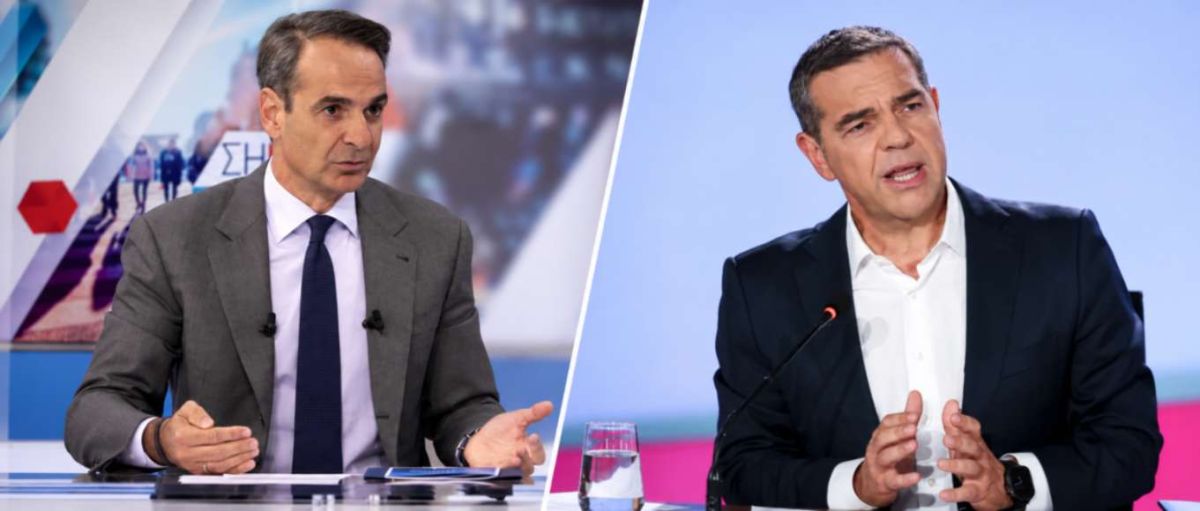
Πηγή Φωτογραφίας: eurokinissi//Tsipras vs Mitsotakis: The Top 1% at the Checkout, €40 Billion on the Table — and a Greece Stuck at 68% of Europe



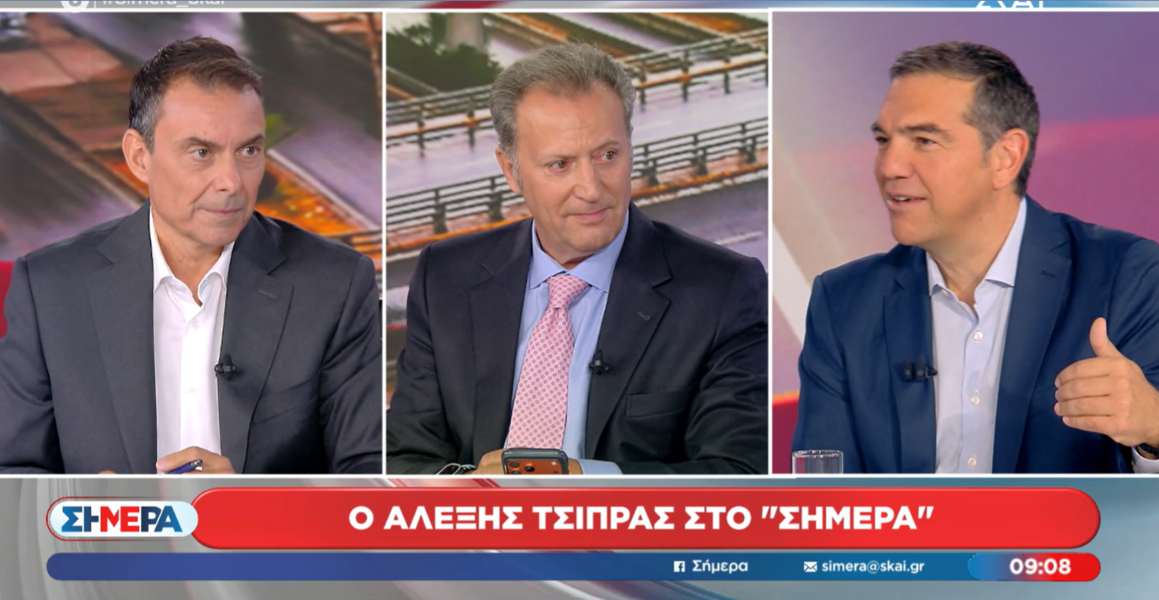
Alexis Tsipras’ Wednesday morning interview with SKAI may prove politically more important than the first headlines suggest.
Not because he unveiled an entirely new economic programme. That has already been presented.
What he did instead was clarify, to a significant extent, the philosophy with which EL.A.S. intends to confront Prime Minister Kyriakos Mitsotakis: the cost-of-living crisis, according to Tsipras, cannot be addressed solely through subsidies and broad-based tax relief. It also requires stronger redistribution, tougher intervention in concentrated markets and a greater contribution from those at the very top of the wealth pyramid.
The Mitsotakis government starts from a different premise: more jobs, higher incomes, lower taxes and temporary — rather than permanent — state intervention when an extraordinary crisis demands it.
For the first time since the Thessaloniki International Fair, those two approaches can now be compared not just politically, but against a series of concrete economic indicators.
The Phrase That Defines Tsipras’ Strategy: “People Cannot Make Ends Meet”
The EL.A.S. leader sought to shift the entire debate away from headline macroeconomic indicators and towards the household economy.
“What I am saying is that people cannot make ends meet. And when people cannot make ends meet, our priority must be to deal with the crisis with concern for the person who gets up every morning to go to work,” Tsipras said.
That is effectively the political arena into which he wants to draw Mitsotakis.
The government can point to growth, falling unemployment and rising nominal wages. Tsipras’ response is that the relevant political test is how much income remains after households pay for housing, food, electricity, heating and transport.
And on that front, several European indicators remain difficult for Greece.
The “68%” Figure Greece May Hear Repeatedly
Greece and Bulgaria stood at the bottom end of the EU rankings in 2025 in terms of GDP per capita expressed in purchasing power standards, at around 68% of the EU average.
The indicator adjusts for price-level differences between countries and should not be confused with the average wage or the disposable income of an individual household.
For Tsipras, however, it offers a powerful political argument: after years outside the bailout era, Greece still remains far below the European average in relative economic prosperity.
The government has a different set of numbers.
Real GDP increased by around 1.9% year-on-year in the second quarter of 2026, while unemployment fell to approximately 7.9% in July, from 8.9% a year earlier. Employment exceeded 4.37 million people.
Both realities can therefore coexist: the Greek economy can continue growing and creating jobs while convergence with the European average remains incomplete.
That contradiction is likely to become one of the central battlegrounds of the coming political period.
Housing: The Numbers Are Particularly Harsh
Tsipras devoted considerable attention to housing costs.
Here, Greece’s comparison with Europe is particularly challenging.
Greek households have been spending roughly 36% of their disposable income on housing, compared with about 19% across the EU — among the highest burdens in the bloc.
A substantial share of the population also lives in households where housing costs exceed 40% of disposable income, far above the European average.
This matters politically because it helps explain why higher nominal wages do not automatically translate into a greater sense of financial security.
If rent, mortgage payments, utilities and other essential costs absorb most of the increase, the voter may hear that incomes are rising without experiencing a corresponding improvement in living standards.
Inflation Is Back in the Political Conversation
The latest inflation picture adds another layer of pressure.
Greece’s harmonised annual inflation rate rose to around 3.7% in August 2026, while the national consumer price index was close to 3.8%.
That helps explain why the opposition has returned so aggressively to the cost-of-living issue despite improvements in other macroeconomic indicators.
Inflation is cumulative.
A 3% or 4% rate today does not reverse the price increases of previous years. It means prices are rising further from an already elevated base.
That creates one of the hardest political challenges for any government: households compare what their salary can buy today not only with last year, but with what the same basket of goods cost several years ago.
Mitsotakis: “I Wish We Could Do Everything”
Kyriakos Mitsotakis has outlined a very different approach to the energy and fuel crisis.
The government is prioritising heating oil and diesel support and has left the door open to temporary tax measures if European fiscal rules provide enough room.
The prime minister has been explicit about the constraint.
“I wish we could do everything,” Mitsotakis has said.
And, in discussing broader tax intervention:
“The reason I am not doing it is because I do not have the fiscal capacity to do it.”
That sentence encapsulates the government’s argument.
The state can absorb part of an external shock, but it cannot permanently substitute itself for the market without creating lasting costs for public finances.
Mitsotakis has also suggested that a temporary reduction in excise duties could be considered under exceptional conditions.
“I would do it temporarily, for a specific period of time, for as long as the crisis lasts. It cannot become a permanent measure because it creates a large hole in public finances.”
Refineries Enter the Debate
There is, however, one interesting area where the two sides are closer than their rhetoric sometimes suggests.
Tsipras is demanding stronger intervention in what he describes as excess profits and concentrated markets.
Mitsotakis, meanwhile, has also argued that refineries should contribute to efforts to contain heating costs.
“The refineries will also have to do their part. They are profitable too, but they have to participate,” the prime minister has said.
When asked whether taxation could be an alternative, Mitsotakis’ preference was for an intervention that would directly lower the final price paid by consumers.
The disagreement, therefore, is not simply over whether the state should intervene.
It is over how far, for how long, and through which mechanism.
Tsipras Reopens the “Cartels” Front
Tsipras raised the temperature further when discussing market structures.
“It exists in supermarkets. It exists in the banks,” he said while discussing concentrated market practices, also drawing attention to the refining sector.
Such statements are political allegations and should not be treated as equivalent to a final finding of illegal collusion by a competition authority.
But they reveal an important element of EL.A.S.’ economic narrative: that part of the price problem should not be attributed exclusively to wars, imported energy costs or external shocks, but also to the degree of competition within the Greek economy.
The government’s counterargument is that much of the pressure in energy markets is external, particularly during a period shaped by wars, disrupted supply chains and higher global fuel prices.
“Seven Years in Government”: Tsipras Tries to Reverse the Comparison
There is also a significant change in the political framing.
In 2019 and 2023, New Democracy could build much of its economic case around comparison with the 2015–2019 Tsipras period.
Tsipras is now attempting to reverse that frame.
“The government has been governing for seven years. It had the tools. It had fiscal capacity. It had the Recovery Fund,” he said on SKAI.
The question he now wants voters to ask is not what Mitsotakis inherited in 2019, but what has changed after seven years in office and tens of billions of euros in European resources.
The government’s answer is equally clear: lower unemployment, stronger investment, improved fiscal credibility and successive tax reductions.
Government spokesman Pavlos Marinakis has framed the ideological divide sharply:
“Our government believes that what is patriotic are tax reductions and the abolition of taxes.”
That message is designed as a direct counterpoint to Tsipras’ proposed “patriotic contribution”.
Tsipras’ Biggest Gamble: The “Patriotic Contribution”
In his SKAI interview, Tsipras tried to close one of the major political vulnerabilities surrounding his economic programme.
Who exactly would pay?
His answer was direct.
“We spoke about the 1% — the strongest and wealthiest segment of our fellow citizens.”
He then elaborated on why his proposal goes beyond declared annual income.
“Today wealth is not visible only in income. It has found a thousand ways not to appear in income. But it appears in real estate, it appears in deposits, it appears in shareholdings.”
EL.A.S. presents the proposal as a levy on substantial wealth rather than a broader burden on the middle class.
Tsipras also offered the political justification for the idea:
“One percent so that we can build schools, build hospitals, give people prospects and bring our children back.”
The Hard Question: What Exactly Would Be Taxed?
This is where the technically difficult part begins.
A tax on net wealth is fundamentally different from a higher income-tax rate.
It requires valuation rules for property, financial holdings and corporate stakes. It requires thresholds, exemptions, treatment of liabilities and mechanisms to avoid double taxation.
The European experience is mixed.
A number of countries have scaled back or abolished broad net-wealth taxes, while others retain more targeted forms of taxation on high-value assets or particular categories of wealth.
That means the political slogan — “1% from the richest 1%” — still requires detailed technical specifications before its likely revenue, behavioural effects and investment impact can be properly assessed.
The €7.5 Billion vs €40 Billion Battle
This is arguably the most vulnerable — and most important — component of the entire debate.
EL.A.S. has presented its main package as costing roughly €7.4–€7.5 billion.
The government’s economic team has argued that the full four-year cost of the commitments could exceed €40 billion.
That is an enormous gap.
And for the moment, these must be treated as competing political costings, not as a settled independent calculation.
The government’s argument is that several measures described in the opposition package carry annual rather than one-off costs, meaning that their four-year fiscal burden is considerably larger than the headline figure suggests.
EL.A.S. rejects the government’s arithmetic and says the programme fits within the fiscal room projected by the medium-term framework.
The Most Important Tsipras Line May Not Have Been About the Wealth Tax
During the interview, however, Tsipras made a politically significant concession — or commitment, depending on the perspective.
He said EL.A.S. would be prepared to submit the programme to the independent Fiscal Council for costing.
“We were the first to say that we would submit our programme to the National Fiscal Council for costing.”
And when asked what would happen if the independent estimate came out higher than his party’s calculation, he replied:
“If it says so, then we will have to prioritise.”
That sentence can be read in two ways.
EL.A.S. can argue that it demonstrates fiscal seriousness: the party is willing to accept independent scrutiny and adapt its programme accordingly.
The government can respond that the reference to “prioritising” effectively acknowledges that some commitments may not be implemented if the numbers do not add up.
That may become one of the most important lines from the interview.
Mitsotakis Has His Own €2.2 Billion Package
New Democracy is not entering this debate empty-handed.
The measures announced by Mitsotakis at this year’s Thessaloniki International Fair carry an overall fiscal impact of around €2.2 billion, according to the government’s implementation timetable.
The government’s approach is deliberately more limited in scale.
Its political philosophy is built around fiscal credibility, targeted temporary support during shocks and a longer-term preference for tax relief rather than the creation of new permanent spending obligations.
That is the core contrast the Mitsotakis camp wants voters to see.
Two Economic Models — Not Just Two Spending Packages
At this point the debate moves beyond individual benefits and tax measures.
What is emerging is a clash between two different approaches to economic policy in a country that has escaped the bailout era but remains well below the EU average in prosperity indicators.
The government’s model begins with the assumption that investment, productivity and employment growth have to generate the resources that make sustainable redistribution possible.
Tsipras places greater emphasis on how the gains from growth are distributed and argues that growth alone does not guarantee social convergence if housing, energy and food absorb an excessive share of household income.
Both sides can cite evidence.
The Numbers That Support the Government’s Case
Unemployment has fallen markedly and stands at around 7.9%, roughly one percentage point below its level a year earlier.
The economy continues to expand, with real GDP growth of about 1.9% year-on-year in the second quarter.
Employment has risen significantly from crisis-era levels.
These indicators allow the government to argue that Greece’s underlying economic structure is stronger than it was before 2019 and dramatically stronger than during the bailout years.
They also support Mitsotakis’ contention that growth, investment and labour-market improvement are not merely theoretical achievements.
The Numbers That Fuel Tsipras’ Argument
Yet the opposition has its own difficult set of indicators.
Greece remains at roughly 68% of the EU average in GDP per capita in purchasing power terms.
Greek households face one of Europe’s highest housing-cost burdens.
Housing overburden rates remain dramatically above the EU average.
And inflation has again moved close to the 4% level.
Those numbers allow Tsipras to argue that macroeconomic improvement has not translated evenly into household economic security.
In other words, the dispute is no longer simply about whether Greece is doing better.
It is about who is feeling that improvement — and by how much.
The European Constraint Behind the Greek Political Battle
There is a larger issue behind all of this.
Greece does not design fiscal policy in isolation.
The EU’s reformed fiscal framework places limits on net expenditure growth and ties permanent measures to each country’s medium-term fiscal path.
That is one reason Mitsotakis has connected any potential temporary reduction in fuel taxes to whether Brussels provides greater flexibility during the current energy shock.
The real test for any party seeking to govern is therefore not just whether its programme has a plausible headline price tag.
It is whether the annual spending path is compatible with European fiscal obligations.
The 13th Pension Returns to the Battlefield
Tsipras also revived one of the most politically symbolic issues from his own term in government.
“I was the one who restored the 13th pension in 2019, although not in full,” he said.
The dispute is familiar but takes on new significance as Greece moves closer to the next electoral cycle.
EL.A.S. wants to present the 13th pension as an example of permanent redistribution towards retirees.
The government responds by pointing to pension increases, tax reductions and targeted permanent or temporary support introduced during the Mitsotakis period.
Both sides are therefore trying to move away from the image of purely ad hoc handouts and argue that their own policy provides a more durable improvement in disposable income.
2015–2019 Returns — But With the Terms Reversed
New Democracy will continue to raise Tsipras’ record in government and the bailout period.
Tsipras wants to change the basis of comparison.
“The country from 2010 to 2018 was in an abnormal situation. To be eight years outside the memoranda today and compare that period directly with the present is paradoxical,” he argued.
That is likely to become a central feature of the political debate.
At what point does comparison with 2015 cease to dominate voter judgement?
And at what point do voters assess the government primarily on the results produced after 2019?
The Real Divide: Growth First or Redistribution Now?
In practice, no modern European economy operates on an absolute choice between the two.
No government can avoid redistribution entirely, and no sustainable social programme can exist without growth.
The difference lies in emphasis.
Mitsotakis gives greater weight to investment attraction, lower taxation, rising employment and fiscal credibility.
Tsipras is trying to persuade voters that, after years of growth, Greece now requires stronger redistribution and a larger contribution from holders of substantial wealth.
That is a genuine economic-policy debate, rather than merely an argument over individual benefits.
And it is likely to become sharper as 2027 approaches.
And Ultimately, Politics Returns to the Polls
The interview comes at a time when EL.A.S. has been appearing in second place in several recent surveys, although the gap with New Democracy varies significantly depending on the polling company and methodology.
In a mid-September Opinion Poll survey, New Democracy stood at 25.7%, EL.A.S. at 13.2% and PASOK at 10.1% in voting intention — a 12.5-point gap between the top two parties.
Other surveys have shown narrower margins. A RealPolls survey earlier in the summer had New Democracy at 25.8% and EL.A.S. at 18.2%, while a GPO poll placed ND at 26%, EL.A.S. at 14.5% and PASOK at 10.2%.
These polls were conducted at different times and under different methodologies and therefore should not be treated as directly interchangeable.
What they do show, however, is that the economic argument is increasingly relevant to the competition for opposition voters and to the broader balance of the political system.
The central question is not whether current polling can determine a future election.
It is whether persistent pressure on household finances will produce further shifts in voter preferences as the country moves closer to 2027.
The Real Test Starts Now
Tsipras’ interview showed that the next major political confrontation will not be fought solely over personalities or the record of the past.
It will be fought around a numerator and a denominator.
In the numerator are growth, wages, investment, jobs and government revenue.
In the denominator are rent, food, petrol, electricity and taxes.
The Mitsotakis government will argue that the first side of the equation is improving quickly enough to gradually transform living standards.
Tsipras will argue that the second side has absorbed too much of that progress and that the burden must be distributed differently.
Between those two narratives stands one constraint that no political slogan can eliminate:
the public finances.
That is why the most consequential line of the interview may not have been the “top 1%” at all.
It may have been this:
“If the Fiscal Council says so, we will have to prioritise.”
Because from that point onwards, the battle moves from announcement to costing — and from political promise to the question of what can actually be implemented.
Source: pagenews.gr
Διαβάστε όλες τις τελευταίες Ειδήσεις από την Ελλάδα και τον Κόσμο