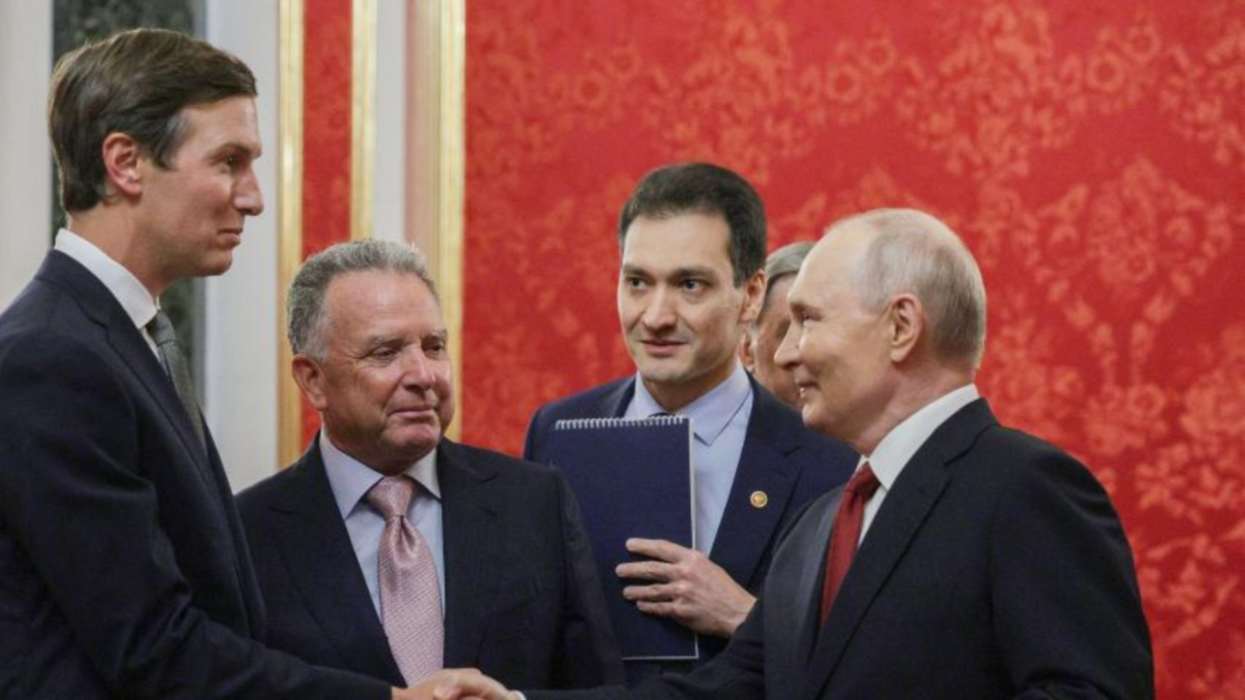
Donald Trump is trying to restart the diplomatic machinery around Ukraine by sending two of his most trusted negotiators directly to Vladimir Putin.
Steve Witkoff and Jared Kushner met the Russian president at the Kremlin on Saturday for talks lasting roughly three hours, presenting US ideas aimed at finding a path toward ending the war.
The timing is critical. US-brokered Russia–Ukraine talks have been effectively frozen for months, while fighting on the ground and Russian strikes against Ukrainian cities have intensified.
Putin: “Full Confidence” in US Mediation
Putin’s opening message was notable.
He told Witkoff and Kushner that he had “full confidence” in US efforts to mediate between Russia and Ukraine.
That does not mean Moscow and Washington are close to a settlement.
But it does show that the Kremlin wants to preserve the direct channel with the Trump administration and continues to view Washington as the actor most capable of influencing the next phase of the conflict.
Washington Brought “New Ideas”
After the meeting, Kremlin foreign-policy aide Yuri Ushakov said the American delegation had come prepared with a series of ideas on how the war might be brought to an end.
The details have not been made public.
At this stage, it remains unclear whether the proposals concern territorial arrangements, sanctions relief, security guarantees, a ceasefire mechanism, or a broader framework for resuming direct negotiations.
That is why the real test is not only what Putin heard in Moscow.
It is what Ukraine will be asked to consider next.
From Moscow to Kyiv
Witkoff and Kushner were expected to continue on to Kyiv for talks with President Volodymyr Zelenskyy, making the mission a shuttle-diplomacy effort rather than a one-sided Kremlin visit.
The US objective is to determine whether any minimum zone of overlap still exists between Russian and Ukrainian positions.
That may be the hardest part.
Ukraine remains deeply skeptical of Putin’s intentions and continues to fear that Russia is using diplomacy while preparing for further military escalation.


Putin Talks Peace While Russia Keeps Striking
That contradiction sits at the center of the current moment.
While Putin publicly welcomes US mediation, Russia has continued large-scale drone and missile attacks on Ukraine.
There are two possible interpretations.
One is that Moscow is using talks tactically, buying time while pursuing military objectives.
The other is that Putin wants to improve Russia’s position on the battlefield before serious negotiations resume.
In a war of attrition, territory is not only a military objective.
It is negotiating leverage.
Sanctions Are in the Background
Another detail from the trip matters.
A senior US Treasury sanctions official also traveled with the wider delegation and took part in preparatory contacts, although not in the face-to-face meeting with Putin.
That does not prove sanctions relief is already being negotiated.
But it underlines an obvious reality: any serious peace process will eventually have to confront the economic side of the war.
For Moscow, sanctions relief is one of the most valuable potential benefits of an agreement.
For Washington, sanctions remain one of its strongest tools of leverage.
Trump Returns to Personal Diplomacy
The choice of Witkoff and Kushner also reveals something about Trump’s preferred diplomatic method.
This is not purely conventional state-to-state diplomacy conducted through ministries and embassies.
Trump is relying on a small circle of trusted emissaries capable of speaking directly with leaders, testing proposals and moving quickly between capitals.
Witkoff has already become one of the administration’s key troubleshooters across multiple international files, while Kushner’s return to a major diplomatic role reinforces the sense that Trump prefers personal channels when the stakes are highest.


The Real Test Starts After the Kremlin
The three-hour meeting with Putin is not a breakthrough.
It is the reopening of a channel.
And that distinction matters.
The decisive question is whether the US ideas can survive the trip from Moscow to Kyiv — and whether there is any formula that both sides can accept without viewing it as a strategic defeat.
Trump is trying to turn a war that is still escalating back into a negotiation.
But the central question remains unresolved:
Is Putin talking because he is prepared to compromise, or because he believes battlefield pressure can force Kyiv and Washington to negotiate closer to his terms?
The answer will not come from the Kremlin photo-op.
It will come from Russia’s next military moves, Zelenskyy’s response, and whether direct Russia–Ukraine negotiations actually restart.
Source: pagenews.gr