Germany has awakened to a fundamentally different political reality.
The Alternative for Germany’s sweeping victory in Saxony-Anhalt is no longer just another warning shot from eastern Germany.
It is a political earthquake for Berlin — and potentially for Europe.
The AfD won 44.2% of the vote, more than doubling its 20.8% result in 2021. Chancellor Friedrich Merz’s CDU collapsed to 17.1%, while turnout surged to 76%.
The result matters for another reason: the AfD is no longer merely accumulating protest votes.
It is approaching the threshold of real political power.
And that turns its 258-page manifesto from campaign rhetoric into a potential blueprint for governing a German state.
The 44% That Changes the Rules
For years, Germany’s mainstream political establishment has dealt with the AfD through the Brandmauer — the political “firewall” excluding cooperation with the far right.
Officially, that firewall remains intact.
After 44%, however, it faces an unprecedented stress test.
The AfD does not have an outright majority, while Germany’s mainstream parties continue to rule out cooperation. But the larger the party becomes, the harder it is for its rivals to construct viable majorities without increasingly complicated coalitions.
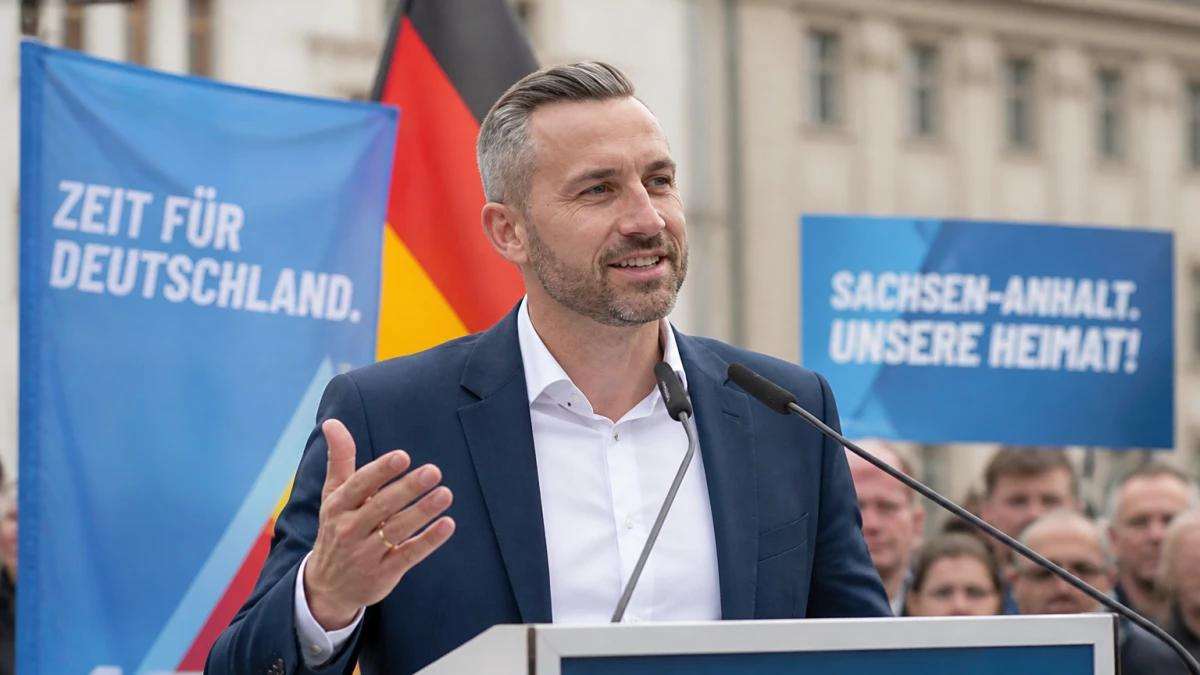
AfD state leader Ulrich Siegmund has already portrayed the result as a mandate to govern.
“If this result is not a mandate to govern, then what is?” he said after the election.
The significance is difficult to overstate.
The question confronting Germany is no longer simply whether the AfD can win elections.
It is what an AfD administration would actually do with power.


“Remigration”: The Migration Experiment
Migration sits at the heart of the party’s programme.
The AfD advocates the rapid deportation of people without a legal right to remain, expanded detention facilities ahead of deportations and a broader policy it describes as “remigration.”
Its plans also target Ukrainian refugees, arguing that people should return where sufficiently large areas of Ukraine can be considered safe.
“People who are required to leave the country must be placed in detention pending deportation under our government,” Siegmund has said.
Yet this is also where the first major constraint of government would emerge.
A German state cannot independently rewrite federal immigration law. Attempts to implement some of the AfD’s most radical proposals could therefore trigger legal battles, constitutional challenges and direct confrontations with Berlin.
That is precisely what makes Saxony-Anhalt so important.
It could become the place where Germany tests the limits between state authority, federal law and constitutional safeguards.
Separate Classes for Refugee Children
Education is a different matter.
Germany’s 16 states exercise extensive powers over schools and cultural policy — meaning an AfD-led government could potentially make its mark far more quickly in these areas.
The party proposes separate classes for refugee children, with education designed partly around the message that their stay in Germany is temporary.
Its programme also calls for separate schooling for children with disabilities.
More broadly, the AfD wants to “de-ideologise” schools, restrict symbols such as Pride flags and place greater emphasis on what it describes as traditional German values.
This is where the prospect of AfD government moves beyond rhetoric.
Education is one of the areas where a German state possesses genuine power.
“More Bismarck, Less Hitler”
Even more explosive is the proposed transformation of how German history is taught.
AfD politicians in Saxony-Anhalt want schools to devote greater attention to German history before the two world wars and reduce what they regard as an excessive focus on the Nazi era.
Hans-Thomas Tillschneider, the party’s regional spokesman for cultural affairs, summarised the approach with a phrase that has reverberated far beyond the state:
“More Bismarck, less Hitler.”
This is not merely a debate over a history curriculum.
It touches one of the foundations of post-war Germany: the idea that confronting and remembering the crimes of Nazism is an integral component of the country’s democratic identity.
A battle over schools could therefore become a battle over German identity itself.


Culture Becomes Another Battlefield
The AfD also wants to use cultural policy to reshape national identity.
Its manifesto calls for a new “patriotic cultural policy” and proposes withdrawing public funding from art it considers “anti-German.”
Artists and cultural institutions seeking state funding could be required to commit to not denigrating Germany and its culture.
Even the Bauhaus, one of Germany’s most influential contributions to modern architecture and design, has entered the dispute.
Critics see disturbing historical echoes in attacks on modernist culture.
German Culture Minister Wolfram Weimer has accused the AfD of attacking the Bauhaus using language reminiscent of that employed against modern art a century ago.
Again, the institutional distinction matters.
Unlike foreign policy or much of immigration policy, culture is an area where German states possess substantial authority.
An AfD administration could therefore begin implementing parts of its ideological programme relatively quickly.
Moscow Is Watching
The implications extend beyond Germany’s borders.
The AfD opposes Berlin’s support for Ukraine and advocates closer relations with Russia, placing it in direct conflict with the federal government’s foreign-policy orientation.
A state government cannot unilaterally reverse Germany’s policy toward Moscow.
But it can increase domestic political pressure on Berlin, particularly if AfD victories spread across eastern Germany.
The larger the AfD becomes, the harder it will be for any German chancellor to treat Ukraine and Russia as foreign-policy questions isolated from domestic electoral politics.
And that matters enormously to Europe.
Germany has been one of Ukraine’s most important European supporters since Russia’s full-scale invasion in 2022.
A sustained political shift inside Europe’s largest economy would inevitably reverberate through EU policy.


Merz’s Real Nightmare
This is where the result becomes particularly dangerous for Chancellor Friedrich Merz.
The CDU did not simply lose a regional election.
It suffered a historic reversal in the balance of political power.
Its second-vote share fell from 37.1% in 2021 to 17.1%, while the AfD surged from 20.8% to 44.2%.
That is not a normal electoral swing.
It is a political inversion.
Merz himself acknowledged the scale of the moment.
“Something changed yesterday — not just in Saxony-Anhalt, but across Germany.”
And that may prove to be the most important assessment of the election.
Because the battle now moves beyond Saxony-Anhalt.


Is Germany’s Firewall Beginning to Crack?
The Brandmauer is facing an increasingly uncomfortable paradox.
By refusing all cooperation with the AfD, mainstream parties keep it outside government — but also outside the political accountability that comes with governing.
The AfD can continue presenting itself as the sole alternative to an establishment forced into increasingly complex coalitions.
Allowing it into government, however, could provide the party with the institutional power to implement policies that challenge some of the fundamental assumptions of post-war German politics.
That is Germany’s new dilemma.
It is no longer simply about how to stop the rise of the far right.
It is about what happens when a party long kept outside the governing system wins the support of almost one in two voters in a German state.
And Saxony-Anhalt may be only the beginning.
Further regional elections will test whether the result represents an exceptional eastern German landslide or the emergence of a much broader political realignment.
If the AfD continues to advance, the implications will eventually reach the federal level — and therefore Brussels.
Saxony-Anhalt Could Be Europe’s First AfD Crash Test
For years, European capitals have watched the AfD primarily as an electoral phenomenon.
That phase may be ending.
Saxony-Anhalt raises a much more consequential question: what happens when the far right gets close enough to power to begin testing the institutions themselves?
Migration.
Schools.
Historical memory.
Culture.
Relations with Russia.
And ultimately the durability of Germany’s political firewall.
That is why the election could prove much more important than one regional contest.
Saxony-Anhalt may become Germany’s first real crash test for how the AfD behaves when it approaches power — and Europe’s first crash test for what happens when the firewall begins to bend.
Source: pagenews.gr