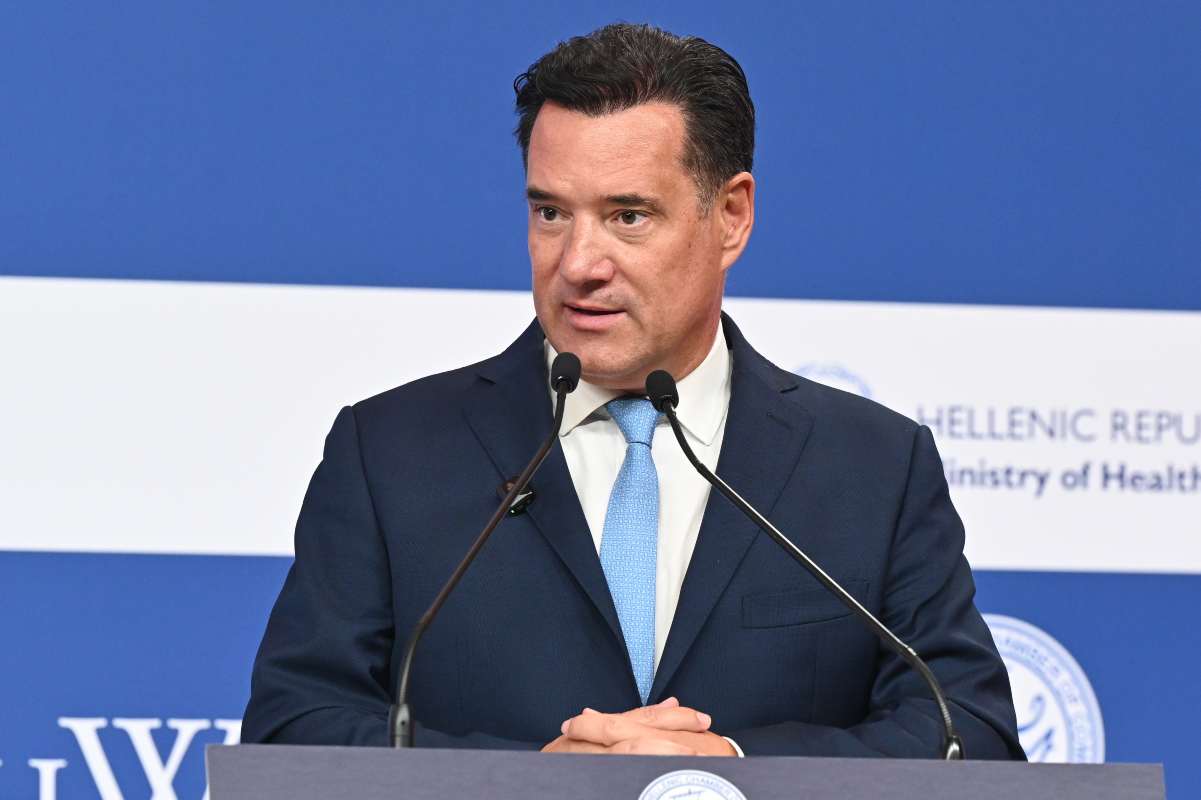
Greece must move faster toward a healthcare model built around innovation, new technologies and investment, Health Minister Adonis Georgiadis said at the American-Hellenic Chamber of Commerce Health Conference.
Georgiadis was the guest of honor at a closed breakfast with the Chamber’s member companies before appearing as one of the conference’s keynote speakers.
In a social media post, he wrote:
“Today at the American-Hellenic Chamber of Commerce Health Conference. I was the guest of honor at a closed breakfast with all its member companies and later one of the keynote speakers. My warmest thanks.”
Innovation is moving faster than public budgets
Georgiadis placed one of the biggest challenges facing modern healthcare systems at the center of his remarks: the extraordinary speed at which medicines, medical technology and healthcare services are evolving.
“The progress of innovation in healthcare, whether we are talking primarily about medicines or technological products and services, is enormous, extremely fast and highly intensive,” he said.
The difficulty, he argued, is that government healthcare budgets are not expanding at the same pace.
That creates a fundamental policy challenge: how can public healthcare systems provide patients with access to cutting-edge treatments without undermining fiscal sustainability?
“Greece has taken a leading role in supporting innovation”
Georgiadis argued that Greece is seeking a more prominent role in the European debate over pharmaceutical and technological innovation.
“At the European level, Greece has taken a leading role in the effort to support technological innovation, and we are trying to transform our country in that direction,” he said.
The strategy goes beyond providing patients with access to new treatments.
It is also about positioning Greece to attract:
- clinical trials,
- pharmaceutical investment,
- drug manufacturing,
- research centers,
- health-tech startups,
- digital health services,
- and medical technology investment.
The broader objective is to turn healthcare from a predominantly expenditure-driven sector into a field capable of generating investment, research and economic value.


Georgiadis openly addresses the clawback problem
One of the most significant parts of the Health Minister’s intervention was his willingness to address one of the most contentious issues between the Greek state and the pharmaceutical industry: clawback.
Georgiadis acknowledged that the scale of mandatory rebates and repayments can create serious disincentives for companies considering introducing innovative products into the Greek market.
“We also face many challenges because — and I believe we should say everything openly rather than hide it — there is significant pressure on budgets through clawback, which creates serious disincentives for bringing innovation to Greece,” he said.
The admission goes directly to the heart of the policy dilemma.
The government wants Greece to attract more pharmaceutical and technological innovation, but it also recognizes that this objective cannot be achieved through political declarations alone if the financing framework discourages investment.
The challenge: innovation without losing fiscal control
This is now one of the central challenges facing the Health Ministry.
Greece needs to create more room for innovative medicines and advanced medical technologies while preventing pharmaceutical expenditure from spiraling out of control.
Georgiadis framed the issue as the need to reconcile two different priorities:
fiscal sustainability and technological progress.
The success of that balancing act will determine whether Greece can evolve from a market that simply purchases innovative treatments into a country that also attracts investment around their development, testing and production.
Georgiadis: “I am strongly pro-Israel — and there is a reason”
The Health Minister also made a pointed reference to Israel, explaining that his positive stance toward the country is linked to what he sees as its ability to transform technological and healthcare innovation into broader economic progress.
“You know that I do not hide my feelings about Israel. I am strongly pro-Israel,” Georgiadis said.
He then explained his reasoning:
“But I am not strongly pro-Israel simply in a general sense. I am strongly pro-Israel because Israel has managed, in a very difficult environment, to turn innovation and technology into economic progress and progress in healthcare services.”

The Israeli model Greece wants to follow
Georgiadis’ reference to Israel reflects a broader policy vision.
Israel has built an ecosystem in which research, technology, healthcare institutions, startups and private capital interact closely.
For Greece, the relevant elements of that model include stronger links between research and business, closer cooperation between universities and startups, the integration of technology into healthcare services and the conversion of innovation into investment and exports.
“This example — of how you combine a genuinely adverse environment with effective management, progress in innovation and improvements in people’s lives — is the example we should follow here in Greece and certainly in Europe,” Georgiadis said.
From the NHS to a new health industrial policy
The remarks also point to a broader shift in how healthcare is being framed by the Greek government.
Healthcare is increasingly being treated not only as a pillar of social policy but also as an economic sector, an investment ecosystem, a research platform and a potential driver of technological development and exports.
That is where healthcare policy begins to intersect with industrial policy.
For Greece, the opportunity lies in connecting the transformation of the National Health System with pharmaceutical production, clinical research, digital health and a broader life-sciences ecosystem.
Greece wants to become part of the innovation chain
The government has already placed greater emphasis on clinical trials, pharmaceutical investment, digitalization of the National Health System and the adoption of new health technologies.

The harder part is the financing framework.
If Greece wants to become a destination for healthcare innovation, it will have to reduce the disincentives created by excessive mandatory repayments while maintaining effective control over public expenditure.
That was ultimately the strategic message behind Georgiadis’ intervention:
Greece does not want simply to buy healthcare innovation. It wants to become part of the ecosystem that creates it.
Source: pagenews.gr