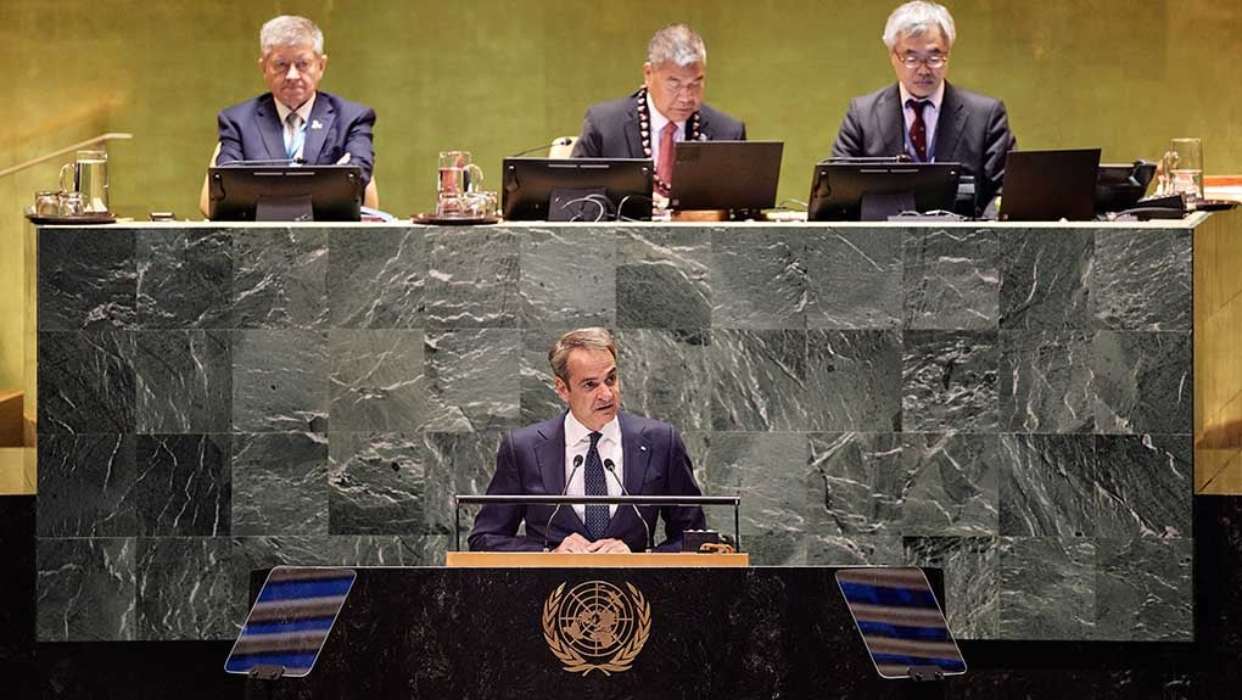
Prime Minister Kyriakos Mitsotakis is heading to the United States from September 21 to 25 for one of his most significant international trips this autumn, at a time when Greek-Turkish relations are again facing heightened tensions and diplomatic activity around the Cyprus issue is picking up.
His trip will not be confined to New York and the 81st High-Level Week of the United Nations General Assembly. It will begin in California, with meetings at the heart of the US technology ecosystem, before moving to New York, where the focus will shift to diplomacy, geopolitics and the economy.
The key question, however, will follow the Greek prime minister all the way to New York: will there be a face-to-face meeting with Turkish President Recep Tayyip Erdoğan?
The New York Question: Will Mitsotakis Meet Erdoğan?
So far, no meeting between the two leaders has been scheduled.
Mitsotakis has nevertheless deliberately left the possibility open.
“I am not ruling anything out, but nothing has been scheduled,” the prime minister said, noting that it is not even certain whether the two leaders’ schedules in New York will allow for a meeting.
Athens is therefore neither announcing a meeting nor closing the door on one.
If it does take place, however, it will unfold against a markedly different backdrop from some of their previous encounters.


Turkish Rhetoric Hardens — Athens Avoids a War of Words
Greek-Turkish relations have recently entered a more difficult phase, with Athens closely monitoring statements and reactions from Turkey concerning the demilitarisation of the Greek islands and even Mitsotakis’ visit to Kastellorizo.
The Greek prime minister has sought to keep the rhetoric under control, drawing a distinction between commentary in Turkish media and Ankara’s official positions.
At the same time, his message to Turkey remains clear.
Greece wants good relations with its neighbour and considers the channels of communication established following the Athens Declaration useful. But Athens does not intend to enter into a daily war of words with Ankara or alter its actions on the ground in response to Turkish rhetoric.
The government’s approach is therefore based on two parallel tracks: dialogue where possible and no retreat from Greece’s established positions.
The 12-Nautical-Mile Issue Remains on the Table
Mitsotakis has reiterated Greece’s position that extending its territorial waters up to 12 nautical miles is a right provided for under international law.
Athens’ position is that the exercise of that right is a sovereign decision for Greece to make when it considers the circumstances appropriate.
That issue acquires additional significance ahead of the UN meetings precisely because any Mitsotakis-Erdoğan encounter would come after a period of sharper rhetoric between the two sides.
For Athens, the core bilateral dispute that can be negotiated with Turkey remains the delimitation of the continental shelf and Exclusive Economic Zone in the Aegean and Eastern Mediterranean.
The Greece-Cyprus Power Cable Enters the Equation
Another sensitive issue is the electricity interconnection between Greece and Cyprus.
Mitsotakis has indicated that the project will move forward and has made clear Athens’ position that Turkey should not obstruct a project of common European interest.
The significance of the cable extends well beyond energy infrastructure.
It is tied to Cyprus’ energy security, the European Union’s connectivity strategy and the broader geopolitical balance in the Eastern Mediterranean.
Athens is also coordinating with the French side over the next steps following Meridiam’s involvement in the project.


Meeting with Guterres — Cyprus Back on the Diplomatic Agenda
Cyprus will be another major component of the prime minister’s New York agenda.
Mitsotakis is due to meet UN Secretary-General António Guterres on September 24, only hours before addressing the UN General Assembly.
The meeting comes amid renewed diplomatic activity surrounding the Cyprus issue and efforts to explore whether conditions can be created for a return to meaningful negotiations.
The latest contacts between Cypriot President Nikos Christodoulides and Turkish Cypriot leader Tufan Erhürman have kept the process alive, with Nicosia putting forward new ideas concerning confidence-building measures, methodology and the substance of the Cyprus question.
Expectations, however, remain measured.
Guterres has indicated that, under current conditions, a 3+1 or 5+1 meeting is not expected on the sidelines of the General Assembly.
New York may therefore be less about a breakthrough and more about preparing the diplomatic ground for what comes next.
Athens Wants to Project Stability in the Eastern Mediterranean
The Greek strategy extends beyond relations with Ankara.
Athens is seeking to reinforce Greece’s position as a regional actor with established partnerships in the Eastern Mediterranean, combining diplomacy, energy cooperation and security.
Cooperation with Cyprus and Egypt remains part of that architecture, while Greece is simultaneously seeking to preserve channels of communication with Turkey.
The message Mitsotakis is expected to carry to New York is therefore carefully calibrated: Greece supports dialogue, but dialogue does not mean abandoning its sovereign positions or its regional partnerships.


First Stop: Silicon Valley
Before the diplomatic stage in New York comes California.
Mitsotakis will be in San Francisco on September 21 and 22, where he is expected to hold meetings with major technology companies as well as Greek scientists, executives and professionals working in Silicon Valley.
The choice of California is significant.
Athens wants to present Greece to the US not only through the prism of geopolitics and defence, but also as a destination for technology, innovation, investment and highly skilled talent.
On September 22, Mitsotakis is also expected to visit Stanford for a closed event hosted by the Hoover Institution, with former US Secretary of State Condoleezza Rice among the participants.
From Geopolitics to Investment
The California leg gives the US trip a second strategic dimension.
Greece has spent recent years seeking to attract major international technology investments and position itself as a growing digital and data infrastructure hub in southeastern Europe.
The meetings in Silicon Valley provide Athens with an opportunity to make the case directly to US technology leaders and investors.
The underlying message is that Greece wants its relationship with Washington to extend beyond traditional defence and foreign-policy cooperation into technology, AI, innovation and investment.
New York with One Eye on the Markets
There is also a third component: international markets.
Mitsotakis has said that he will hold extensive contacts with US financial institutions during his visit, against the backdrop of volatility in global bond markets.
That adds an economic and investment dimension to a trip already dominated by geopolitics.
For Athens, the objective is to present Greece simultaneously as a strategic US partner in the Eastern Mediterranean, an investment destination and a country seeking a larger role in the technological transformation now reshaping Europe.
Three Agendas, One Crucial Question
The prime minister therefore arrives in the United States with three interconnected agendas.
In California, the focus will be technology, investment and Silicon Valley.
At the United Nations, it will be diplomacy, Cyprus and Greece’s wider international role.
And behind both will stand the increasingly complex relationship with Turkey.
Until the final hours of the New York programme, one question will remain unanswered: whether Mitsotakis and Erdoğan will ultimately sit down across the same table — and, if they do, what message that meeting will send at a moment when the temperature in Greek-Turkish relations is once again rising.
Source: pagenews.gr