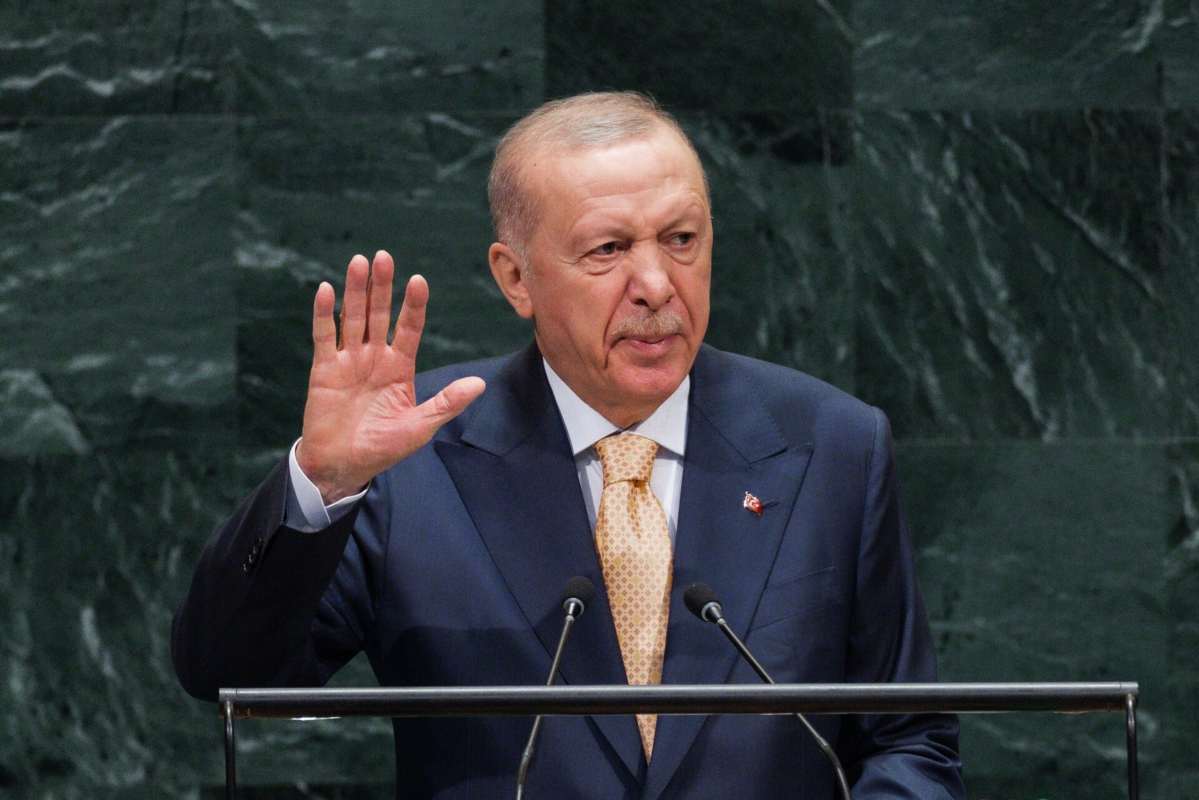
Recep Tayyip Erdogan used the UN General Assembly to present two distinct faces of Turkish foreign policy: a relatively restrained message toward Greece over the Aegean and Eastern Mediterranean, coupled with an uncompromising restatement of Ankara’s position on Cyprus.
The Turkish president said existing issues in the Aegean and Eastern Mediterranean should be resolved on the basis of good-neighbourly relations and international law.
At the same time, however, he once again urged UN member states to recognise the self-declared “Turkish Republic of Northern Cyprus” and establish political, diplomatic and economic relations with it.
That juxtaposition is central to understanding Ankara’s message from New York: Erdogan invoked international law when discussing the Aegean, while advocating a Cyprus settlement based on two separate entities — a position that falls outside the existing framework established by UN Security Council resolutions.
“According to international law”
Erdogan adopted relatively measured language when referring directly to the Aegean and Eastern Mediterranean.
“We want the existing issues in the Aegean and Eastern Mediterranean to be resolved on the basis of good-neighbourly relations and in accordance with international law,” he said.
The wording is politically significant because Athens likewise places international law at the centre of its approach to Greek-Turkish relations.
The two sides, however, differ substantially over the scope of the disputes between them.
Greece’s longstanding position is that the principal issue capable of judicial settlement is the delimitation of the continental shelf and Exclusive Economic Zone in the Aegean and Eastern Mediterranean.
Prime Minister Kyriakos Mitsotakis has also presented maritime delimitation as the principal unresolved bilateral issue when speaking before the United Nations.
Erdogan’s broader reference to “existing issues” therefore leaves unresolved a crucial question: which matters Ankara considers open for negotiation.


Erdogan revives the Eastern Mediterranean conference proposal
The Turkish president also renewed his proposal for a multilateral Eastern Mediterranean conference.
Ankara has long argued that such a forum could bring regional actors together to discuss maritime zones, energy resources and regional security.
Turkey’s vision, however, includes direct participation by the Turkish Cypriot side.
That makes the proposed conference inseparable from Ankara’s broader Cyprus strategy, under which Turkish Cypriots would participate in regional arrangements as a separate political entity.
Athens and Nicosia oppose arrangements that could amount, directly or indirectly, to recognition of separate statehood in the occupied northern part of Cyprus.
Cyprus exposes the deeper divide
The distance between the two sides became considerably clearer when Erdogan turned to Cyprus.
“The sovereign equality and equal international status of the Turkish Cypriot people must be secured, and the inhumane isolation to which they have been subjected must now come to an end,” he said.
He then issued another explicit appeal to the international community.
“I call on the international community to recognise the ‘Turkish Republic of Northern Cyprus’ and establish political, diplomatic and economic relations with it.”
This is not a new position.
In recent years Ankara has increasingly promoted a two-state model for Cyprus rather than a reunification settlement under a federal structure.
What the UN resolutions actually say
The setting of Erdogan’s appeal is particularly significant: he made it from the podium of the United Nations.
UN Security Council Resolution 541 of 1983 considered the attempted creation of the so-called “Turkish Republic of Northern Cyprus” legally invalid and called on states not to recognise any Cypriot state other than the Republic of Cyprus.
Resolution 550 of 1984 reiterated that position and again called on states not to recognise or assist the secessionist entity.
Erdogan’s call for recognition therefore goes beyond a disagreement with Athens and Nicosia over negotiating tactics. It departs from the existing framework established by the UN Security Council.


Athens and Nicosia remain on the opposite side
The Greek government continues to support a settlement based on a bizonal, bicommunal federation with a single international personality, sovereignty and citizenship, in accordance with the relevant UN Security Council resolutions and EU law.
Athens reiterated that position again in July 2026 on the anniversary of the Turkish invasion of Cyprus.
The same framework remains central to UN-led efforts to revive negotiations.
That means that despite the lower temperature in Greek-Turkish relations, Cyprus remains a fundamental strategic divide between Ankara, Athens and Nicosia.
Erdogan to Europe: You cannot build security without Turkey
Erdogan also delivered a direct message to European capitals, arguing that Europe cannot become stronger or safer by excluding Turkey from its security architecture.
The statement fits Ankara’s wider effort to position Turkey as indispensable to European security.
Turkey is seeking to leverage several assets simultaneously: its status as one of NATO’s major military powers, its expanding defence industry, its geographic position between Europe, the Black Sea and the Middle East, and its ability to operate diplomatically across several regional theatres.
The underlying message to Europe is straightforward: as the continent increases defence spending and redesigns its security architecture, Ankara wants a seat at the table.
Gaza brings Erdogan’s harshest rhetoric
The largest part of Erdogan’s address was nevertheless devoted to Gaza.
The Turkish president launched another fierce attack on Israel and used extremely strong language to describe the humanitarian situation in the Palestinian enclave.
He called Gaza “the most inhumane and shameful concentration camp of our age” and “the world’s largest cemetery for children.”
He accused Israel of “state terrorism” and a “genocidal mentality”, while urging UN member states to increase pressure on the Israeli government and move rapidly towards Gaza’s reconstruction.
Israel rejects accusations that it is committing genocide and maintains that its military campaign targets Hamas.
Palestinian statehood remains central to Ankara’s strategy
Erdogan again backed the establishment of an independent Palestinian state based on the 1967 borders, with East Jerusalem as its capital.
He argued that efforts to prevent Palestinian statehood would ultimately fail and called on countries that have not yet done so to recognise Palestine.
The Palestinian issue has become a central pillar of Erdogan’s regional diplomacy and public messaging.
For Ankara, the issue also provides a platform from which Turkey seeks to expand its influence across the Arab and Muslim worlds while drawing an increasingly sharp distinction between its policies and those of Israel.
Lower tones in the Aegean — no shift on Cyprus
The geopolitical significance of Erdogan’s UN address ultimately lies in this contrast.
On the Aegean, he avoided confrontational rhetoric and spoke instead of good-neighbourly relations and international law.
On the Eastern Mediterranean, he again proposed multilateral dialogue.
But on Cyprus, there was no movement away from Ankara’s two-state position. On the contrary, Erdogan once again explicitly called for international recognition of the breakaway entity — a position incompatible with the relevant UN Security Council resolutions.
That distinction marks the current limits of Greek-Turkish détente.
Athens and Ankara can maintain communication channels, avoid unnecessary escalation and expand cooperation in less contentious areas.
The harder test begins when general references to “international law” give way to the precise definition of what each country considers a bilateral dispute — and, above all, when the discussion reaches Cyprus.
Erdogan’s message from New York showed that on that question, the strategic distance remains wide.
Source: pagenews.gr