Europe’s energy map is being redrawn — and Greece is seeking to move from the edge of that map toward its center.
That is the geopolitical backdrop to the Greek government’s renewed emphasis on the Vertical Gas Corridor, US energy investment and offshore hydrocarbon exploration.
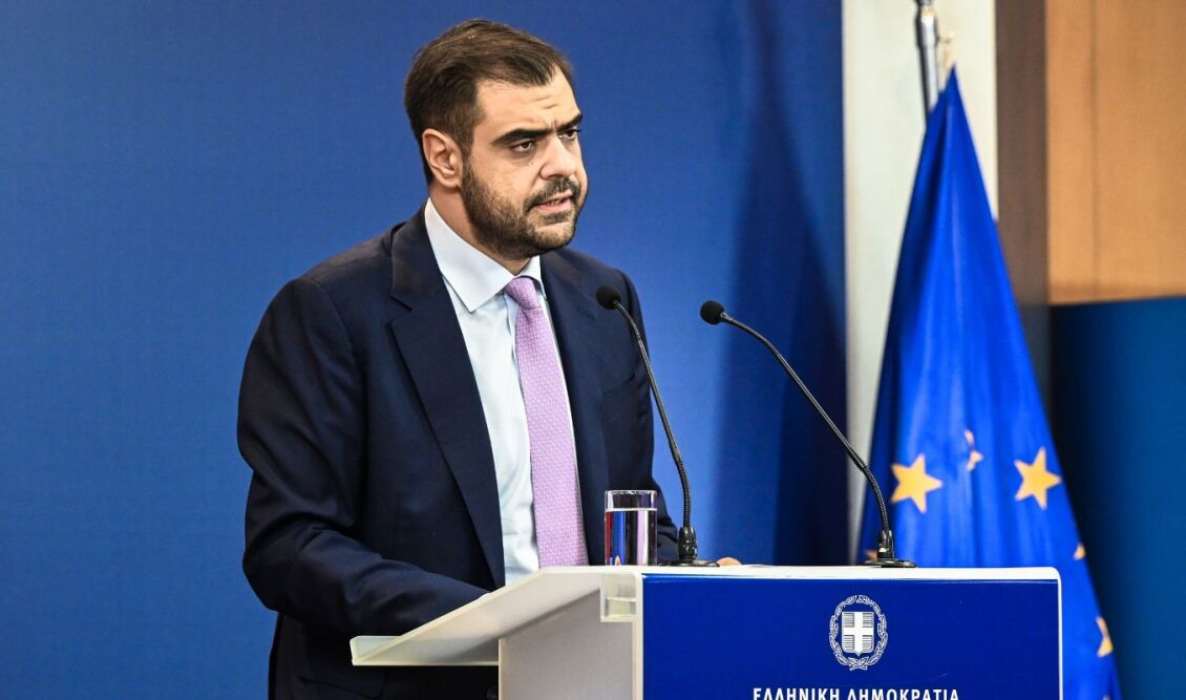
Government spokesman Pavlos Marinakis directly linked energy policy to the strategic relationship between Athens and Washington, pointing to the involvement of ExxonMobil and Chevron in exploration projects alongside Greek companies, as well as plans for an exploratory offshore drilling campaign in the Ionian Sea.
His message was explicit:
“It is true that the relationship between Greece and the United States is today closer and more stable than ever. It is a strategic relationship with depth, based on mutual respect and shared values.”
Behind that diplomatic language lies a much larger energy equation.
The Vertical Corridor Is More Than Another Pipeline
The strategic objective is, in effect, to help reverse the traditional energy geography of Southeastern Europe.
For decades, significant gas volumes moved broadly from north to south.
The emerging architecture is designed to strengthen the ability to move gas in the opposite direction: from south to north.
Gas entering Southeastern Europe through LNG terminals and other non-Russian sources can use interconnected networks to move through Bulgaria and Romania and potentially farther north.
The European Commission has identified the Trans-Balkan route as part of the alternative infrastructure capable of transporting gas from Greece, Türkiye and Romania northward, supporting markets in Southern and Central Europe, including Moldova and Ukraine.
That is what gives the Vertical Corridor its geopolitical dimension.
The question is no longer simply how much gas Greece itself needs.
It is increasingly about who can supply Southeastern and Central Europe as the continent changes its sources of energy.


Greece Has Been Building the Infrastructure for Years
The architecture did not appear overnight.
A series of projects has gradually changed Greece’s position on the regional energy map:
- The Trans Adriatic Pipeline (TAP) has been operating since 2020.
- The Greece–Bulgaria Interconnector (IGB) followed in 2022.
- The Alexandroupolis FSRU added another LNG entry point.
- New compressor infrastructure has been developed to increase northbound transmission capacity.
- The broader Vertical Corridor connects national systems across Southeastern and Central Europe.
The objective is not merely to bring additional gas into Greece.
It is to create the infrastructure necessary to move energy through Greece toward other markets.
Geography is being converted into infrastructure — and infrastructure into geopolitical leverage.
The Timing: Europe Is Closing the Door on Russian Gas
This is where the broader European story becomes critical.
The European Union has moved beyond the initial emergency response that followed Russia’s invasion of Ukraine and toward a structural reduction of its dependence on Russian fossil fuels.
That shift fundamentally changes the strategic value of alternative entry points.
Before the energy crisis, Russia accounted for roughly 45% of EU gas imports in 2021. That share has since fallen dramatically as Europe expanded LNG capacity, diversified suppliers and reduced gas consumption.
But replacing Russian molecules requires more than buying gas from another supplier.
Europe also needs new routes, terminals, interconnectors and reverse-flow capacity.
That is precisely where Greece’s location matters.
The country sits at the southern end of one of Europe’s emerging alternative energy routes.
From Russian Pipeline Gas to LNG
Europe’s changing relationship with LNG is equally important.
As Russian pipeline deliveries declined, LNG became a much larger component of Europe’s gas supply.
That transformation changes the geopolitical value of infrastructure.
When gas arrives predominantly through fixed pipelines, strategic advantage belongs to countries located along those routes.
When LNG becomes more important, the advantage shifts toward countries with:
ports, regasification terminals, floating storage units and pipeline networks capable of moving imported gas inland.
That is the model Athens is increasingly pursuing.
Alexandroupolis: From Border City to Energy Entry Point
Alexandroupolis illustrates the transformation particularly clearly.
Northern Greece can increasingly function not merely as a consumer or transit area, but as an energy entry point for Southeastern Europe.
Combined with the IGB and regional pipeline connections, LNG entering Greece can potentially travel north into Balkan markets.
That does not mean Greece will automatically become the region’s exclusive energy hub.
There are competing supply routes through countries including Italy, Türkiye, Germany and Poland.
Indeed, Europe’s strategy is specifically designed to avoid replacing one dominant route with another.
The objective is multiple suppliers and multiple routes.
Paradoxically, that competition makes Greek infrastructure more strategically relevant, not less.
Then Come ExxonMobil and Chevron
The second pillar of Athens’ strategy lies beneath the seabed.
Marinakis highlighted the participation of ExxonMobil and Chevron, alongside Greek companies, in exploration for potential domestic energy resources.
The government has also linked the next phase of its energy strategy to the prospect of Greece’s first offshore exploratory drilling campaign in decades.
Prime Minister Kyriakos Mitsotakis recently pointed to a possible drilling timetable around spring 2027.
But one distinction is crucial.
Exploratory drilling does not mean that a commercially viable gas field has been discovered.
A drilling campaign is precisely what helps determine whether geological indications can eventually translate into commercially recoverable reserves.
That uncertainty matters.
The Vertical Corridor has strategic value regardless of whether Greece ultimately discovers significant domestic gas reserves.
A major commercial discovery, however, would add an entirely new dimension.
Greece would no longer be positioning itself only as an energy transit state.
It could potentially become a producer as well.
Marinakis Draws a Line Over Kimberly Guilfoyle
The government also sought to draw a clear distinction between the strategic Greece–US relationship and individual commercial interests.
Asked about a Wall Street Journal report concerning Kimberly Guilfoyle and the opposition’s reaction to it, Marinakis said there had been no question of a threat against the Greek government.
He added that such conduct would never be accepted.
The government, he said, is working toward Greece’s energy and geopolitical upgrading and the protection of the national interest, while “not becoming involved in commercial and business rivalries.”
The distinction is politically significant.
Athens wants its energy relationship with Washington to be understood as a state-level strategic partnership, rather than alignment with the interests of any individual company.
The Real Game Is North of Greece
Look at the map and the broader significance becomes clearer.
Europe is trying to solve three problems simultaneously:
reduce Russian dependence, preserve security of supply and create multiple alternative energy routes.
Greece sits at the southern end of one of those routes.
That gives infrastructure such as Alexandroupolis, the IGB and the Vertical Corridor importance beyond Greece’s domestic gas market.
The potential destination is not simply Athens or Thessaloniki.
It is the wider arc running through the Balkans toward Central and Eastern Europe.
And potentially, depending on infrastructure, capacity and market conditions, farther toward Moldova and Ukraine.
From Transit Country to Energy Distributor
This is ultimately Greece’s strategic bet.
Not simply to have another pipeline crossing Greek territory.
But to build an interconnected system in which the country can simultaneously function as:
an LNG entry point, a pipeline hub, a gateway toward the Balkans and — if exploration eventually produces commercially viable discoveries — a potential gas producer.
Not every part of that strategy has been completed.
And the outcome of offshore exploration remains unknown.
But the Vertical Corridor possesses one major advantage that does not depend on discovering Greek gas:
It can use Greece’s geography to move energy produced elsewhere toward Europe’s north.
That is why Marinakis’ description of Greece–US relations as “closer and more stable than ever” now has an increasingly tangible energy dimension.
LNG. Pipelines. Alexandroupolis. The Ionian Sea.
The Athens–Washington strategic relationship is increasingly intersecting with Europe’s new energy map — and Greece is trying to convert its position on that map into greater geopolitical weight.
Source: pagenews.gr