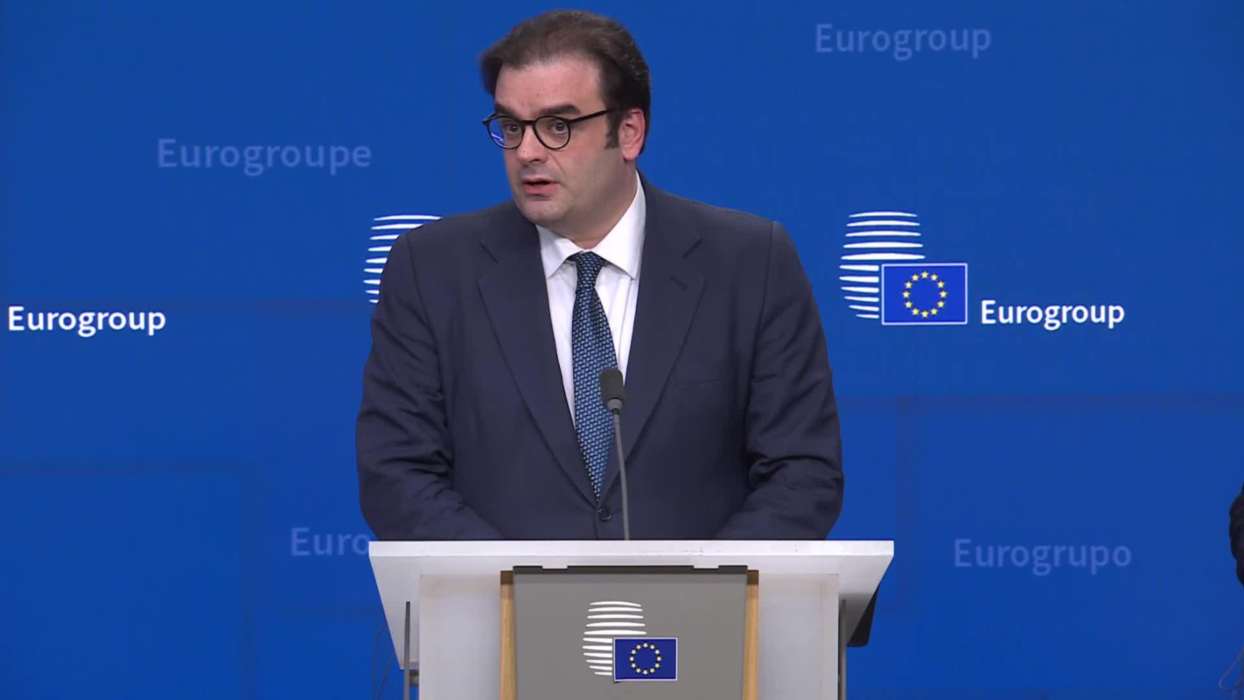
Europe is entering a new economic era in which cheap borrowing is disappearing, sovereign debt is becoming more expensive, and governments are facing growing pressure to protect households and businesses without undermining fiscal stability.
That was the central message delivered by Kyriakos Pierrakakis, Greece’s Minister of National Economy and Finance and President of the Eurogroup, during an interview with CNN’s Richard Quest on the sidelines of the annual meetings of the International Monetary Fund and World Bank.
The interview developed into a pointed debate over the possibility of another European sovereign debt crisis, the growing cost of energy, the limits of fiscal flexibility and the European Union’s persistent difficulties in completing its banking and capital markets reforms.
Pierrakakis acknowledged that the global financial environment has changed fundamentally but argued that Europe is institutionally stronger and better prepared than it was during the previous sovereign debt crisis.
“The Era of Cheap and Abundant Capital Is Over”
Richard Quest opened the discussion by highlighting rising European government bond yields, particularly in France and Italy, and questioning whether the European Central Bank might eventually be forced to intervene.
Pierrakakis agreed with European Central Bank President Christine Lagarde’s assessment that France must address its fiscal difficulties primarily through domestic policy decisions.
However, he stressed that the rise in borrowing costs reflects a broader international transformation.
“Ten years ago, the average bond yield in Europe was 1.1%. Today, the average ten-year bond yield stands at 4.4%,” he said.
He then delivered the interview’s defining warning:
“The era of cheap and abundant capital is over globally.”
According to the Eurogroup President, inflation expectations, energy prices, artificial intelligence and geopolitical developments have fundamentally reshaped the global investment environment.
Higher borrowing costs are placing additional pressure on European governments precisely when they need substantial resources for infrastructure, energy security, defense and economic modernization.
The implications are particularly serious for highly indebted economies, where refinancing costs and fiscal credibility remain closely linked.
CNN Presses Pierrakakis: Is Another European Debt Crisis Coming?
Quest repeatedly challenged the Greek minister over the possibility of a new sovereign debt crisis affecting major European economies.
Pierrakakis avoided offering an unconditional guarantee that such a crisis could not occur.
“We are monitoring the situation carefully, but we are not overly concerned,” he responded.
He emphasized that the European Union has developed a substantially stronger institutional framework since the financial turmoil of the previous decade.
“Europe has a very strong fiscal framework, which we are implementing right now.”
The minister also highlighted the importance of credibility in financial markets.
“The greater a country’s credibility regarding its fiscal policy, and the greater the credibility of its political system, the more this is reflected in its bond yields.”
His comments underline a central principle of contemporary European economic policy: investors increasingly differentiate between sovereign borrowers according to their fiscal performance, institutional stability and perceived ability to manage future economic shocks.
For Greece, which experienced one of the most severe sovereign debt crises in modern European history, the comparison carries particular significance.


The Fiscal Dilemma: Brussels Wants Flexibility, the IMF Demands Restraint
One of the most confrontational moments of the interview came when Quest questioned whether European governments could simultaneously demand greater fiscal flexibility while the IMF was urging countries to limit fiscal expansion.
The journalist argued that rising bond yields were already making public borrowing more expensive, leaving governments with less room for additional spending.
Pierrakakis rejected the suggestion that these objectives were necessarily contradictory.
“It is a balancing exercise between the increasing energy needs we are facing and the support we need to provide to citizens,” he explained.
He argued that existing European fiscal rules contain mechanisms that could accommodate targeted flexibility without triggering an uncontrolled increase in public expenditure.
“Within the existing fiscal framework and its provisions, flexibility can be incorporated into the system without fiscal expansion.”
When Quest pressed him further, Pierrakakis clarified the distinction.
“Our proposal was not about more spending, but about a different allocation of spending.”
The debate reflects a broader disagreement across Europe over how to respond to extraordinary economic pressures while maintaining fiscal discipline.
Governments are seeking room to finance energy-related measures, strategic investments and industrial support, while financial institutions are warning against excessive deficits and growing debt burdens.
Greece’s €1.4 Billion Support Package Amid the Energy Crisis
The conversation then shifted to the consequences of persistently high energy prices.
Quest suggested that Europe could face an extended period of expensive energy, placing additional strain on households, businesses and public finances.
Pierrakakis responded:
“That is precisely why we need to support citizens.”
Speaking specifically about Greece, he pointed to the government’s fiscal measures.
“This year, we have presented a €1.4 billion package of measures to support citizens and businesses.”
He attributed the government’s ability to introduce these measures to the improvement of Greece’s public finances.
The minister argued that responsible fiscal management creates the capacity for targeted intervention when extraordinary circumstances arise.
At the European level, he acknowledged that the Union must continue supporting citizens while preserving financial stability.
He also maintained that Europe is in a stronger energy position than it was when Russia launched its full-scale invasion of Ukraine.
The diversification of energy supplies and increased investment in infrastructure have strengthened the continent’s resilience.
Nevertheless, substantial gaps remain.
“We need to invest more in energy storage, grids and interconnections,” Pierrakakis stressed.
These investments are increasingly central to Europe’s efforts to reduce dependence on imported fossil fuels and protect its industrial competitiveness.
Banking Union: Richard Quest Challenges Europe’s Record
The interview became particularly animated when the discussion turned to the European Banking Union.
Quest questioned whether European leaders were genuinely capable of completing reforms that have been discussed for years.
He argued that successive Eurogroup presidents and European officials had repeatedly promised progress without delivering the structural changes required.
Pierrakakis disagreed.
“The key is implementation. Our motto must be: implementation, implementation, implementation.”
The Eurogroup President argued that recent developments in capital markets integration demonstrate that European reform efforts are beginning to accelerate.
“Over the last ten months, we have seen more progress than in the previous ten years,” he said.
He referred to an initial agreement reached at Council level concerning capital markets supervision.
In his assessment, deeper financial integration would allow European savings to be directed more efficiently toward productive investments.
The broader objective is to reduce fragmentation across national financial systems and improve Europe’s capacity to finance innovation, infrastructure and business expansion.
Europe Needs Bigger Banks and Industrial Champions
Pierrakakis also addressed one of the central structural weaknesses identified in European competitiveness debates: the relatively limited scale of many European businesses compared with their American counterparts.
“We need bigger banks. They need to achieve greater scale,” he said.
The minister argued that Europe must remove regulatory and administrative barriers that prevent companies from expanding across national borders.
Citing IMF calculations, he said that internal barriers in the European services sector are equivalent to a tariff of approximately 110%, while the corresponding figure for manufacturing is 44%.
These estimates illustrate the economic cost of fragmentation within what is supposed to be a single European market.
Pierrakakis also referred to the productivity gap between Europe and the United States, arguing that the absence of sufficiently large European companies accounts for a significant part of the difference.
The implications extend beyond banking.
Telecommunications, artificial intelligence, defense, energy and advanced manufacturing all require substantial investment and economies of scale.
Quest challenged the minister over whether European governments were prepared to accept the political consequences of creating powerful cross-border companies.
Such consolidation could require national governments to abandon long-standing preferences for maintaining domestic corporate champions.
Pierrakakis argued that the benefits of greater economic scale could ultimately extend across the Union.
“The Era of Geopolitical Innocence Is Coming to an End”
Toward the end of the interview, Pierrakakis connected Europe’s economic challenges to the rapidly changing geopolitical environment.
“The era of geopolitical innocence is coming to an end,” he declared.
He argued that geopolitical fragmentation, energy insecurity and intensifying global competition are forcing European governments to reconsider traditional national approaches.
For decades, European leaders have broadly supported deeper integration in principle while frequently resisting specific reforms that might affect domestic economic interests.
Pierrakakis acknowledged this historical pattern.
He suggested, however, that the changing international environment is creating stronger incentives for cooperation.
The need to diversify energy supplies, strengthen strategic industries and compete with the United States and China is increasing pressure for structural reforms.
In his assessment, European governments across the political spectrum increasingly recognize that the Union must act with greater speed and coordination.
Draghi’s Warning and Europe’s Competitiveness Challenge
The Eurogroup President also referred to the reform agendas associated with former Italian Prime Minister Mario Draghi and former European Prime Minister Enrico Letta.
Their work has highlighted structural weaknesses in the European economy, including fragmented capital markets, insufficient investment and obstacles to cross-border business activity.
Pierrakakis argued that the central challenge is no longer identifying the problems.
Europe already possesses extensive analysis of its competitiveness gap.
The question is whether national governments and European institutions can implement the necessary changes.
Greater financial integration, stronger banks, larger companies and more efficient capital allocation are among the priorities he identified.
The stakes are particularly high as the European Union confronts simultaneous pressures from energy costs, geopolitical uncertainty and technological competition.
The Message to Financial Markets: Stability Without Complacency
Pierrakakis’s interview offered a clear picture of the difficult choices confronting European economic policymakers.
Higher bond yields are narrowing fiscal space, while the energy crisis is increasing pressure for public intervention.
At the same time, Europe must invest heavily in energy infrastructure, technological innovation and industrial modernization.
The Eurogroup President maintained that these objectives can be reconciled through fiscal credibility, targeted flexibility and faster implementation of structural reforms.
His position was not that Europe faces no economic risks, but that its institutions are better equipped to manage them than during the previous sovereign debt crisis.
The central message is unmistakable: the age of easy borrowing has ended, and Europe’s next economic chapter will depend on fiscal credibility, investment capacity and the political willingness to complete long-delayed reforms.
For Greece, the challenge is equally significant: preserving fiscal stability while protecting households and businesses from high energy costs and maintaining the momentum of economic investment.
For the European Union, the broader question is whether it can transform repeated commitments to economic integration into concrete results.
Source: pagenews.gr