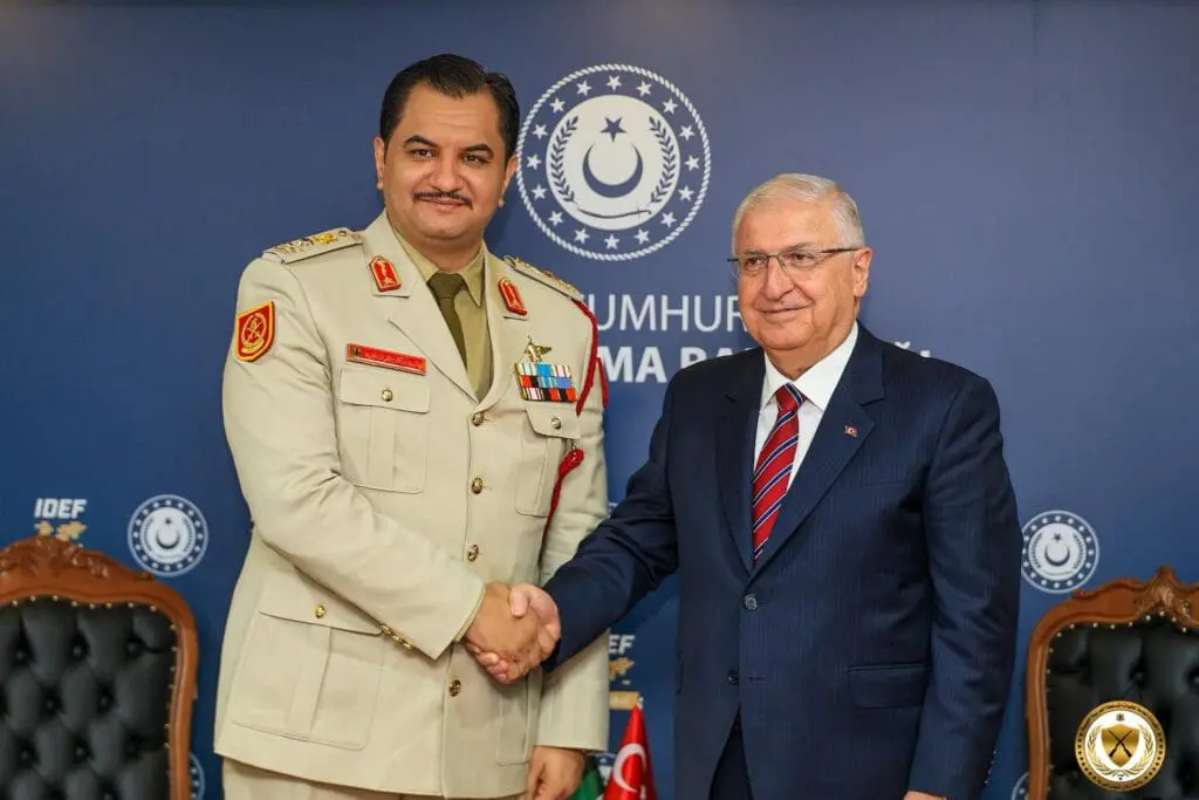
A significant geopolitical shift is unfolding in the Eastern Mediterranean following the decision by Libya’s eastern-based House of Representatives to approve the controversial maritime boundary agreement signed between Turkey and Libya’s Tripoli-based government in 2019.
The decision marks a substantial change in the political landscape surrounding the Turkish-Libyan memorandum, which Greece has consistently rejected on the grounds that it disregards the maritime rights of Greek islands, particularly Crete.
For Athens, the immediate concern is not that Turkey has suddenly acquired new legal rights over disputed waters. Rather, Ankara has secured political support from a Libyan faction that previously opposed the agreement.
That development could strengthen Turkey’s diplomatic position while complicating Greece’s efforts to challenge Ankara’s maritime claims.
At the same time, the debate over extending Greek territorial waters to 12 nautical miles south and west of Crete is returning to the forefront.
The implications extend beyond maritime boundaries. They involve offshore hydrocarbon exploration, Chevron’s anticipated activities south of Crete, the Greece–Cyprus electricity interconnection and the broader strategic competition for influence in North Africa.


Libya’s Parliamentary Decision Changes the Diplomatic Equation
On October 20, 2026, Libya’s House of Representatives approved the maritime agreement concluded between Ankara and the former Tripoli-based Government of National Accord in November 2019.
The vote was unanimous, according to the parliament’s spokesperson, Abdullah Bliheq.
The legislature also reversed its earlier 2020 decision rejecting the memorandum and severing ties with Turkey.
This reversal carries considerable political significance.
When the agreement was first signed, eastern Libya’s authorities, aligned with military commander Khalifa Haftar, strongly opposed the Tripoli government and its Turkish backers.
Turkey had intervened militarily in support of Tripoli during the Libyan civil war, placing Ankara and Haftar on opposite sides of the conflict.
Seven years later, eastern Libya’s political establishment has moved toward accepting a maritime arrangement that had once symbolized its confrontation with Turkey.
The development illustrates how Ankara has expanded its influence beyond its traditional allies in western Libya.
Athens Responds: Geography and International Law Cannot Be Rewritten
Greece’s Foreign Ministry reacted sharply to the parliamentary decision.
Athens maintains that the Turkish-Libyan memorandum is illegal, null and void, arguing that the maritime boundary it establishes disregards the rights of Greek islands and lacks a valid geographical foundation.
In its response, the ministry emphasized:
“Geography and the International Law of the Sea do not change through unilateral, legally unfounded parliamentary decisions.”
The Greek position rests on the argument that Turkey and Libya do not have opposite or adjacent coastlines capable of supporting the maritime delimitation envisaged by the memorandum without taking into account the intervening Greek islands.
Athens also points to its maritime delimitation agreements with Italy and Egypt as examples of agreements based on international maritime law.
Greek officials have reiterated that the parliamentary decision does not alter Greece’s sovereign rights or the legal objections it has consistently raised.
The distinction is crucial.
A parliamentary vote may strengthen political support for an agreement between its signatories, but it does not automatically resolve competing maritime claims or impose legal obligations on third countries.


Ankara Welcomes the Decision
Turkey, by contrast, welcomed the Libyan parliament’s approval.
In an official statement on October 20, the Turkish Foreign Ministry presented the memorandum as an agreement protecting the mutual rights and interests of Turkey and Libya under international law and the principle of equity.
Ankara regards the agreement as an important component of its broader maritime strategy in the Mediterranean.
Greece disputes that interpretation, arguing that the agreement infringes upon the maritime entitlements of Greek islands.
The disagreement reflects a longstanding dispute over maritime delimitation, including the extent to which islands should influence the boundaries of exclusive economic zones and continental shelves.
Turkey is not a party to the United Nations Convention on the Law of the Sea, while Greece invokes both the convention and relevant customary international law.
The Libyan vote therefore reinforces the political dimension of an unresolved legal and diplomatic dispute.
Konstantinos Filis: Turkey Has Established a Dominant Role in Libya
Greek international relations expert Konstantinos Filis highlighted the broader significance of the parliamentary decision in remarks to SKAI television.
According to Filis, the endorsement has both symbolic and practical implications.
“Now Parliament is taking this step, which confirms that Turkey has a dominant role in Libya,” he said.
Filis argued that Ankara has built influence through investments, economic assistance and political engagement with both rival Libyan camps.
Turkey has also sought to participate in efforts to reconcile Libya’s competing political authorities.
This strategy has allowed Ankara to develop relationships with figures who were previously hostile to Turkish involvement.
The significance becomes even greater when considering that eastern Libya historically maintained close relationships with Egypt and the United Arab Emirates.
Turkey has effectively broadened its network of influence without abandoning its established partnership with Tripoli.


The Haftar Family’s Strategic Recalculation
One of the most important dimensions of the story concerns the political evolution of the Haftar family.
Khalifa Haftar’s forces attempted to capture Tripoli in 2019, confronting the internationally recognized government supported by Turkey.
The failure of that offensive and the subsequent ceasefire in 2020 changed the balance of power.
As Libya remained divided, Ankara began cultivating relationships with eastern Libyan authorities.
This outreach gradually expanded into military, political and economic contacts.
International analysts have identified Saddam Haftar, Khalifa Haftar’s son and a senior military figure, as a central player in the rapprochement.
Claudia Gazzini, a senior Libya analyst at the International Crisis Group, linked the parliamentary approval partly to Saddam Haftar’s political ambitions.
“It was clear that Saddam Haftar wanted the House of Representatives to ratify the agreement with Turkey,” she told Al-Monitor.
Gazzini also suggested that Saddam Haftar hopes to secure Turkish support for his presidential ambitions.
That assessment points to a possible convergence of political interests, although it does not establish the existence of a confirmed political bargain.
For Ankara, cultivating ties with the Haftar family provides access to eastern Libya’s political and military structures.
For the Haftar camp, improved relations with Turkey could expand its diplomatic options during negotiations over Libya’s political future.
A Leadership Change That Helped Clear the Way
The parliamentary decision followed an important leadership change.
Aguila Saleh, who had led Libya’s House of Representatives for approximately 12 years, was removed from his position in early October.
Saleh had consistently opposed the maritime agreement, describing it as legally invalid in December 2025.
His successor, Al-Salheen Abdelnabi al-Obeidi, had previously chaired the Libyan-Turkish Parliamentary Friendship Committee.
The leadership transition created a more favorable political environment for approval of the memorandum.
Although the change alone cannot explain the broader strategic realignment, it helped remove a prominent institutional obstacle.
The sequence illustrates how domestic Libyan political developments can directly affect the balance of power in the Eastern Mediterranean.
Why Analysts Describe a Geopolitical Victory for Turkey
Libya specialist Jalel Harchaoui, associated with the Royal United Services Institute, characterized the parliamentary approval as a major strategic geopolitical success for Ankara.
His assessment focuses on the political implications of securing support from eastern Libya.
The endorsement suggests that both major Libyan political camps now offer a degree of acceptance to Turkey’s interpretation of the maritime boundary issue.
Harchaoui also argued that the decision could make it more difficult for the Haftar family to balance relations with Turkey against its partnerships with Greece, Cyprus, Israel and the United Arab Emirates.
From this perspective, Ankara has achieved an important diplomatic objective.
It has moved beyond reliance on the Tripoli government and established a broader foundation for its maritime strategy.
Nevertheless, diplomatic support should not be confused with a final legal settlement.
The memorandum remains contested, and its approval does not determine the maritime rights of neighboring states.


Greece’s 12-Nautical-Mile Option Returns to the Spotlight
Against this backdrop, the possibility of extending Greek territorial waters to 12 nautical miles south and west of Crete is attracting renewed attention.
Under the international law of the sea, coastal states are entitled to establish territorial seas up to a maximum breadth of 12 nautical miles, subject to applicable legal rules and geographical circumstances.
Greece has already exercised this right in the Ionian Sea.
Konstantinos Filis argued that the latest developments provide an opportunity for Athens to consider a similar move around Crete.
Such an extension would represent the exercise of Greek sovereignty rather than simply a diplomatic response to Turkey.
It could also alter the operational and strategic environment in parts of the surrounding maritime area.
However, Filis warned that Turkey could react, particularly to an extension west of Crete, where important international shipping routes are located.
The implications would therefore require careful diplomatic and legal assessment.
A crucial distinction must also be maintained: extending territorial waters is not the same as delimiting an exclusive economic zone or continental shelf.
An extension to 12 nautical miles would not automatically resolve every maritime dispute involving Greece, Turkey and Libya.
It would nevertheless constitute a significant sovereign decision.
Chevron and the Energy Stakes South of Crete
The dispute is increasingly intertwined with Greece’s offshore energy ambitions.
Chevron’s anticipated exploration activities south of Crete have attracted geopolitical attention because parts of the broader region overlap with competing maritime claims associated with the Turkish-Libyan memorandum.
Filis suggested that Ankara could react when exploration activities move forward.
The issue extends beyond the commercial prospects of discovering hydrocarbons.
Energy exploration in contested maritime environments involves legal certainty, operational security and geopolitical risk.
International energy companies assess not only geological potential but also the political and regulatory environment in which projects operate.
Chevron’s involvement adds an important American commercial dimension.
However, the presence of a major US energy company does not automatically eliminate the possibility of diplomatic friction.
For Greece, proceeding with lawful exploration activities is part of its broader strategy of exercising the maritime rights it maintains under international law.
For Turkey, the issue intersects with its own maritime claims and its strategic partnership with Libya.
This combination could make offshore exploration one of the most closely watched developments in the Eastern Mediterranean.
The Great Sea Interconnector Faces a More Complex Environment
Another major concern is the Great Sea Interconnector, the planned electricity connection between Greece and Cyprus.
The project is strategically important because it aims to connect Cyprus to the European electricity network, reducing the island’s energy isolation and strengthening regional energy security.
The infrastructure also carries wider geopolitical significance for the European Union and the Eastern Mediterranean.
Previous disputes over maritime surveys and subsea cable operations have demonstrated the sensitivity of the surrounding waters.
Filis warned that the Libyan parliament’s endorsement could complicate efforts to reach understandings between Athens and Ankara.
He also referred to reports of discussions involving French and Turkish representatives, while making clear that these reports did not establish a finalized arrangement.
The latest developments do not automatically change the legal status of the electricity interconnection.
They may, however, make the diplomatic environment more difficult.
For Greece and Cyprus, the challenge is to advance the project within the applicable legal framework while managing potential objections and operational risks.
For Turkey, maritime activities in the region remain connected to its broader claims concerning jurisdiction and delimitation.
The project therefore sits at the intersection of energy policy, European strategic interests and regional diplomacy.
Egypt and Cyprus: The Wider Regional Dimension
Greece is not the only country opposing the Turkish-Libyan memorandum.
Cyprus and Egypt have also raised objections, arguing that the agreement affects the maritime interests and rights of other states.
Egypt occupies a particularly important position.
Cairo has historically maintained strong ties with eastern Libya and supported Khalifa Haftar during the country’s internal conflict.
At the same time, Egypt has developed its own diplomatic relationship with Turkey, creating a complex regional balance.
In 2020, Greece and Egypt signed an agreement on the partial delimitation of their exclusive economic zones.
That agreement reflects a different approach to maritime boundaries from the one advanced by Ankara through its memorandum with Libya.
Egypt also lodged a formal diplomatic objection to the Turkish-Libyan agreement at the United Nations in September 2025.
The latest developments place Cairo in a delicate position.
Egypt must balance its interests in Libya, its relationship with Turkey and its own maritime claims.
For Greece, coordination with Egypt and Cyprus remains an important diplomatic instrument.
However, shared objections to the memorandum do not necessarily translate into identical political priorities or coordinated responses on every issue.
Intelligence Diplomacy: Ibrahim Kalin’s Visit to Libya
The parliamentary vote coincided with a visit to Libya by Ibrahim Kalin, head of Turkey’s National Intelligence Organization.
Kalin held talks with senior officials in Tripoli, including Prime Minister Abdul Hamid Dbeibah.
The visit took place as Ankara intensified its diplomatic engagement with Libya’s competing political centers.
The timing highlights Turkey’s sustained interest in shaping Libya’s political future.
It does not, by itself, prove that the parliamentary vote resulted from a secret agreement or specific exchange of concessions.
Nevertheless, it fits into a broader Turkish strategy combining diplomacy, intelligence contacts, military cooperation and economic engagement.
Libya is strategically important to Ankara because of its geographical position, energy resources, reconstruction opportunities and proximity to Mediterranean maritime routes.
Turkey’s involvement is therefore not limited to the 2019 memorandum.
It forms part of a long-term effort to secure influence across North Africa and the Eastern Mediterranean.
What Options Does Athens Have?
Greece now faces several possible courses of action.
One involves intensifying diplomatic engagement with European institutions, international partners and regional governments to explain its legal position and challenge the Turkish-Libyan maritime claims.
Another involves strengthening communication with all Libyan political factions rather than relying on a single center of power.
The recent developments demonstrate how quickly regional alignments can change.
Athens can also continue examining the exercise of its maritime rights, including the potential extension of territorial waters around Crete.
A further priority concerns the continuation of offshore energy projects and electricity interconnections, alongside careful management of their legal and operational challenges.
These approaches are not mutually exclusive.
They can form parts of a broader strategy combining diplomacy, international law, energy policy and regional cooperation.
Each, however, carries different practical challenges.
Diplomatic initiatives require sustained engagement, while sovereign decisions concerning maritime zones may generate objections from states advancing competing claims.
The Eastern Mediterranean Enters a New Phase
The Libyan parliament’s approval of the Turkish-Libyan memorandum represents an important shift in the political balance surrounding one of the Eastern Mediterranean’s most contentious maritime disputes.
Turkey has secured broader political support in Libya for a central component of its maritime strategy.
Greece, meanwhile, faces a more complicated diplomatic environment following the reversal of eastern Libya’s previous opposition to the agreement.
The development does not settle the underlying legal dispute or automatically change Greek sovereign rights.
It does, however, highlight the growing importance of Libya in the wider competition over maritime jurisdiction, energy exploration and regional influence.
The debate over extending Greek territorial waters to 12 nautical miles around Crete, the anticipated exploration activities involving Chevron and the future of the Great Sea Interconnector are now closely connected to this evolving diplomatic landscape.
The next phase will be shaped not only by government statements, but by concrete decisions concerning maritime jurisdiction, offshore operations and regional partnerships.
For Athens and Ankara, the stakes extend far beyond the original 2019 memorandum.
They concern the future strategic balance of the Eastern Mediterranean.
Source: pagenews.gr