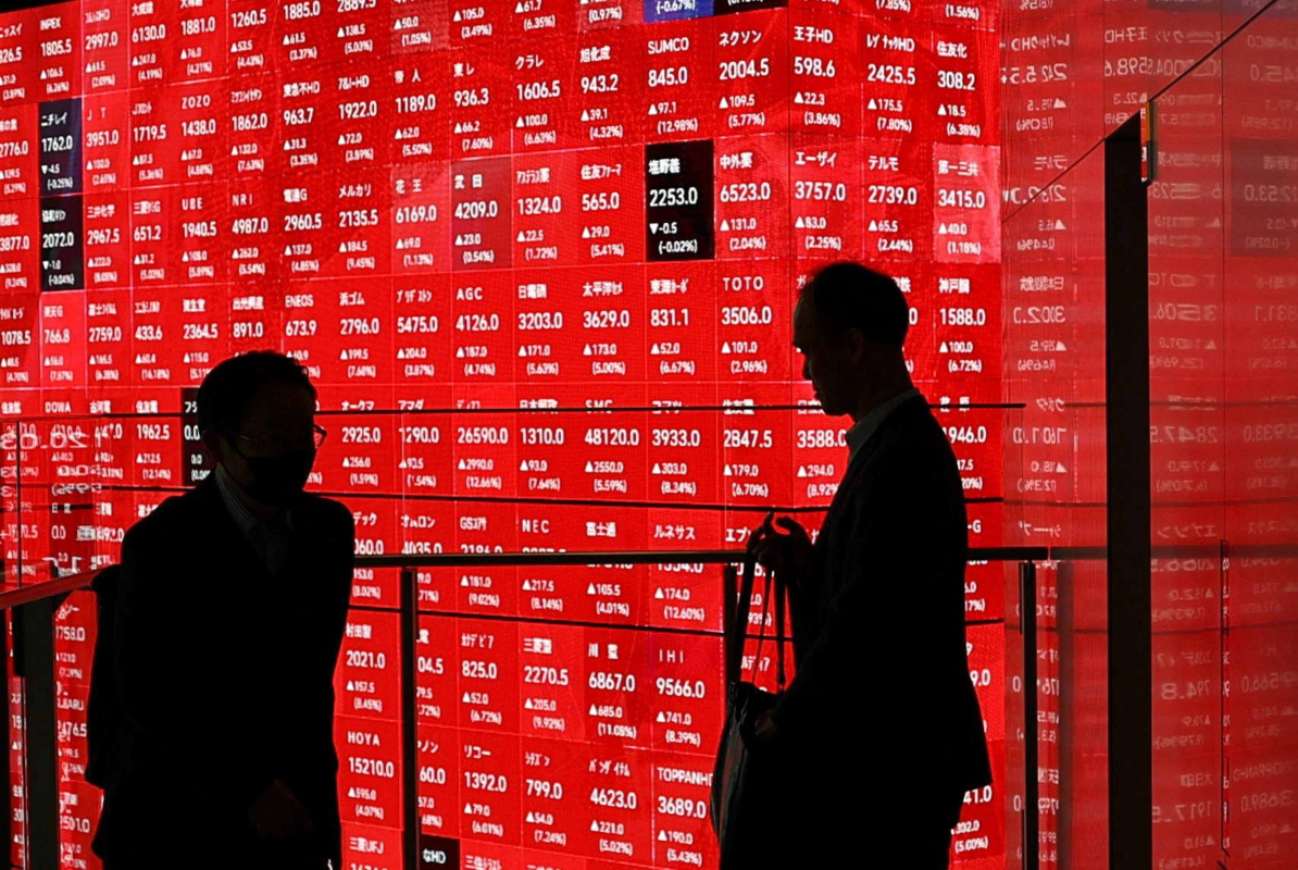
Global financial markets came under intense pressure on Thursday, October 22, 2026, as surging oil prices, escalating geopolitical tensions and growing concerns over European sovereign debt triggered another wave of selling across major stock exchanges.
According to the Financial Times, the downturn spread from Asian equity markets to European trading floors, while US stock futures pointed to a weaker opening on Wall Street.
Brent crude rose approximately 3% to $112 a barrel, reflecting mounting concerns about potential disruptions to global energy supplies amid renewed tensions in the Middle East.
At the same time, eurozone government bonds faced additional selling pressure, with France emerging as a particular focus of investor anxiety.
The combination of falling equities, rising energy costs and widening sovereign bond spreads has created an increasingly challenging environment for international investors.
China: CSI 300 Drops 1.8% as Bear Market Concerns Intensify
China’s benchmark CSI 300 index fell 1.8%, extending a prolonged period of weakness in the country’s equity markets.
The index has lost approximately 20% since June, bringing it into territory commonly described by investors as a bear market.
The decline reflects persistent concerns about the outlook for the world’s second-largest economy.
Investors remain cautious about domestic demand, economic growth, corporate earnings and the impact of geopolitical uncertainty on Chinese businesses.
The CSI 300 tracks major companies listed on the Shanghai and Shenzhen stock exchanges, making it an important indicator of sentiment toward China’s largest publicly traded corporations.
Its continued weakness suggests that investors remain unconvinced about the prospects for a sustained recovery.


Asian Markets Slide: Japan, South Korea and Hong Kong Hit Hard
The sell-off extended across major Asian financial centres.
Japan’s Nikkei 225 fell 2.7%, while South Korea’s Kospi dropped 3.5%.
Hong Kong’s Hang Seng index declined 3%.
The broad retreat reflected a shift away from riskier assets as investors assessed the implications of higher energy prices and tighter financial conditions.
The increase in oil prices is particularly significant for Asian economies that rely heavily on imported energy.
Higher fuel costs can increase manufacturing and transportation expenses, squeeze corporate profit margins and add to inflationary pressures.
At the same time, rising bond yields can make borrowing more expensive for businesses and governments.
These pressures create an increasingly difficult backdrop for export-oriented economies already facing uncertainty over global demand.
Alibaba Shares Fall 4% Amid Renewed Regulatory Concerns
Chinese technology shares also came under pressure.
Shares in Alibaba fell approximately 4% in Hong Kong following fresh scrutiny from Chinese regulators over standards and consumer protection in online commerce.
Regulators highlighted concerns surrounding emerging forms of digital retail, including livestream shopping and transactions conducted through social media platforms.
Issues under scrutiny include misleading advertising, counterfeit products and consumer safeguards.
The developments have added to uncertainty surrounding China’s major technology companies, which are attempting to strengthen growth amid challenging domestic economic conditions.
For international investors, the latest regulatory concerns represent another factor complicating the outlook for Chinese equities.
Wall Street Under Pressure: Nasdaq 100 Futures Fall 1.8%
The downturn also affected expectations for US trading.
Futures linked to the Nasdaq 100 declined 1.8%, while S&P 500 futures fell approximately 1%.
The moves indicated growing caution toward American equities, particularly technology companies with elevated valuations.
Higher bond yields can reduce the present value investors assign to future corporate earnings, creating additional pressure on growth-oriented stocks.
Meanwhile, rising oil prices have raised questions about whether inflation could remain elevated for longer than previously anticipated.
That uncertainty may complicate the outlook for US monetary policy.
Investors are assessing whether the Federal Reserve will have sufficient room to ease financial conditions if energy prices continue climbing.
Futures movements, however, remain preliminary indicators and do not necessarily determine where US markets will close.
Oil Reaches $112: Middle East Tensions Shake Energy Markets
One of the most important drivers of the latest market turmoil is the sharp rise in crude oil prices.
International benchmark Brent crude climbed to approximately $112 a barrel, gaining around 3%.
The increase came amid escalating tensions in the Middle East and concerns about further disruptions to regional energy infrastructure.
Attacks by the Iran-backed Houthis against targets in Saudi Arabia have added to uncertainty surrounding oil production and transportation.
Any significant disruption to regional energy supplies could have consequences extending far beyond the Middle East.
Higher crude prices directly affect transportation, aviation, shipping, manufacturing and consumer fuel costs.
They can also complicate the efforts of central banks to contain inflation.
For oil-importing economies, sustained price increases risk weakening household purchasing power and reducing corporate profitability.
The energy market has therefore become a critical source of uncertainty for global equities.


Eurozone Bond Sell-Off Deepens
While stock markets struggled, European government bonds faced another wave of selling.
Investors increasingly demanded higher yields to hold sovereign debt issued by countries facing significant fiscal pressures.
France and Italy were among the markets attracting particular attention.
Germany, by contrast, continued to benefit from demand for assets traditionally regarded as relatively safe within the eurozone.
The divergence highlights growing differentiation between European government borrowers.
Investors are paying closer attention to fiscal deficits, public debt levels, political stability and the credibility of national budget plans.
The result has been widening borrowing-cost differences between eurozone member states.
France at the Centre of the Storm: Ten-Year Yield Reaches 5.11%
French government bonds were particularly hard hit.
The yield on France’s benchmark ten-year government bond climbed to 5.11%, reflecting increased investor concern about the country’s fiscal outlook.
The spread over equivalent German bonds widened to approximately 170 basis points, or 1.7 percentage points.
Such levels evoke memories of earlier periods of severe sovereign debt stress in Europe.
A widening spread means investors are demanding substantially higher returns to lend to France than to Germany.
The increase reflects concerns about France’s budget deficit, elevated public debt and political difficulties surrounding fiscal consolidation.
Higher government borrowing costs can gradually place additional pressure on public finances as existing debt is refinanced.
The longer elevated yields persist, the more challenging debt management can become.
However, rising spreads do not automatically mean that a sovereign debt crisis is inevitable.
Their future direction will depend on fiscal policy, economic growth and broader market conditions.
Germany Attracts Investors Seeking Safety
Germany continues to occupy a distinctive position within European bond markets.
Its government securities are widely viewed as a benchmark for relatively low-risk eurozone sovereign debt.
During periods of financial uncertainty, investors often increase their exposure to German bonds while reducing holdings of debt issued by countries perceived as carrying greater fiscal risk.
This divergence can widen borrowing-cost differences across the currency union.
The European Central Bank closely monitors such developments because excessive fragmentation in sovereign bond markets can interfere with the transmission of monetary policy.
Nevertheless, differences in bond yields also reflect legitimate variations in fiscal conditions and investor assessments of risk.
The challenge for European policymakers is to preserve financial stability without eliminating market discipline.
The Threat of Stagflation Returns
The combination of expensive energy and rising borrowing costs has revived concerns about stagflation.
Stagflation occurs when economic growth slows while inflation remains elevated.
It presents a particularly difficult challenge for policymakers.
Higher oil prices can increase business costs and reduce household purchasing power.
At the same time, elevated interest rates can discourage investment, weaken consumer demand and increase debt-servicing expenses.
Central banks may consequently face competing priorities.
Maintaining restrictive monetary policy can help contain inflation but may also deepen an economic slowdown.
Easing policy too quickly, however, risks allowing price pressures to become more persistent.
The current market environment illustrates how geopolitical shocks can complicate monetary policy decisions even when underlying economic conditions are already fragile.
What the Global Sell-Off Means for Greece
Although Greece is not at the centre of the international market turmoil, its economy remains exposed to several transmission channels.
Higher oil prices can increase the country’s energy import bill and contribute to rising transportation and production costs.
These increases may eventually affect fuel prices, consumer goods and business operating expenses.
Meanwhile, rising eurozone sovereign bond yields can influence borrowing costs for governments, banks and private companies.
For Greece, the spread between Greek and German government bond yields remains an important indicator of investor confidence.
Maintaining credible public finances and stable access to capital markets becomes particularly important during periods of international volatility.
The Athens Stock Exchange may also experience pressure if foreign institutional investors reduce their exposure to equities across Europe.
Nevertheless, the impact on Greek assets will depend on domestic fundamentals as well as global market conditions.
Global Investors Face a Dangerous Double Shock
The latest turmoil highlights two major risks confronting the global economy.
The first is the possibility that energy prices remain elevated because of prolonged geopolitical instability.
The second is the increasing sensitivity of financial markets to government debt and fiscal sustainability.
Together, these forces can place simultaneous pressure on equities, bonds, businesses and households.
Investors must assess geopolitical developments, central bank decisions and the fiscal outlook of major economies while navigating substantial market volatility.
The sharp fall in Asian equities, Brent crude’s rise toward $112 and widening European sovereign spreads all point to an increasingly uncertain financial environment.
A Critical Moment for the Global Economy
The latest global sell-off is not simply a reaction to one disappointing economic indicator or a single corporate earnings report.
It reflects the interaction of geopolitical risk, inflation concerns, sovereign debt pressures and uncertainty over future monetary policy.
China’s market weakness raises questions about the outlook for global growth.
Higher oil prices threaten to intensify inflationary pressures.
And the sell-off in European government bonds highlights growing concern over fiscal sustainability.
The central question for international investors is whether these pressures will prove temporary or develop into a more prolonged period of financial instability.
With energy markets, sovereign debt and global equities increasingly interconnected, developments in one region can rapidly influence investment decisions around the world.
For governments, central banks and businesses alike, the coming weeks could prove decisive in determining whether markets stabilise or face another period of heightened turbulence.
Source: pagenews.gr