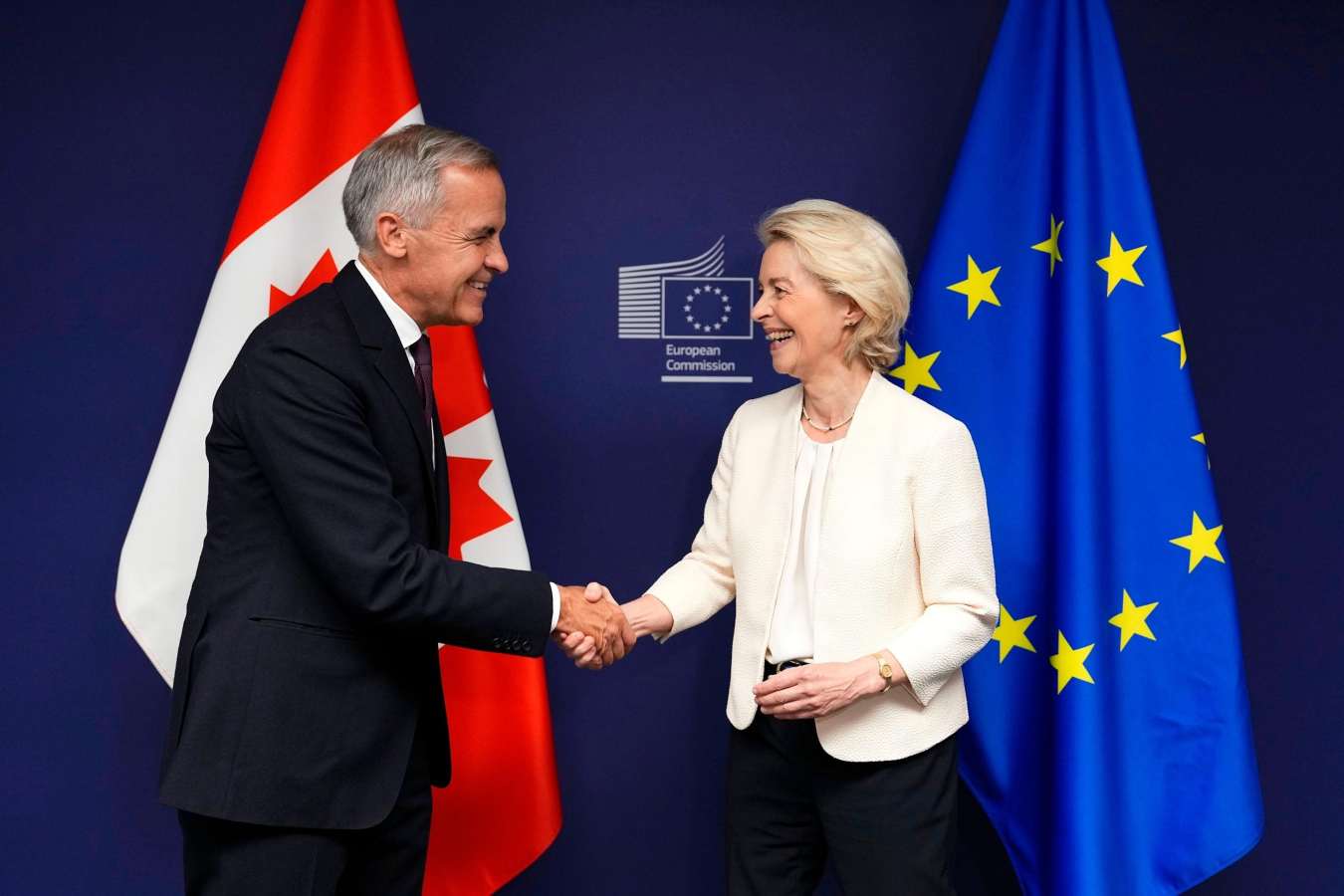
A diplomatic dispute is unfolding inside the European Union, with Germany spearheading efforts to prevent Canada from being described as an “associate member” of the bloc.
The controversy follows an ambitious proposal by European Commission President Ursula von der Leyen to establish a new framework for relations with Canada, potentially bringing Ottawa closer to European institutions than ever before.
According to a report published by POLITICO on October 23, 2026, Berlin is pushing to remove the term “associate membership” from a draft joint declaration being negotiated ahead of the upcoming EU–Canada summit.
France, Italy and Belgium are among the countries expressing reservations, while at least eight EU member states reportedly oppose the proposed terminology.
The disagreement does not necessarily reflect opposition to closer cooperation with Canada. Instead, it highlights growing concerns about whether the European Commission has moved too quickly in proposing a new political status without first establishing its legal meaning, institutional implications or practical benefits.
Berlin Challenges Brussels: Germany Demands Clarity
Germany has emerged as the most prominent opponent of the proposed designation.
According to European diplomats cited by POLITICO, Berlin is pressing for the removal of the term from the summit declaration.
The German position carries considerable political weight.
As Europe’s largest economy and one of the EU’s most influential member states, Germany plays a central role in shaping the bloc’s external economic and strategic relationships.
Berlin strongly supports deeper cooperation with Canada, particularly in trade, investment, defence and international security.
However, German officials are concerned that the proposed designation could create expectations that the European Union has not yet agreed how to fulfil.
The central question is straightforward: What would associate membership actually mean for Canada?
Would Ottawa gain privileged access to European programmes? Would it participate in certain institutional discussions? Could it receive additional rights within the single market?
And, crucially, how would such arrangements differ from the association agreements and strategic partnerships the EU already maintains with other countries?
Without clear answers, Germany and other governments are reluctant to endorse the terminology.


‘Putting the Cart Before the Horse’: Diplomats Criticise the Process
The frustration among European governments is reflected in comments attributed to diplomats involved in the negotiations.
One diplomat told POLITICO that the EU had effectively “put the cart before the horse.”
The criticism centres on the perception that Brussels announced a political concept before determining its substance.
Rather than negotiating the practical elements of a partnership and subsequently defining its status, critics believe the Commission began with an ambitious label and left national governments to work out the details.
Several diplomats reportedly argued that the meaning of associate membership should have been established before discussions with Canada advanced.
Others expressed frustration that national capitals had not been adequately consulted before von der Leyen publicly presented the proposal.
The dispute has therefore become a test of the relationship between the European Commission and the EU’s member states.
At stake is not simply Canada’s future relationship with Europe, but the question of who has the authority to define new categories of international partnership.
Von der Leyen’s Surprise Proposal
The controversy dates back to von der Leyen’s State of the Union address on September 16, 2026.
Speaking in the presence of Canadian Prime Minister Mark Carney, the Commission president proposed exploring a new level of institutional cooperation.
Her vision was to open the door for Canada to become the EU’s first associate member.
The announcement was intended to demonstrate Europe’s willingness to forge closer relationships with like-minded democratic partners amid mounting geopolitical uncertainty.
Canada was presented as a particularly suitable candidate.
The country shares extensive economic, political and security interests with the European Union, while its relationship with the United States has faced additional pressures from Washington’s trade policies.
Yet the announcement also surprised several European governments.
They had not previously agreed on the creation of a new category of association, and the Commission’s initiative raised questions about the institutional consequences.
Five weeks later, those disagreements remain unresolved.
With the Montreal summit approaching, negotiators face increasing pressure to produce a joint declaration acceptable to all sides.


France, Italy and Belgium Join the Opposition
Germany is not acting alone.
France, Italy and Belgium have also expressed reservations about the proposed terminology, according to POLITICO.
Their involvement suggests that the controversy is more than a disagreement over diplomatic wording.
It reflects broader concerns about institutional decision-making within the European Union.
National governments are wary of endorsing a new relationship category that could carry political implications beyond those originally intended.
Some fear that the designation could blur distinctions between full EU membership, formal association agreements and strategic partnerships.
Others are concerned that introducing a new status for Canada could generate expectations among other international partners.
If Canada were granted associate membership, would countries such as the United Kingdom, Norway or other close European partners seek comparable arrangements?
Would the designation eventually become a recognised institutional category?
These questions remain unanswered.
For the governments resisting the proposal, the priority is to establish the substance of cooperation before agreeing on a potentially far-reaching political label.
Bernd Lange: Close Cooperation Without Institutional Confusion
The debate has also reached the European Parliament.
Bernd Lange, the German chair of Parliament’s International Trade Committee, has emphasised the importance of maintaining close relations with Canada.
However, he has expressed reservations about the term associate membership, warning that it risks creating confusion with existing forms of EU partnership.
His intervention illustrates a significant distinction.
European policymakers may agree on the strategic value of closer cooperation with Ottawa while disagreeing on the institutional language used to describe it.
The European Union already has mechanisms allowing non-member countries to participate in selected programmes, research initiatives and economic arrangements.
A new category would need to demonstrate what additional benefits it could deliver.
Otherwise, critics argue, the terminology could generate political controversy without producing meaningful practical advantages.

Brussels Pushes Back: Substance Matters More Than the Label
The European Commission is seeking to contain the disagreement.
According to the POLITICO report, an EU official indicated that discussions with sceptical governments would continue in an effort to reach a mutually acceptable formulation.
The Commission’s position is that member states broadly agree on the objective of strengthening ties with Canada.
The dispute, from this perspective, concerns the name of the proposed relationship rather than its strategic purpose.
Brussels wants to focus on tangible cooperation in areas including trade, defence, energy, technology and international security.
However, the opposing governments believe terminology can have consequences.
A designation such as associate membership could create expectations among businesses, citizens and international partners regarding Canada’s relationship with EU institutions.
For that reason, the debate cannot necessarily be resolved by treating the name as a secondary consideration.
Can Canada Actually Become an EU Member?
One distinction is essential.
Canada is not being offered full membership of the European Union.
Article 49 of the Treaty on European Union provides that a European state meeting the relevant conditions may apply to join the bloc.
Canada is not a European state.
Moreover, associate membership is not currently an established membership category under the EU treaties.
The Union maintains various association agreements with non-member countries, but these do not grant the same rights and obligations as full membership.
Von der Leyen’s proposal therefore concerns the possible development of a new framework for particularly close cooperation.
Such an arrangement might allow Canada to participate more extensively in selected European initiatives without becoming part of the EU’s political institutions.
However, the exact rights, responsibilities and legal structure would need to be negotiated.
This institutional uncertainty lies at the centre of the current dispute.
Mark Carney’s Strategy: Reducing Dependence on Washington
For Canadian Prime Minister Mark Carney, closer relations with Europe form part of a wider effort to diversify Canada’s international economic and strategic partnerships.
The country remains deeply integrated with the United States through trade, investment and cross-border supply chains.
However, Washington’s tariff policies and increasingly unpredictable trade environment have encouraged Ottawa to seek stronger connections elsewhere.
The European Union represents an attractive alternative.
Its large single market, advanced industrial base and substantial investment capacity offer opportunities for Canadian businesses.
Canada also possesses natural resources and technological capabilities that are increasingly important to Europe’s economic security.
Carney has emphasised the value of partnerships that strengthen Canada’s sovereignty rather than weaken it.
From Ottawa’s perspective, the objective is not to surrender political autonomy to Brussels.
It is to create a deeper strategic relationship that offers greater economic resilience and more diversified international opportunities.
This helps explain why the precise meaning of associate membership matters to Canada as well as to European governments.
Defence, Ukraine and Critical Minerals: The Strategic Stakes
Beyond the disagreement over terminology lies an ambitious agenda for cooperation.
The European Union and Canada have overlapping interests in several strategically important sectors.
Defence cooperation is among the most significant.
Both sides are seeking to strengthen their industrial capabilities, improve supply-chain resilience and maintain support for Ukraine.
Canada’s relationship with NATO and its established defence partnerships with European countries provide a foundation for closer cooperation.
Critical minerals are another major priority.
Canada possesses substantial resources of minerals used in batteries, renewable-energy technologies, advanced manufacturing and defence systems.
For Europe, securing reliable supplies has become increasingly important as governments seek to reduce dependence on concentrated international supply chains.
Closer cooperation could facilitate investment in mining, processing and industrial infrastructure.
Energy security, digital technologies and advanced research also feature prominently in the broader relationship.
These areas offer tangible opportunities regardless of whether the final agreement includes the term associate membership.
Horizon Europe, Erasmus and Research Cooperation
Research and education represent another dimension of the partnership.
Canada already participates in Horizon Europe, the EU’s flagship research and innovation programme, through an association arrangement covering its second pillar.
This allows Canadian researchers and institutions to collaborate more extensively with European partners on major scientific and technological projects.
Further cooperation could involve artificial intelligence, clean technologies, advanced manufacturing and health research.
Educational exchanges are also part of the wider discussion.
Closer links with European universities and mobility programmes could create additional opportunities for students, academics and researchers.
However, participation in EU programmes does not confer EU membership.
Nor does it automatically grant access to all aspects of the European single market.
Any expanded arrangements would require specific agreements defining their scope and conditions.
A Six-Priority Roadmap and a One-Year Timeline
According to POLITICO, the draft framework envisages work beginning on six priority areas following the summit.
Progress would be assessed after approximately six months, with a broader review expected around one year later.
This phased approach could offer a compromise between the Commission’s ambitions and the concerns of national governments.
Instead of immediately introducing a new institutional designation, the EU and Canada could first demonstrate progress through practical agreements.
A future decision on the terminology could then be informed by the substance of the relationship.
Such an approach would also allow governments to evaluate whether the proposed framework delivers benefits beyond those already available under existing EU–Canada agreements.
The possibility remains that Canada could eventually receive a unique designation not intended for wider application.
But that outcome has not yet been agreed.
Nuclear Energy Opens Another Front in the Negotiations
The dispute over associate membership is not the only obstacle facing negotiators.
The POLITICO report also identifies disagreements over nuclear-energy cooperation.
Austria is reportedly resisting language that would deepen cooperation in the nuclear sector.
By contrast, France, Romania and Slovakia, among other countries, support including such provisions.
The disagreement reflects longstanding divisions within the European Union over nuclear power.
France considers nuclear energy essential to energy security, industrial competitiveness and decarbonisation.
Austria has traditionally opposed the expansion of nuclear power and remains sceptical of policies that promote it as a strategic energy solution.
Canada’s nuclear expertise and resources make the sector a potentially important area for transatlantic cooperation.
However, differences among EU member states complicate efforts to include ambitious commitments in the summit declaration.
The dispute demonstrates how broader European policy disagreements can affect even partnerships with countries that enjoy strong political relationships with the bloc.
Trump’s Trade Policies Reshape the Transatlantic Landscape
The initiative also needs to be understood against the background of changing relations with the United States.
President Donald Trump’s trade policies have increased pressure on traditional American partners, including Canada and the European Union.
Tariffs and uncertainty surrounding international trade arrangements have encouraged both sides to reassess their economic vulnerabilities.
For Canada, diversification offers a way to reduce exposure to decisions made in Washington.
For Europe, deeper cooperation with Ottawa could support efforts to strengthen strategic autonomy and improve access to essential resources.
Both sides remain closely connected to the United States.
Neither is seeking to abandon the transatlantic relationship.
Nevertheless, the changing geopolitical environment has created incentives to build additional partnerships.
The proposed EU–Canada framework is one expression of that shift.
Its importance extends beyond the institutional debate currently dominating Brussels.
It reflects a broader effort by democratic economies to strengthen their resilience in a more fragmented international system.
Montreal, October 29–30: A Critical Diplomatic Test
The immediate focus is now on the EU–Canada summit scheduled for October 29–30 in Montreal.
European and Canadian officials hope to use the meeting to outline the next stage of their strategic relationship.
However, the wording of the joint declaration remains under negotiation.
EU ambassadors are expected to continue discussions as governments seek agreement on the disputed provisions.
The central question is whether the Commission will insist on retaining the associate-membership designation or accept alternative language.
One possible compromise would emphasise deeper strategic cooperation while postponing any decision on a new institutional status.
That would allow Brussels and Ottawa to preserve momentum without forcing an immediate resolution of the legal and political questions.
Such an outcome would not necessarily represent a defeat for the broader partnership.
It could instead provide the time needed to build a more clearly defined framework.
The Bigger Picture: Europe Wants Canada Closer, but Cannot Agree on the Terms
The controversy illustrates a familiar challenge within the European Union.
Brussels increasingly seeks to act as a major geopolitical power, developing ambitious partnerships and responding rapidly to international developments.
Yet the EU remains a union of sovereign member states whose governments expect to shape important external decisions.
Von der Leyen’s proposal reflects a desire to strengthen Europe’s global influence through innovative strategic relationships.
Germany and other sceptical governments are insisting that such innovation must be supported by clear institutional rules and political agreement.
Canada, meanwhile, wants the economic and security advantages of a closer European partnership without compromising its independence.
The fundamental disagreement is therefore not whether Europe and Canada should move closer together, but how that relationship should be defined, negotiated and governed.
The Montreal summit will reveal whether the European Union can transform an ambitious political announcement into a practical and broadly supported strategic agreement.
For Brussels, the challenge is to balance geopolitical ambition with institutional consensus.
For Ottawa, it is to secure a more diversified international future.
And for the wider transatlantic relationship, the outcome could help determine how Europe and Canada cooperate in an era of growing economic competition and strategic uncertainty.
Source: pagenews.gr