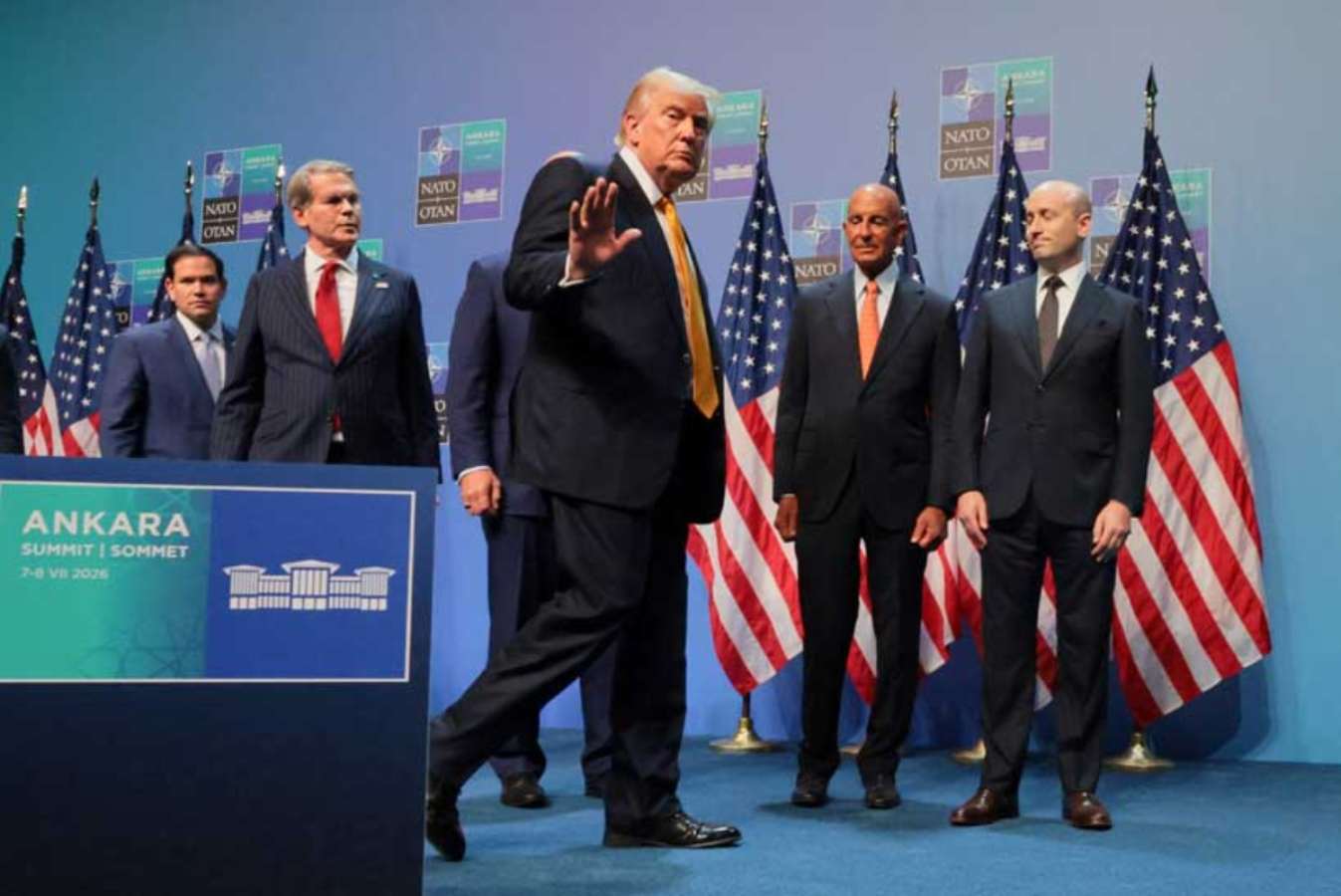
Europe is approaching a critical moment in its relationship with the United States. The November 3, 2026, midterm elections will determine the balance of power in Congress, but an equally consequential decision could follow just three days later.
On November 6, Pentagon officials are expected to present Defense Secretary Pete Hegseth with at least four options for the future deployment of American military forces in Europe.
The review, overseen by Pentagon policy chief Elbridge Colby, forms part of a broader effort to transfer greater responsibility for Europe’s conventional defence to European NATO members.
For governments across the continent, the timing raises a difficult question: Would a politically weakened Donald Trump become more restrained in his dealings with NATO, or could domestic setbacks encourage an even more confrontational foreign policy?
The distinction matters because Congress can impose limits on military withdrawals, but it cannot fully determine how the president communicates America’s security commitments.
November 6: The Pentagon’s Four Options for Europe
The American military posture review has become one of the most closely watched developments in transatlantic security.
Colby has advocated moving NATO “fast and irreversibly” toward a structure in which European allies assume primary responsibility for their conventional defence.
The approach, often described as “NATO 3.0,” reflects a broader shift in Washington’s strategic priorities.
The United States wants European governments to provide more of the personnel, equipment, logistics and military capabilities required to defend the continent.
According to the reporting cited in the underlying analysis, Pentagon officials are preparing at least four possible courses of action for Hegseth.
These could involve changes to troop deployments, military infrastructure and the distribution of responsibilities between American and European forces.
The Pentagon has also asked allies about their willingness to support US military operations, including access to bases and airspace during the conflict involving Iran.
Such questions suggest that Washington is evaluating not only the military capabilities of its allies but also the practical conditions under which American forces can operate from European territory.
No final decision on the four options has been announced.
Nevertheless, the review has raised concerns that a reduction in American forces could affect NATO’s operational readiness, particularly along its eastern flank.


Trump’s Domestic Political Pressures
The November elections take place against a backdrop of economic pressure, foreign-policy controversy and declining public approval of the administration.
A Reuters/Ipsos poll cited in the source analysis placed Trump’s approval rating at 31% on October 19, while Democrats held a lead in the national congressional ballot measure.
The war involving the United States, Israel and Iran has also intensified political tensions, particularly because of its impact on energy prices.
These developments have increased scrutiny of the White House’s foreign-policy decisions.
If the balance of power changes in Congress, the administration could face tougher legislative oversight, budget negotiations and challenges to its military priorities.
However, domestic political constraints do not automatically translate into restraint abroad.
American presidents retain substantial authority over diplomacy, military planning, sanctions policy and the operational deployment of forces.
That creates a fundamental difference between limiting a president’s domestic legislative agenda and constraining the direction of American foreign policy.
Congress Can Protect NATO’s Structure, but Can It Guarantee Deterrence?
The US Congress has already established important safeguards concerning American membership in NATO.
Legislation enacted in 2023 restricts the president’s ability to withdraw the United States from the alliance without congressional or Senate approval.
American defence legislation also contains provisions concerning the reduction of US forces in Europe below a threshold of 76,000 military personnel.
These measures provide institutional protections against abrupt changes.
Yet NATO’s credibility depends on more than formal membership and troop numbers.
The alliance’s collective-defence principle, established under Article 5 of the North Atlantic Treaty, relies on the expectation that member states will respond to an attack against an ally.
For deterrence to function, potential adversaries must believe that NATO’s political leadership is prepared to act.
A president could therefore comply with legal restrictions on troop levels while adopting rhetoric or policies that create uncertainty about the extent of American support.
Military specialists also distinguish between the number of troops deployed and the capabilities those forces provide.
Air defence, intelligence, command systems, logistics, ammunition stocks and rapid reinforcement capacity can be as important as the overall size of a deployment.
For Europe, preserving these capabilities may prove more consequential than maintaining a particular numerical threshold.


Iran and the Growing Transatlantic Divide
The conflict involving Iran has become another source of tension between Washington and European governments.
Several European allies have been reluctant to participate in military operations or provide the level of support requested by the United States.
Trump has criticised NATO partners over their responses to the conflict and questioned the value of an alliance in which Washington believes it carries a disproportionate burden.
The dispute has reinforced a long-standing American demand for greater European defence spending.
But it has also introduced a more politically sensitive question: Should military cooperation within NATO depend on whether allies support individual American foreign-policy decisions?
The Pentagon’s questionnaire concerning access to bases and airspace has added to these concerns.
European governments must balance their commitments to collective defence with their own constitutional procedures, national interests and assessments of military operations outside NATO’s traditional geographic area.
Differences over Iran illustrate how disagreements beyond Europe can influence the wider transatlantic security relationship.
Is Washington Developing Different Categories of NATO Allies?
Another issue attracting attention is the possibility of increasingly selective American engagement with European partners.
The source analysis identifies Germany, Poland, the Netherlands, Norway, Sweden and Finland as countries involved in a particular group of defence consultations.
It also highlights the absence of Britain, France and the Baltic states from those discussions.
Such arrangements do not formally create different categories of NATO membership.
All member states retain their rights and obligations under the North Atlantic Treaty.
However, selective consultations can influence perceptions of political access, strategic importance and military cooperation.
For European governments, the concern is that bilateral relationships with Washington could become increasingly important in determining where American forces and capabilities are deployed.
That would present NATO with a delicate challenge.
The alliance’s military effectiveness depends on integrated planning, common operational standards and confidence that security commitments apply across its membership.
A system in which individual allies compete for American military attention could complicate efforts to maintain a unified deterrence posture.
Russia, Ukraine and the Energy Factor
The future of US policy toward Russia is another major uncertainty.
The source analysis links Trump’s domestic economic pressures to decisions concerning Russian energy supplies and sanctions.
It cites an October arrangement involving Russian diesel and sanctions exemptions as an example of how energy prices can influence Washington’s relationship with Moscow.
The broader strategic question is whether American domestic economic priorities could diverge from Europe’s approach to Russia.
European governments have invested substantial political and financial resources in supporting Ukraine and maintaining sanctions designed to constrain Moscow’s war-making capacity.
Changes in American policy could affect sanctions coordination, energy markets and the diplomatic environment surrounding the war.
For NATO’s eastern members, these questions are directly connected to the credibility of Western deterrence.
For the European Union, they also concern the ability to sustain a common foreign-policy position when the United States pursues different short-term priorities.
NATO 3.0: A Fundamental Change in the Alliance
The concept of NATO 3.0 goes beyond the immediate political confrontation between Trump and European leaders.
It represents a proposed restructuring of responsibilities within the alliance.
Under this approach, European NATO members would provide a greater share of the conventional military capabilities needed to defend the continent.
The United States would continue to play a significant strategic role, particularly through its nuclear deterrent and advanced military capabilities, while shifting more resources toward other global priorities.
European countries have already increased defence spending and announced investments in ammunition production, air defence, military mobility and industrial capacity.
Nevertheless, major capability gaps remain.
Europe continues to depend heavily on the United States for strategic intelligence, advanced command-and-control systems, certain missile-defence capabilities and the logistics required for large-scale military operations.
Replacing or supplementing these capabilities requires more than higher defence budgets.
It also demands industrial coordination, procurement reform, training and long-term political commitment.
The challenge is therefore not simply to spend more, but to develop military capabilities that can operate together effectively.
Poland, Germany and NATO’s Eastern Flank
The potential redistribution of American forces has particular implications for Poland, Germany and the Baltic region.
Germany remains a central hub for American military infrastructure, logistics and operational support in Europe.
Poland has become increasingly important to NATO’s eastern defence posture, particularly through its military investments and role in supporting Ukraine.
The Baltic states, meanwhile, regard credible allied reinforcement as essential to their security.
A reduction in American personnel would not necessarily produce the same effects in every country.
The consequences would depend on which units were withdrawn, which capabilities remained and whether European allies could replace them.
For example, the withdrawal of specialised air-defence or logistics assets could have consequences extending beyond the country where those assets are based.
This makes the Pentagon’s review a matter of concern for NATO as a whole rather than merely a bilateral issue between Washington and individual European capitals.
The 2027 US Defence Bill: Europe’s Legislative Opportunity
The American defence authorisation process offers European governments another avenue for influencing the debate.
The proposed 2027 National Defense Authorization Act includes provisions concerning the future American military presence in Europe.
According to the source analysis, the House version would extend restrictions related to troop reductions and require further examination of previous Pentagon decisions.
Such provisions could strengthen congressional oversight and increase the political costs of major changes to American deployments.
However, the final legislation remains subject to negotiation.
Congressional safeguards can impose procedures, reporting requirements and restrictions, but they cannot resolve every disagreement between the White House and European governments.
The legislative process is therefore important because it may provide additional time for Europe to strengthen its own defence capabilities.
It should not be interpreted as a substitute for long-term military planning.
Three Scenarios for the Winter of 2026–2027
The underlying geopolitical analysis identifies three possible directions for the coming months.
Scenario One: Continued Pressure on Europe
Under this scenario, Washington maintains its formal commitment to NATO while accelerating demands for greater European responsibility.
American troop adjustments remain within existing legal constraints, but political pressure on European governments increases.
The United States continues to prioritise a redistribution of conventional defence responsibilities.
For European allies, the main challenge would be maintaining deterrence while adapting to a reduced American operational role.
Scenario Two: A Confrontation Over Military Withdrawals
A deterioration of the conflict in the Middle East could increase demands on American military resources.
Washington might seek to redeploy specialised units, air-defence systems or logistical capabilities from Europe to other theatres.
Such decisions could trigger disagreements with Congress over consultation requirements and statutory restrictions.
The resulting uncertainty could affect NATO planning even if overall American troop numbers remained relatively stable.
Scenario Three: Stronger Congressional Safeguards
Congress could preserve or strengthen restrictions on major changes to America’s European military posture.
This would provide greater procedural stability and potentially allow European governments more time to expand their defence capabilities.
However, the long-term American objective of transferring more conventional defence responsibilities to Europe could continue regardless of immediate legislative developments.
These are analytical scenarios, not confirmed decisions or established forecasts.
Europe’s Strategic Dilemma: Washington or Greater Defence Autonomy?
The central challenge for Europe is to pursue two objectives simultaneously.
First, European governments want to preserve a credible transatlantic alliance, including American military capabilities and political commitments.
Second, they must develop greater capacity to defend the continent without relying on the assumption that Washington’s priorities will remain unchanged.
These objectives are not necessarily contradictory.
A stronger European conventional defence capability could support NATO’s overall deterrence posture while reducing the burden on the United States.
However, achieving that outcome will require difficult decisions concerning defence budgets, procurement, military integration and industrial policy.
It will also require coordination among European countries whose threat perceptions and strategic priorities are not identical.
December Could Reveal NATO’s Next Direction
The final text of the American defence bill and the Pentagon’s decisions on military posture will provide important indications of Washington’s future approach.
European governments will be watching whether restrictions on troop reductions remain in place, whether operational capabilities are preserved and how the administration communicates its commitments to NATO.
The November 3 elections may change the balance of political power in Washington.
But the implications for European security will depend on decisions made after the votes are counted.
For Europe, the fundamental question is not simply whether Donald Trump emerges politically stronger or weaker from the midterms. It is whether NATO can maintain credible collective defence while the United States and its European allies redefine their respective military responsibilities.
The coming months will test both the resilience of the transatlantic alliance and Europe’s ability to translate its ambitions for greater defence responsibility into operational capabilities.
Source: pagenews.gr