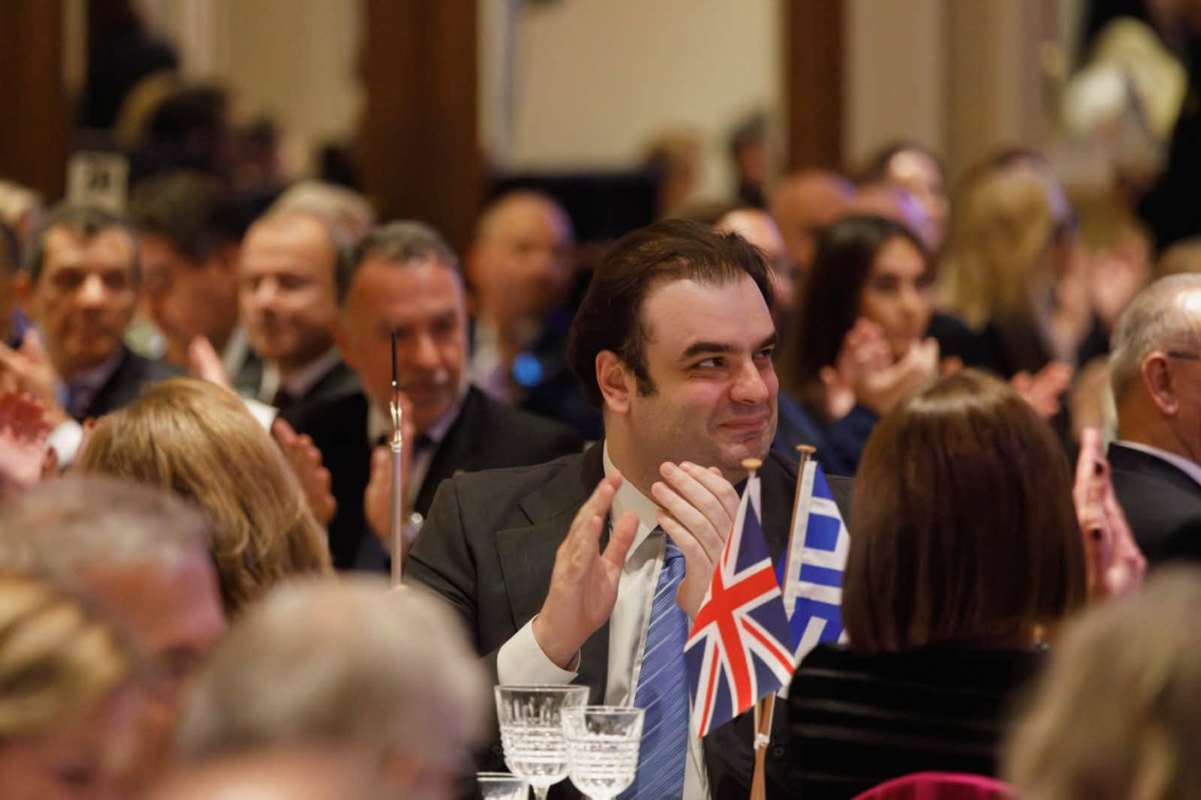
Greece must move beyond recovering the losses of the financial crisis and build a different productive model, Kyriakos Pierrakakis told the British business community, inviting investors to participate in the country’s next phase of development.
Speaking at the British Hellenic Chamber of Commerce’s “Back-to-Business Dinner 2026,” the Minister of National Economy and Finance and President of the Eurogroup connected Greek investment opportunities with a broader European challenge: substantial savings exist, but they are not being converted into business financing, innovation and growth at the scale required.
Two figures stood out, each describing something different: British investment flows into Greece, which he said reached €5.3 billion in 2025, and European savings exceeding €10 trillion, whose more productive deployment is a central objective of the Savings and Investments Union.
“We must build a different productive model”
Pierrakakis presented Greece’s recovery as the foundation for its next phase, arguing that a return to growth does not complete the economic transformation.
“In the next phase of our economic policy, it is not enough simply to restore what was lost during the crisis, even in a different form. We must build a different productive model. In this effort, Britain can be an exceptionally important partner.”
His proposition rests on the economies’ complementary strengths: British financial services, universities and technological research alongside Greek shipping, energy, services and geographical advantages.
“Our geography is an advantage that we must turn into productive strength,” he said.
The economic objective is for cooperation to generate higher productivity and export capacity, alongside increased investment inflows.
British investment flows reached €5.3 billion
The minister said the United Kingdom was Greece’s largest investor in 2025 when measured by investment flows.
“In 2025, the United Kingdom was the largest investor in Greece in terms of investment flows, with €5.3 billion. British businesses operate, among other sectors, in financial services, telecommunications, energy, tourism, healthcare and real estate.”
Looking in the opposite direction, he cited METLEN, Energean, PeopleCert, Viohalco Group and KRI-KRI as examples of Greek companies with a stronger presence in the British market.
He also linked the Athens stock exchange’s integration into Euronext with opportunities for Greek businesses to gain broader access to investment capital.
The relationship he outlined therefore encompasses both attracting British investment and financing Greek companies’ international expansion.
Unlocking Europe’s savings
Speaking as Eurogroup president, Pierrakakis emphasised the need for a European business idea to secure financing, achieve scale and compete internationally.
“Our self-criticism in Europe today is that this is not happening at the scale it should, and that is why we are discussing the Savings and Investments Union.”
The aim, he explained, is to channel European savings exceeding €10 trillion more effectively into productive investment.
That figure is neither a new funding package nor capital earmarked for Greece. It describes the broader pool of savings he referenced, illustrating the gap between available money and financing for growth.
On European capital-market integration, he said:
“The progress of the past ten months is greater than the progress of the past ten years.”


Governments and technology giants compete for capital
A notable part of his speech addressed pressure on borrowing costs.
Pierrakakis linked geopolitical instability, defence and investment needs, population ageing and artificial intelligence to growing competition for financing.
“While states seek capital for their bonds, we are competing for that same capital with the major technology companies, seeking borrowing from the same markets. And all of this puts upward pressure on interest rates.”
The observation highlights a financial dimension of the technological revolution: major AI investments require capital and influence the environment in which governments and businesses borrow.
“Artificial intelligence is not only a technological force; in a sense, it is also a macroeconomic force, and we must fully grasp this in all the economic planning we undertake.”
From sending students abroad to attracting universities
On education, the minister described the potential reversal of a longstanding flow.
“Where Greece for decades ‘exported’ thousands of students to the United Kingdom every year, it now attracts major university institutions from there that are interested in establishing a presence in our country.”
He connected that interest with English-language programmes at Greek public universities and Greece’s potential to become a regional education hub.
“In this case, too, this is not simply another investment. It concerns the most important element of economic development: human capital.”
Turning to technology, he referenced the “Daedalus” supercomputer and AI Factory PHAROS, saying access for researchers, universities, start-ups and small and medium-sized enterprises would largely be free.
Tourism, energy and shipping
Tourism remains a major pillar of bilateral economic relations. According to the figures Pierrakakis cited, receipts from the United Kingdom rose by 18.41% in 2025 to €3.7 billion, with approximately 4.9 million arrivals.
“The next phase of Greek tourism is not only about increasing arrivals. In economic terms, it is about attracting investment in infrastructure and modern hospitality services.”
In energy, he highlighted opportunities involving renewables, electricity interconnections, storage and natural gas infrastructure.
In shipping, he emphasised the relationship between Greek shipowners and London’s financial, insurance and other maritime services.
“The best investment incentive is a state that works”
Pierrakakis argued that attracting capital depends on institutional credibility and predictable rules.
“Attracting investment is not simply a matter of tax incentives. It is primarily a matter of trust. Trust in the economy and in institutions. Investors seek a public administration that operates effectively. A tax system that is transparent.”
He added:
“The best investment incentive is ultimately a state that works well and effectively.”
His invitation to British investors was to participate in Greece’s next economic chapter:
“Greece is not simply asking to be trusted for what it has achieved. It invites its partners to invest in the considerable potential it has demonstrated for the future.”
Source: pagenews.gr