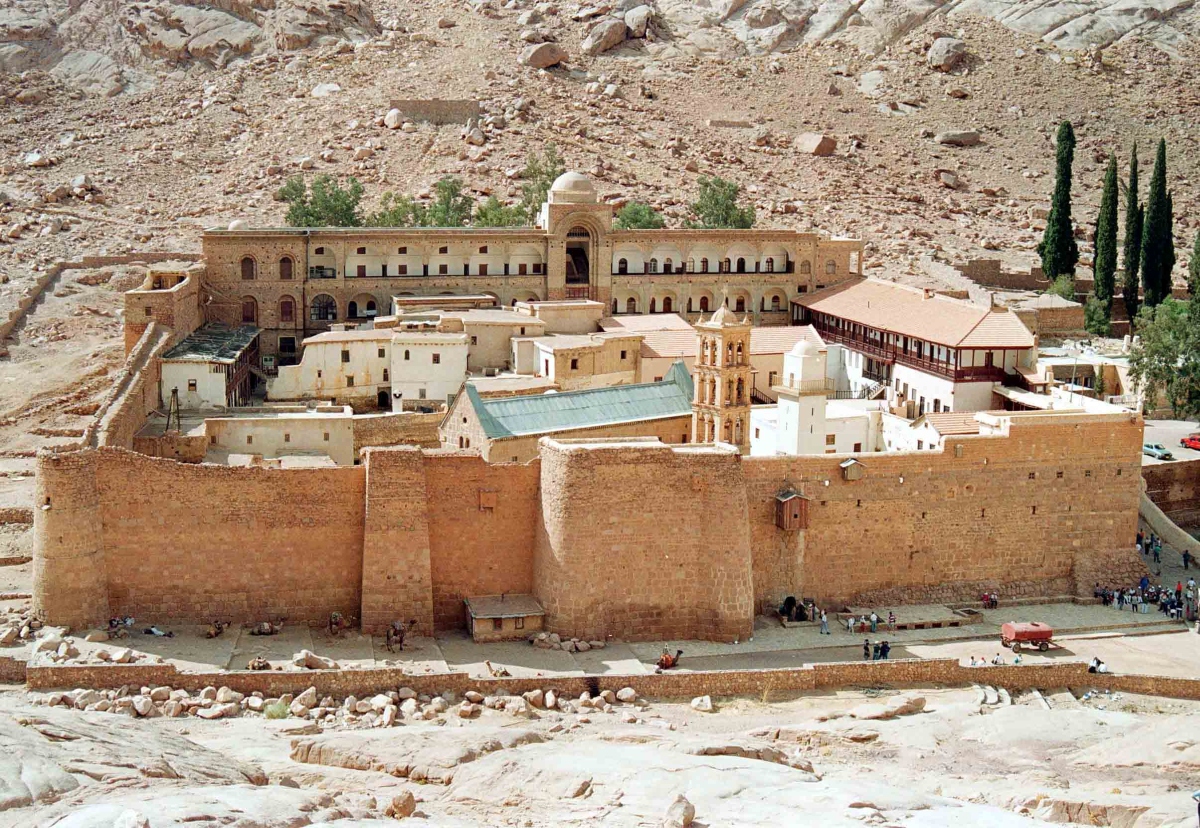
A significant development concerning the future of St Catherine’s Monastery in Sinai has been announced by Archbishop Symeon of Sinai, Pharan and Raitho, who says he intends to sign an agreement with the Egyptian state following prolonged negotiations.
The announcement’s strongest institutional element is the unanimous support of the Ecumenical Patriarchate, the Patriarchates of Jerusalem and Alexandria, and the Churches of Cyprus and Greece. Symeon also explicitly acknowledges assistance from the Greek state and the understanding shown by Egypt’s government and President Abdel Fattah el-Sisi.
The agreement has not yet been signed. A date will be arranged with the monastic brotherhood and the Egyptian government once the Archbishop’s health permits.
The diplomacy behind the announcement
The dispute concerns the position of a monastery with a fifteen-century history, its ecclesiastical autonomy, its operation within Egypt’s legal framework and questions relating to its properties.
The announcement describes an effort to reach an understanding between the monastery and the Egyptian state, supported by Greek assistance and broad ecclesiastical consultation.
The Archbishop states:
“In this endeavour, we had the Greek state as a supporter and helper, alongside many other circles of friends of the monastery around the world.”
The reference carries particular significance for Greek–Egyptian relations. Symeon presents the monastery as an institution through which the longstanding relationship between the two countries is reaffirmed, adopting language of trust toward Cairo.
The crucial reference to the court
Particular attention centres on Symeon’s assessment that, following the announcement of the agreement:
“The reason for issuing the decision of the Supreme Court of Cassation of the Arab Republic of Egypt no longer exists.”
This expresses the monastery’s understanding of the significance of the forthcoming agreement. It does not itself constitute a court announcement concerning the pending proceedings.
The Archbishop also anticipates that outstanding matters may be clarified during implementation of the agreement and its accompanying documents. The announcement therefore signals progress toward a settlement, with signature and implementation remaining the next critical steps.


Orthodox unity as institutional support
Symeon outlines the consultation process: the monastery approached the Patriarchate of Jerusalem, whose Patriarch Theophilos, with the monastery’s agreement, sought the views of the other Churches named in the statement.
According to the Archbishop, this produced Patriarchal and Synodal letters supporting signature, with the expectation that the agreement would safeguard the monastery’s historic and lawful rights.
That collective support forms the announcement’s central institutional message. Symeon also confirms that monastic life and the reception of pilgrims continue.
Archbishop Symeon’s full statement
English translation of the statement supplied.
STATEMENT BY HIS EMINENCE SYMEON, ARCHBISHOP OF SINAI, PHARAN AND RAITHO
Athens, 24 October 2026
Reference No.: 23 (Athens Metochion)
The Greek Orthodox Holy Monastery of the God-Trodden Mount Sinai—St Catherine’s—received, a year ago, following the election of my humble person as the new Archbishop of Sinai, a draft agreement from the respected Egyptian government between the state of the Arab Republic of Egypt and the Holy Monastery. This followed the decision of the Ismailia Court of Appeal of 28 May 2025, issued before my election, which established certain circumstances within the Egyptian legal order. The proposed agreement sought to clarify further aspects of that judicial decision and the manner of its implementation, consistently with arrangements prevailing for centuries, so as to safeguard the monastery’s uninterrupted monastic life and clarify its position and operation within Egypt’s contemporary legal order.
The Monastery of Sinai entered into dialogue bound by Egyptian legislation and the decisions of Egyptian courts, with a sense of responsibility toward its centuries-old spiritual heritage, as well as toward the authorities of Egypt, the land of the Nile, within which it has flourished for fifteen centuries.
At the same time, it requested sufficient time to study the proposal thoroughly, submit counterproposals improving aspects of its practical implementation—to which end it was supplemented with additional explanatory accompanying documents—and compile, on a scholarly basis, the dossier concerning its status quo and the documentation of the properties under discussion. That dossier was subsequently developed into a scholarly study.
We wish to emphasise, with particular satisfaction, that the monastery encountered understanding in this regard from the respected Egyptian government and His Excellency President Abdel Fattah el-Sisi. As a result, the dialogue has already extended beyond one year, something to which my recent health difficulties also contributed.
In this endeavour, we had the Greek state as a supporter and helper, alongside many other circles of friends of the monastery around the world. It is well known that the Monastery of Sinai has historically enjoyed a special status of ecclesiastical autonomy. At the same time, however, it constitutes an Ark of universal Orthodoxy, and matters concerning it can potentially become major issues for Christians throughout the world, particularly Orthodox believers. It is therefore no coincidence that, during the intervening period, the Sinai Brotherhood received various contradictory recommendations and information from competent and non-competent persons, from experts and from those who, despite their good intentions, lacked knowledge.
Nevertheless, without disregarding or underestimating any substantiated opinion, the Brotherhood judged that it stood to benefit above all from the centuries-long, uninterrupted experience of the Autocephalous Orthodox Churches, particularly the Patriarchates of our Orthodox East.
In this context, we approached the Patriarchate of Jerusalem, to which we are connected under ecclesiastical and canonical law, so that, following a detailed briefing on the draft agreement and related matters, we might receive the responsible opinion of the Church of Zion. His Beatitude Patriarch Theophilos of Jerusalem, discerning that the matter required broader consideration, and in accordance with our own wishes, further approached His All-Holiness Ecumenical Patriarch Bartholomew, His Beatitude Patriarch Theodore of Alexandria, and the Autocephalous Churches of Cyprus and Greece.
Today, with profound emotion, we can state that all the aforementioned Churches, having been fully informed, welcome the signing of the agreement through Patriarchal and Synodal letters, which have been entered into the monastery’s archives. They express their wholehearted fraternal support for its signing, with the prayer and expectation that it will contribute to the secure resolution of outstanding matters and the safeguarding of the monastery’s historic and lawful rights.
This development gives the Sinai Brotherhood, and me personally, the support to proceed with signing the agreement in the near future, once my health permits. A specific signing date will then be arranged with the Fathers and the Egyptian government.
Above all, however, this development expresses the unity of the Orthodox Churches of the East. The God-Trodden Mount Sinai rejoices that the honoured Patriarchal and Synodal letters it has received have provided an occasion to reaffirm this unity once again, and that the Monastery of Sinai, situated “in a land of wilderness, impassable and without water,” enjoys their love and practical support in complete unanimity.
Within this climate of increasingly established trust between the Arab Republic of Egypt and the Monastery of Sinai, we are confident that, following today’s announcement concerning the agreement, the reason for issuing the decision of the Supreme Court of Cassation of the Arab Republic of Egypt no longer exists.
We are confident that, during implementation of the agreement, the climate of established trust between the Arab Republic of Egypt and the Monastery of Sinai will allow us to finalise specific outstanding matters that may arise concerning the agreement and its accompanying documents.
Warmly thanking the revered Primates and their Holy Synods, we offer praise to Almighty God. We humbly believe that the intercession of our patron, the holy Great Martyr Catherine, has brought the entirety of Orthodoxy in our East into remarkable unity alongside the Monastery of Sinai. Through this institution, the longstanding, deep and fraternal relationship between two states and great civilisations—Egypt and Greece—is reaffirmed.
Finally, addressing everyone, we offer the assurance that, by the grace of God, the God-Trodden Mount Sinai remains “in its place,” with the Fathers serving it, continuing their endeavours and welcoming every pilgrim, visitor and traveller.
Source: pagenews.gr