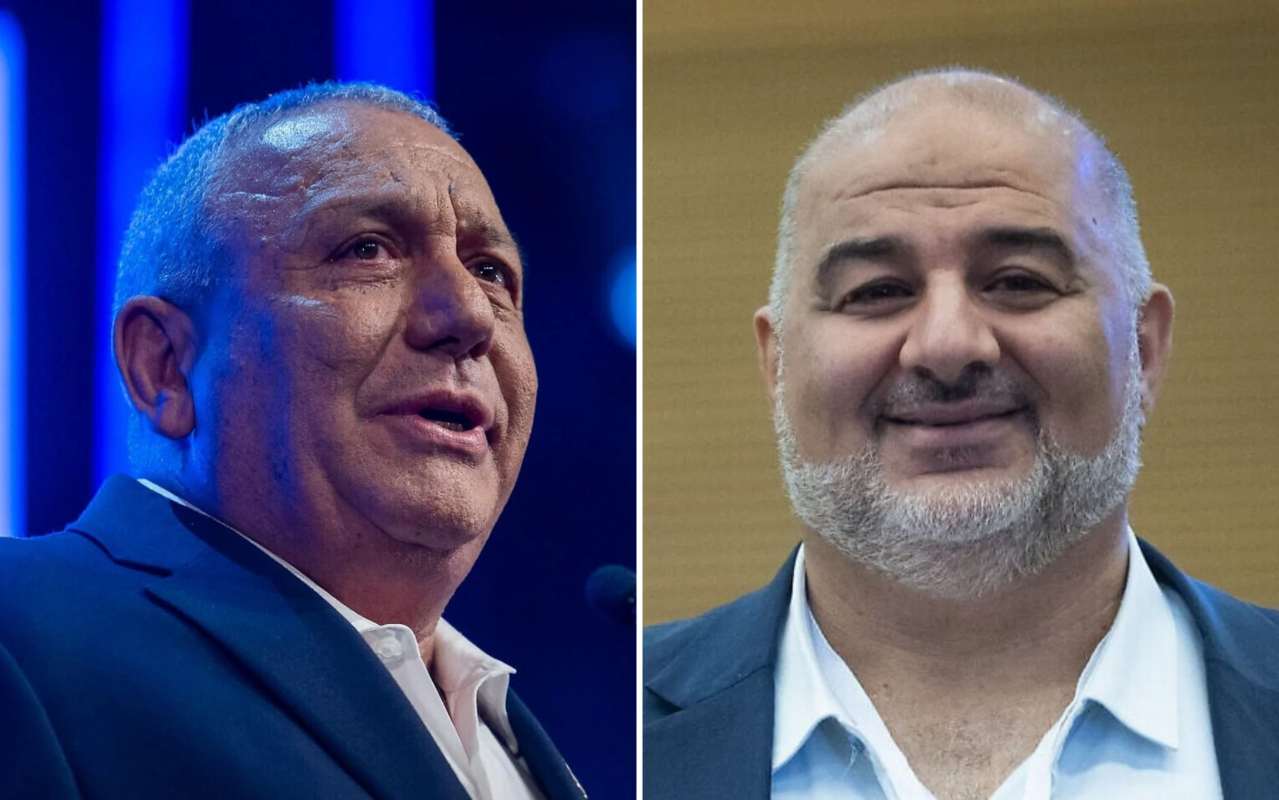
Benjamin Netanyahu leads the contest between Israel’s political blocs, but he has not secured another government. Gadi Eisenkot wants to replace him, but has yet to assemble the parliamentary support needed to do so.
Between them stand the Arab-led parties: strengthened electorally, open to discussions and determined to turn their seats into political influence.
Israel’s central question is now who can gather enough parliamentary support to govern — and which campaign commitments they would have to reconsider to achieve it.
The Joint List and Mansour Abbas’s Ra’am could shape that calculation. Their gains, however, do not mean a government without Netanyahu is ready to take office.
The numbers are shifting — and so are the possible outcomes
In a counting snapshot published by The Times of Israel at 11:04 a.m. on Wednesday, October 28, using figures available at 10:58 a.m. and covering 76.8% of ballot boxes, the provisional allocation showed:
- 54 seats for Netanyahu’s bloc.
- 47 seats for Eisenkot’s bloc.
- 19 seats combined for the Arab-led parties.
These are provisional seat projections based on a partial count, not final results. Election-night exit polls produced different balances, and outstanding ballots could still alter the distribution.
The figures expose both contenders’ difficulties. Netanyahu is seven seats short of an absolute majority in the 120-member Knesset. Eisenkot is further away, but has potential negotiating partners outside his bloc.
Adding 47 opposition seats to 19 Arab-party seats produces 66. That demonstrates the mathematical possibility of an alternative majority. It does not establish a political agreement.
Parties opposed to Netanyahu do not necessarily agree with one another, or on the terms of a shared governing arrangement.


Ra’am opens the door without promising a solution
Mansour Abbas has signalled a willingness to negotiate while avoiding claims that an agreement already exists.
“I believe that in the end the numbers will work out. We will discuss it,” he told Channel 12.
His account of contacts beyond the opposition was equally significant:
“Everyone is talking to us, not just the change bloc. A few days ago, a very, very senior figure from the right contacted me.”
That statement broadens the potential field of negotiations. It does not establish that Netanyahu personally approached Abbas or that Likud authorised formal talks.
For Abbas, the strategy is to remain a potential partner with influence over the outcome. Ra’am also brings the precedent of participating in the Bennett–Lapid coalition in 2021–2022.
That experience makes it a more tested participant in coalition negotiations. It does not mean Ra’am’s seats alone would deliver a stable majority for Eisenkot. If the opposition bloc remains below 50 seats, it would need a broader agreement, additional support or a parliamentary arrangement involving other parties.
The Joint List seeks influence without joining the cabinet
Ahmad Tibi has outlined a different route: an Eisenkot-led minority government supported by Arab-led parties.
“Eisenkot has the opportunity to form a minority government with the support of the Arab parties, despite the difficulties,” he told Nas Radio.
He added:
“We want to use today’s results to bring about real political change.”
External support differs substantially from joining a governing coalition. A party can help a government win confidence or support particular parliamentary votes without accepting ministerial positions and collective responsibility for its overall policies.
That distinction could create room for agreement. It could also produce an administration dependent on repeated negotiations over budgets, legislation and major decisions.
Removing Netanyahu may provide a shared objective. Governing together requires considerably more.
Eisenkot’s obstacles also lie within his own camp
Eisenkot must manage both his stated conditions for cooperation and the objections of potential coalition partners.
Central issues include recognition of Israel as a Jewish state, positions on Hamas, and disagreements over security and the Palestinian question. Those conditions create particular difficulties for an understanding with the Joint List.
An agreement between Eisenkot and Arab-led parties would not automatically bind every member of his opposition camp. Reservations among its right-wing partners represent a separate obstacle.
The former military chief therefore needs two agreements simultaneously: one with parties that might support him from outside government, and another within his own political camp.
Netanyahu leads, but his options are constrained
Likud has publicly ruled out cooperation with an Arab party.
“There is no chance,” party spokesperson Guy Levy said.
That position also reflects the composition of Netanyahu’s right-wing and religious bloc, which includes Itamar Ben Gvir’s party. An approach to Arab-led parties could provoke resistance among the prime minister’s existing allies.
Netanyahu may therefore lead the provisional seat allocation while still needing additional partners or parliamentary defections if his bloc falls short of 61.
Finishing ahead offers a political argument and negotiating weight. It does not supply the missing votes.


What stronger Arab representation would mean
Moving from ten seats in the outgoing parliament to the 17–19 appearing in successive projections would represent a substantial change. At the particular morning snapshot showing 19 seats, the increase over ten would be 90%.
That calculation concerns parliamentary representation, not an equivalent increase in votes or turnout.
Politically, the gains give greater weight to issues raised by Arab-led parties during the campaign: crime in their communities, policing, public services and living conditions.
If those priorities become concrete commitments in a governing agreement, additional seats could translate into practical influence. If negotiations focus exclusively on who becomes prime minister, underlying disagreements could quickly re-emerge.
The next contest is over credible commitments
After the results are finalised, President Isaac Herzog will consult parliamentary parties and assign the task of forming a government. The initial mandate lasts 28 days, with a possible extension of up to 14 days.
The decisive question will be which candidate can demonstrate credible parliamentary support.
For Eisenkot, the challenge is to turn a desire for political change into an agreement capable of surviving his prospective partners’ differences. For Netanyahu, it is to close the majority gap without breaking apart his existing bloc.
For Abbas and the Joint List, the task is to demonstrate that stronger representation can change government decisions.
As Tibi put it: “We want to use today’s results to bring about real political change.”
Source: pagenews.gr