“This undertaking clearly has significant geopolitical value for Greece. In my view, it is a national project for many reasons, but it obviously has many enemies.”
With that warning, Alexandros Exarchou, Chairman and Chief Executive Officer of AKTOR Group and CEO of ATLANTIC SEE LNG TRADE, placed Greece’s emerging role in European energy security at the centre of an increasingly consequential geopolitical debate.
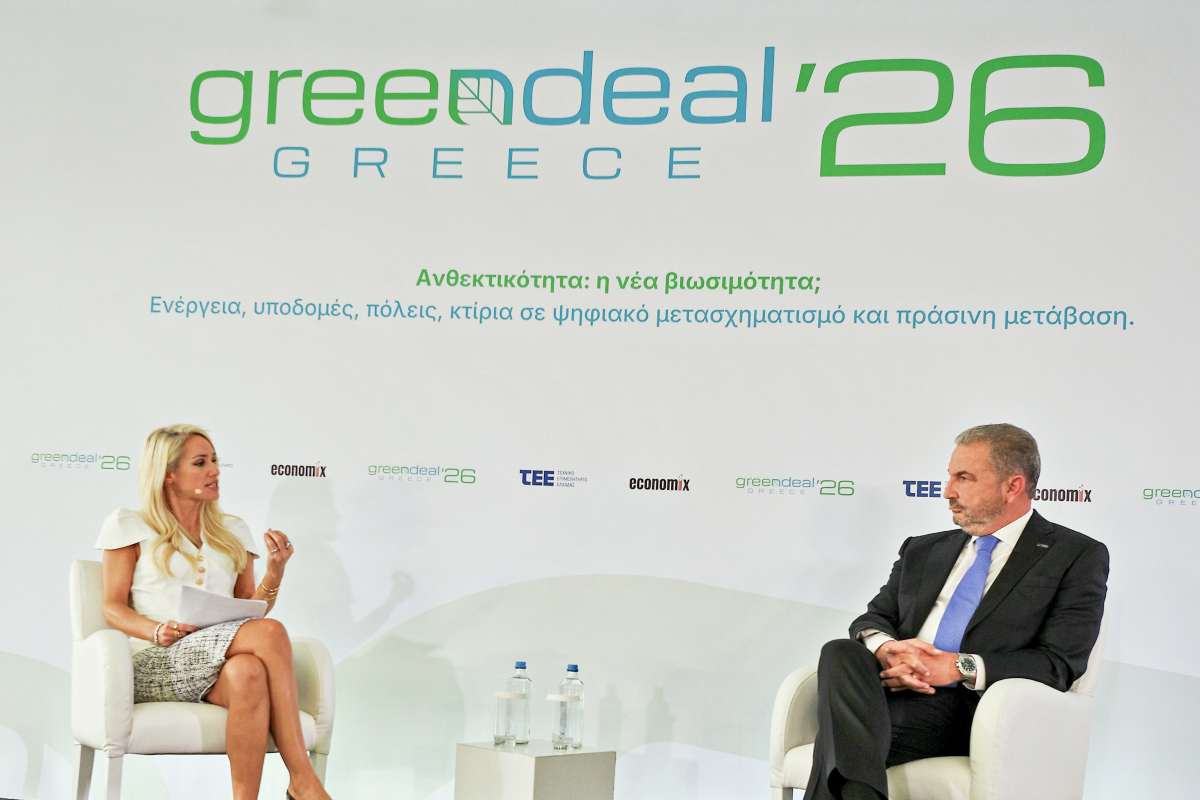
Speaking on November 2, 2026, during a discussion with journalist Katerina Panagopoulou at the Green Deal Greece 2026 conference in Athens, Exarchou described the commercial and strategic competition surrounding the Vertical Gas Corridor, an initiative designed to transport natural gas northward from Greece into Eastern Europe.
His message went beyond the economics of LNG trading.
At stake, he argued, is Greece’s ability to establish itself as a major energy gateway for Southeastern and Eastern Europe, strengthening its geopolitical position while contributing to the diversification of European gas supplies.
But this ambition, according to Exarchou, faces opposition from competing commercial interests, including those favouring alternative supply routes through Turkey.
A National Energy Project Facing International Competition
Exarchou warned that the Vertical Gas Corridor should not be viewed simply as another infrastructure initiative.
Its importance, he argued, lies in the commercial relationships and long-term energy flows it can support.
The corridor offers Greece an opportunity to become a key entry point for American LNG destined for markets further north, potentially strengthening the country’s role in the European energy architecture.
However, Exarchou maintained that competing interests could seek to divert those flows through alternative routes.
“What matters is the battle that has taken place and is still continuing. And yes, there is a risk. There is no doubt about that,” he said.
According to the AKTOR chief, some competitors of Venture Global, the American LNG supplier working with ATLANTIC SEE LNG TRADE, would prefer a supply route through Turkey rather than Greece.
He argued that such a route could offer different commercial opportunities, particularly through the potential blending of American LNG with Russian natural gas to achieve lower prices.
Exarchou also claimed that certain Greek commercial interests oppose the Vertical Corridor initiative.
These allegations were presented as his assessment of the competitive environment; the statement did not identify specific companies or provide independent evidence of particular actions intended to undermine the project.
Nevertheless, the broader issue is significant: control over energy routes can influence commercial relationships, supply security and geopolitical leverage across Southeastern Europe.
Why the Vertical Corridor Is About Contracts, Not Just Pipelines
One of Exarchou’s central arguments concerned the distinction between energy infrastructure and commercially viable energy flows.
The Vertical Gas Corridor, he explained, is not defined merely by existing or future pipelines and gas terminals.
Its real economic value depends on the commercial agreements that make use of those facilities.
Infrastructure creates the possibility of moving natural gas. Long-term contracts, reliable demand and competitive pricing determine whether that infrastructure becomes a sustainable energy route.
The strategic objective is therefore to establish substantial gas flows from south to north, connecting Greece with markets across Eastern Europe.
This approach places commercial execution at the heart of the initiative.
For Greece, successful implementation could translate into increased energy-related activity, stronger regional partnerships and greater strategic relevance within Europe’s changing energy system.
AKTOR’s 60% Stake and the Strategic Partnership With DEPA
The commercial effort is being advanced through ATLANTIC SEE LNG TRADE, a company owned 60% by AKTOR Group and 40% by DEPA Commercial.
The venture is pursuing LNG supply and trading opportunities across Southeastern and Eastern Europe.
Exarchou confirmed that discussions with additional Eastern European countries are continuing, signalling an intention to expand the company’s regional commercial presence.
He also highlighted the importance of the agreement concluded with Venture Global in November 2025.
According to Exarchou, the prices secured under that agreement are no longer available in the current market and differ substantially from prevailing levels.
The timing of the contract, he argued, demonstrates the importance of taking a long-term commercial position before market conditions change.
He recalled that, when the agreement was signed, some market participants had questioned whether its pricing terms would prove sustainable.
His assessment today is that the decision to secure long-term supply conditions has acquired greater commercial significance amid changing market dynamics.
“Nobody Was Prevented From Buying American LNG”
Exarchou directly addressed questions about competition and the role of ATLANTIC SEE LNG TRADE.
“Nobody who wanted to buy American LNG and sell it in Europe was prevented from doing so. This is neither a privilege nor an exclusivity of ATLANTIC SEE LNG,” he stated.
He argued that the defining factor was not privileged access to American gas, but the willingness to accept the risks associated with a long-term supply agreement.
“Nobody was interested at the time in committing to a fixed LNG price for twenty years. At that point, nobody wanted to take that risk.”
According to Exarchou, other private-sector participants were unwilling to make comparable commitments when the agreement was negotiated.
“There was no private company eager to sign a similar agreement and potentially become a competitor,” he said.
He then pointed to the historical role of Russian gas in European energy trading.
“There were private operators who did not want American gas at all, because for many years they had been using and trading Russian gas.”
The comments underline a central element of ATLANTIC SEE LNG TRADE’s commercial strategy: securing long-term supply arrangements while developing access to markets that are reassessing their traditional energy relationships.
No LNG Purchase Obligation for the Greek State
Exarchou also addressed the financial implications of the agreements for Greece.
He stressed that the Greek state has not committed to purchasing quantities of American natural gas under the commercial arrangements described.
Instead, he argued, Greece stands to benefit from the economic activity associated with LNG flows and trading agreements.
He specifically referred to commercial arrangements involving Albania and Bosnia and Herzegovina, which ATLANTIC SEE LNG TRADE has secured.
The distinction is important.
Commercial commitments undertaken by the companies involved should not automatically be interpreted as equivalent obligations imposed on the Greek state.
At the same time, any eventual public-sector benefit will depend on the actual implementation of the agreements, the volumes transported and the applicable commercial and infrastructure arrangements.
For Exarchou, the broader strategic argument remains that Greece can strengthen its position as an energy gateway without the government itself being required to purchase the LNG volumes covered by these contracts.
Turkey, Russian Gas and the Battle Over Europe’s Energy Routes
A particularly significant part of Exarchou’s intervention concerned Turkey’s potential competitive position.
He argued that alternative routes through Turkey could allow traders to combine American LNG with Russian natural gas, potentially producing a lower-priced commercial offering.
In his assessment, Greece does not currently enjoy the same flexibility because of European restrictions on Russian gas imports.
The argument highlights the relationship between geopolitics, regulation and commercial competitiveness.
Energy routes are shaped not only by their physical capacity but also by the origin of the gas, the rules governing imports and the cost structures available to traders.
Exarchou went further, suggesting that a future change in Europe’s restrictions on Russian gas could strengthen rather than weaken the Vertical Corridor.
“If Russian gas is allowed back into Europe, it will be the greatest gift anyone could give us for strengthening the Vertical Corridor,” he said.
His reasoning was that access to a broader range of supplies could provide ATLANTIC SEE LNG TRADE with additional commercial flexibility, including the potential to combine gas from different sources.
However, he ruled out such a change becoming a realistic prospect in the foreseeable future.
His comments should therefore be understood as a longer-term commercial scenario, not an indication of any imminent change in European policy.
Europe Must Avoid Replacing One Energy Dependency With Another
Exarchou also challenged the idea that Europe’s energy strategy should simply replace Russian gas with American LNG.
He argued that excessive dependence on any single supplier creates geopolitical vulnerabilities.
The objective, in his view, should be a diversified energy system capable of drawing on different sources under appropriate commercial and regulatory conditions.
“A balance between American and Russian gas will be required,” he said.
The statement reflects his assessment of a possible longer-term European energy configuration, rather than a description of current EU policy.
His wider argument is that energy security requires flexibility, competition and multiple supply options.
From this perspective, the Vertical Corridor’s strategic importance lies not in dependence on one producer, but in Greece’s capacity to serve as a commercially relevant route within a diversified European energy market.
Europe Risks Becoming a Spectator to Its Own Energy Crisis
Beyond the Vertical Corridor, Exarchou delivered a warning about the broader European economy.
He criticised what he sees as the European Union’s inadequate response to the international energy crisis.
In his assessment, Europe is absorbing the consequences of rising natural gas prices without taking sufficiently decisive action.
He referred to the pressure created by international LNG demand, including purchases from the United States by major market participants such as China and Qatar.
According to his account, disruptions affecting Qatar’s ability to meet gas supply commitments have contributed to changing trading patterns and greater demand for spot-market LNG.
He warned that Europe’s continued exposure to expensive energy could affect industrial competitiveness, household finances and economic growth.
The implications, he argued, extend well beyond the energy sector.
A Difficult Winter: Inflation, Interest Rates and Economic Pressure
Exarchou predicted that the winter of 2026–2027 could bring substantial inflationary pressure across Europe.
As colder weather increases demand for natural gas, he warned, prices could rise further, intensifying pressure on businesses and consumers.
He also raised the possibility that persistent inflation could lead to higher interest rates.
That remains his economic forecast, not an announced monetary-policy decision by the European Central Bank.
The consequences could be particularly serious if major European economies experience a sharp slowdown.
Exarchou specifically identified Germany and France as economies whose difficulties could transmit additional pressure to Greece.
His warning reflects the interconnected nature of European trade, investment and industrial activity.
A prolonged energy shock in the continent’s largest economies could have consequences for smaller member states, even when their domestic energy conditions differ.
The Case for an Immediate European Response
The AKTOR chief argued that the European Union cannot afford to postpone decisions until the economic consequences of the energy crisis become more severe.
His central concern is that delayed intervention would require greater financial resources and could leave European economies exposed to more serious damage.
He therefore called for a coordinated European response capable of addressing the crisis before its effects intensify.
The most concrete proposal he advanced was the issuance of a joint European bond.
Such an instrument, in his view, could provide the financial capacity needed to respond to mounting energy-related pressures.
The effectiveness of any such proposal would depend on its design, the agreement of European institutions and member states, and the measures it would finance.
For Exarchou, however, the immediate priority is speed.
“A Eurobond Now, Not in February”
Exarchou concluded his intervention with an urgent appeal to European policymakers.
“I hope that at some point Europe will realise that the only thing that can save the situation right now is a Eurobond, which must be issued now, not in February.”
He warned that postponement would increase the cost of intervention.
“First, because it will require much more money if it is done late.”
And he ended with a warning about the political consequences of a prolonged energy crisis.
“Second, because I fear that the political consequences caused by this winter’s crisis will be significant for Europe as a whole.”
Πηγή: pagenews.gr