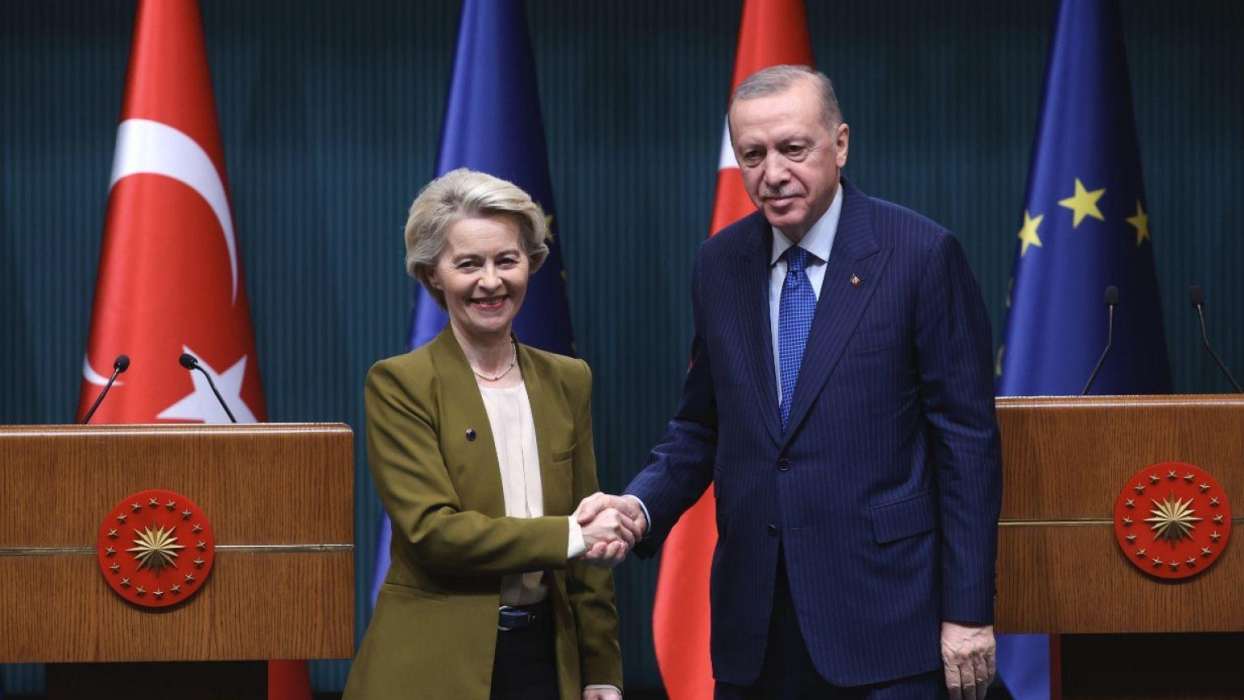
Turkey wants closer relations with the European Union, but Brussels is delivering a clear message: strategic cooperation cannot erase concerns over democratic standards, the rule of law or unresolved disputes in the Eastern Mediterranean.
The European Commission’s 2026 Enlargement Report, released on Wednesday, November 4, presents a critical assessment of Turkey’s political trajectory, documenting further deterioration in democratic governance, judicial independence and the protection of fundamental rights.
The report also places considerable emphasis on Turkey’s relations with Greece and Cyprus, highlighting renewed violations in the Aegean, the controversial Turkey–Libya maritime memorandum and Ankara’s continuing refusal to recognise the Republic of Cyprus.
The Commission acknowledges Turkey’s importance as a regional security partner, a major trading partner and a key country in European migration management.
Yet its central conclusion remains unchanged: the conditions that brought Turkey’s accession negotiations to an effective standstill in 2018 have not been resolved.
Instead, the gap between Ankara’s declared ambition to join the European Union and its compliance with the political criteria for membership has widened.
Democracy Under Pressure: Brussels Raises the Alarm Over Judicial Independence
One of the strongest criticisms in the report concerns the independence and impartiality of Turkey’s judiciary.
The European Commission finds that judicial independence remains seriously weakened, with continuing risks of political interference and insufficient safeguards against state influence.
The assessment raises broader questions about the functioning of democratic institutions and the protection of fundamental rights.
According to the Commission, legal and administrative measures continue to restrict the activities of civil society organisations, while the extensive application of national security legislation places additional pressure on independent groups and activists.
The report also identifies concerns over arrests and judicial proceedings involving LGBTQI+ individuals, activists, human rights organisations and businesses.
These developments, the Commission warns, contribute to an increasingly restrictive environment for the exercise of fundamental rights.
Press freedom is another area of concern.
The safety of journalists, media independence and the protection of pluralism remain central issues in the EU’s assessment of Turkey.
For Brussels, progress in these areas is not a secondary consideration. Respect for democracy, the rule of law and fundamental rights forms part of the political criteria that every candidate country must meet before joining the European Union.
Greece–Turkey Relations: Better Dialogue, but Renewed Aegean Violations
The Commission acknowledges that the rapprochement between Greece and Turkey has continued.
Diplomatic contacts and communication channels have helped improve the atmosphere between Athens and Ankara since 2023.
The report also notes that Turkey did not conduct unauthorised drilling activities in the Eastern Mediterranean during the period under review.
However, these positive developments coexist with persistent disagreements over maritime jurisdiction and sovereignty.
The Commission records an increase in violations of Greek airspace, including flights over Greek islands, as well as violations of Greek territorial waters.
Outstanding disputes concerning the continental shelf and Exclusive Economic Zones continue to affect bilateral relations.
The assessment draws an important distinction between improved diplomatic communication and the resolution of underlying disputes.
While dialogue may help manage tensions, it does not eliminate disagreements over maritime boundaries, sovereign rights or military activities.
For Athens, the European report provides an official record of the continuing challenges in the Aegean despite the more constructive diplomatic environment.


The Turkey–Libya Maritime Deal Returns to the European Agenda
The report also addresses the renewed controversy surrounding the 2019 Turkey–Libya maritime memorandum.
On October 20, 2026, Libya’s eastern-based House of Representatives ratified the agreement, bringing the dispute back to the forefront of Eastern Mediterranean diplomacy.
The move prompted a response from the European Union’s leadership.
The EU maintains that the memorandum infringes the sovereign rights of third states, does not comply with the law of the sea and cannot produce legal consequences for countries that are not parties to it.
European Council President António Costa and European Commission President Ursula von der Leyen reaffirmed that position in a joint statement, describing the memorandum as “null and void.”
The issue is particularly important for Greece.
Athens rejects the maritime delimitation agreed between Turkey and Libya, arguing that it disregards the maritime rights of Greek islands.
Ankara, meanwhile, maintains that the agreement reflects its legitimate maritime claims.
By including the controversy in its enlargement assessment, the European Commission places the dispute within the wider framework of Turkey’s relations with the EU.
The report does not introduce new sanctions over the agreement, but it confirms that the issue remains a significant point of disagreement between Brussels and Ankara.
Brussels Sets Three Conditions for Good-Neighbourly Relations
The European Commission calls on Turkey to demonstrate an unequivocal commitment to international law, good-neighbourly relations and the peaceful settlement of disputes under the United Nations Charter.
Its expectations focus on three central requirements:
- Refraining from threats or actions that undermine good-neighbourly relations.
- Normalising relations with the Republic of Cyprus.
- Respecting the sovereignty of EU member states over their territorial waters and airspace, as well as their sovereign rights.
These requirements are especially relevant to Greece and Cyprus.
They underline the Commission’s position that disputes involving EU member states cannot be separated from the broader political relationship between Turkey and the European Union.
The EU continues to encourage dialogue, but it also insists that closer cooperation must be consistent with international law and the rights of its members.
Cyprus: Ankara’s Two-State Position Remains at Odds With the EU Framework
The Cyprus issue remains one of the most significant obstacles to closer EU–Turkey relations.
The European Commission notes that Turkey continues to refuse to recognise the Republic of Cyprus and does not cooperate with it even on certain security matters.
Ankara has also failed to fulfil its obligation to implement the Additional Protocol to the EU–Turkey Association Agreement fully and without discrimination.
The European Union reiterates its commitment to a comprehensive settlement under United Nations auspices, based on a bizonal, bicommunal federation with political equality, in accordance with the relevant UN Security Council resolutions and the EU acquis.
This position contrasts with Turkey’s support for a two-state settlement.
The Commission calls on Ankara to contribute constructively to efforts to resume negotiations and to fulfil its obligations towards all EU member states, including the Republic of Cyprus.
Progress towards a settlement, the report suggests, could create new opportunities for cooperation and contribute to an improvement in EU–Turkey relations.
However, the fundamental differences over the framework for a settlement remain unresolved.


Raffaele Fitto: The European Commission Seeks a More Active Role in Cyprus
A significant development highlighted in the report is the appointment of European Commission Executive Vice-President Raffaele Fitto as the Commission’s special representative for Cyprus in July 2026.
The appointment reflects Brussels’ intention to play a more active role in the UN-led settlement process.
The European dimension is particularly important because the Republic of Cyprus is an EU member state.
Any comprehensive settlement would therefore need to be compatible with the EU’s legal and institutional framework.
For Nicosia, the Commission’s involvement adds an important European element to diplomatic efforts surrounding the future of the island.
The EU maintains that meaningful progress in the Cyprus negotiations could contribute to a broader improvement in relations with Ankara.
Ankara Rejects the Criticism: A Dispute Over European Standards
Turkey has rejected the European Commission’s criticism of its record on fundamental rights, the judiciary and Cyprus.
According to Reuters, Ankara described the EU’s assessment as “biased and unfair,” challenging the conclusions drawn by Brussels about developments inside Turkey.
The disagreement illustrates a longstanding divide between the two sides.
The European Commission regards progress on democratic standards and the rule of law as essential to Turkey’s accession prospects.
The Turkish government disputes aspects of the EU’s assessment and maintains its own position on the country’s political and institutional development.
The result is a continuing diplomatic impasse over the criteria that should shape Turkey’s future relationship with Europe.
Foreign Policy: Only 4% Alignment With EU Positions
One of the report’s most striking findings concerns Turkey’s extremely low alignment with the European Union’s Common Foreign and Security Policy.
According to the Commission, the alignment rate stands at approximately 4%, compared with 3% previously.
The figure is significant given Turkey’s membership in NATO and its strategic role in regions where the European Union seeks greater influence.
Nevertheless, Brussels recognises that Turkish and European interests converge on several international issues.
These include stability in Syria, peace and regional connectivity in the South Caucasus, efforts towards a ceasefire in Gaza and a two-state solution to the Israeli–Palestinian conflict, and support for Ukraine’s sovereignty and territorial integrity.
The Commission also notes that Turkey has taken certain measures to prevent the circumvention of EU sanctions against Russia through its territory.
It encourages Ankara to continue and strengthen these efforts.
The report therefore presents a complex picture: Turkey is an important geopolitical actor whose interests sometimes align with those of the EU, but whose overall foreign policy positions remain substantially different.
Migration: A Strategic Partnership That Keeps Dialogue Open
Despite the political disagreements, migration management remains a major area of cooperation between Brussels and Ankara.
The Commission reports that irregular arrivals in the EU from Turkey continued to decline in 2025, following a reduction already recorded in 2024.
The European Union also continues to support Turkey in hosting approximately 2.3 million refugees, most of them from Syria.
Migration and border management remain areas where both sides have a direct interest in maintaining close cooperation.
This shared interest helps explain why Brussels continues to engage with Ankara despite concerns over democracy, fundamental rights and regional disputes.
The EU’s approach reflects the need to manage practical challenges while maintaining its political expectations of a candidate country.
Trade and the Customs Union: Turkey’s Economic Importance to Europe
Economic interdependence remains another defining feature of EU–Turkey relations.
Turkey has a diversified industrial base and is deeply integrated into European production and supply chains through the EU–Turkey Customs Union.
According to the Commission, the Turkish economy expanded by 3.6% in 2025, driven primarily by strong domestic demand.
However, the report identifies continuing trade barriers and difficulties in implementing the Customs Union.
The Commission calls for further efforts to improve its operation.
It also notes that, in July 2026, the EU–Turkey Customs Cooperation Committee adopted an agreement on the mutual recognition of authorised economic operator programmes.
Trade, transport, energy and the green transition remain important areas for future cooperation.
These economic links create incentives for continued engagement even as the political accession process remains stalled.
The European Dilemma: Strategic Cooperation Without Accession Progress
The Commission’s overall approach to Turkey remains gradual, proportionate and reversible.
This means that cooperation can advance in specific areas of mutual interest, while remaining conditional on developments in the broader relationship.
The policy is based on the EU’s 2023 joint communication and the conclusions of the European Council in 2024.
It does not, however, amount to a restart of Turkey’s accession negotiations.
The Commission concludes that the underlying problems which brought the negotiations to a standstill in 2018 remain unresolved.
Furthermore, the deterioration in democratic governance and fundamental rights has increased the distance between Turkey’s declared European ambitions and the requirements for EU membership.
The distinction is central to the EU’s policy.
Brussels is prepared to cooperate with Ankara on migration, trade, energy and regional security.
But it continues to insist that such cooperation cannot replace the reforms required for meaningful progress towards membership.
The Message to Erdoğan: Cooperation Cannot Replace Political Reform
The 2026 Enlargement Report highlights the contradictions shaping Turkey’s relationship with Europe.
Ankara remains a major economic and strategic partner for the European Union, but its accession process is effectively frozen.
Brussels recognises the importance of maintaining dialogue, yet it continues to raise concerns about judicial independence, democratic institutions, press freedom and fundamental rights.
At the same time, unresolved disputes involving Greece and Cyprus remain directly relevant to the future of EU–Turkey relations.
The Commission’s position is that progress requires more than diplomatic engagement.
It requires respect for international law, peaceful relations with neighbouring countries, recognition of the sovereignty and sovereign rights of EU member states, and meaningful improvements in democratic governance.
The European Commission’s central conclusion is that the circumstances which brought Turkey’s accession negotiations to a standstill in 2018 have not been addressed.
For Ankara, the challenge is therefore twofold: maintaining its strategic relationship with Europe while confronting the political and legal conditions that continue to obstruct its path towards EU membership.
Source: pagenews.gr