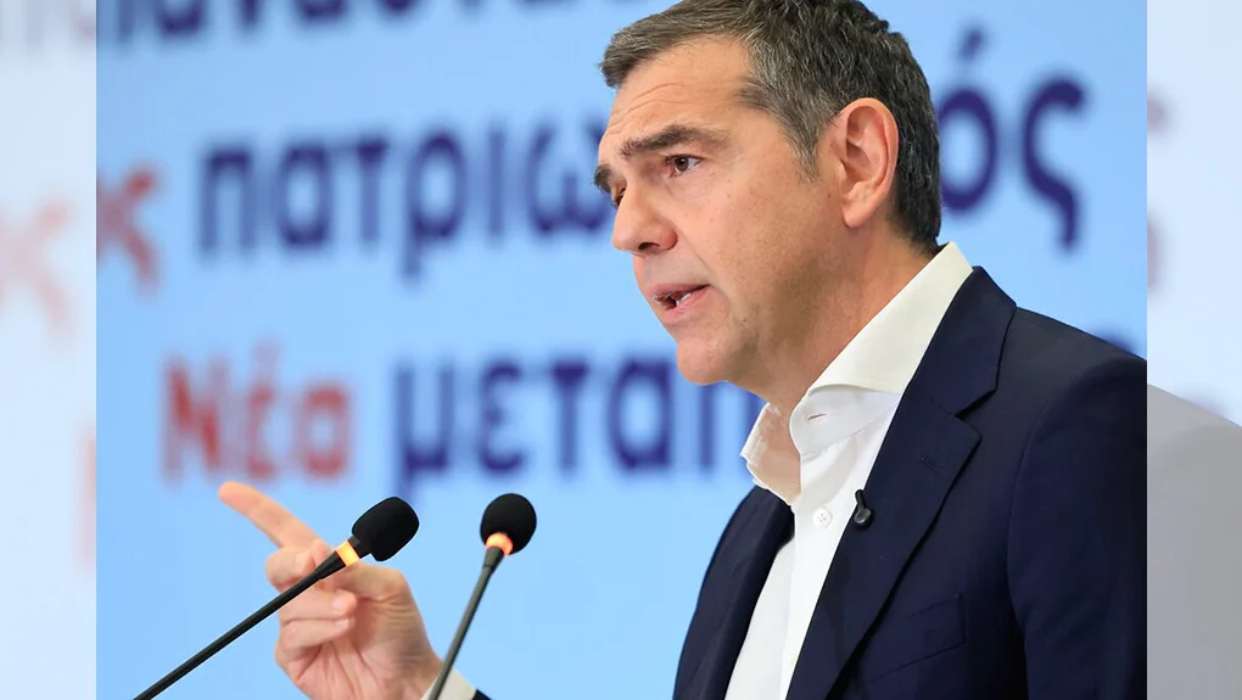
“If that is the case, I wonder why the actions being taken today by the Greek government and the Ministry of Foreign Affairs were not taken a year ago.”
With this pointed question, former Greek Prime Minister Alexis Tsipras has brought the Greece–Cyprus electricity interconnection project back into the political spotlight, challenging the government’s handling of delays and diplomatic tensions surrounding one of the Eastern Mediterranean’s most strategically significant energy infrastructure projects.
Speaking about the anticipated resumption of undersea cable-laying operations, Tsipras acknowledged that Turkey’s conduct has been provocative. However, he also questioned why Athens had not acted sooner to protect the project’s implementation.
His intervention comes amid renewed preparations for the Great Sea Interconnector, a project intended to connect the electricity networks of Greece and Cyprus and strengthen regional energy connectivity.
“An Endless Saga Creating Unnecessary Tensions”
Asked whether the latest developments should be considered positive and whether concerns about potential escalation were justified, Tsipras declined to predict the outcome.
“That remains to be seen. I don’t know,” he responded.
He then criticized the prolonged uncertainty surrounding the project, arguing that it should already have been completed under international law.
“What is certain is that, in a matter which, under international law, should already have been completed, we are witnessing a recurring saga that creates tensions and unnecessarily raises the temperature,” he said.
Tsipras explicitly attributed a significant part of the problem to Ankara.
“This is obviously due to Turkey’s position, which, to call things by their proper name, is provocative.”
His comments reflect the broader dispute over maritime rights and jurisdiction in the Eastern Mediterranean, where Greece and Turkey maintain conflicting interpretations of certain maritime boundaries.


The Law of the Sea and Turkey’s Claims
A central element of Tsipras’ argument concerns the United Nations Convention on the Law of the Sea (UNCLOS).
The former prime minister emphasized that international law recognizes the right to lay submarine cables and that such operations do not generally require authorization from a neighboring country merely because a cable crosses its continental shelf.
He also argued that there was no indication that the planned route crossed the Turkish continental shelf.
Article 79 of UNCLOS recognizes the right of states to lay submarine cables on the continental shelf, subject to specific provisions concerning the rights of coastal states and the protection of existing infrastructure.
The legal framework is particularly important because the electricity interconnector has become entangled in broader Greek–Turkish disagreements over maritime jurisdiction.
For Athens, the project is an energy infrastructure initiative that should proceed in accordance with international law. Ankara’s objections and naval activity have raised questions about the practical implementation of those rights in disputed maritime areas.
Warning of Potential Confrontations at Sea
Tsipras also warned about the possibility of tensions escalating into operational confrontations.
“We find ourselves in a situation of major tension, even on the verge of potentially violent actions or operations at sea, over something for which there is absolutely no reason for such confrontation,” he stated.
His remarks were a political warning rather than confirmation of an imminent military incident.
Nevertheless, they highlight the security dimension of a project that extends beyond energy policy and touches upon sovereignty, maritime rights and regional stability.
The Kasos Incident: Tsipras’ Central Question to Athens
The sharpest part of Tsipras’ intervention concerned earlier developments near the Greek island of Kasos.
Referring to the presence of Turkish naval vessels during previous survey operations, he questioned why the Greek government had not adopted its current approach at that time.
“I wonder why the actions being taken today by the Greek government and the Ministry of Foreign Affairs were not taken a year ago, when Turkish warships prevented the laying of the cable just outside Kasos.”
The former prime minister’s criticism focuses on the timing of Athens’ diplomatic and operational preparations.
Rather than opposing the interconnector itself, Tsipras is asking why the government did not take comparable measures earlier, when Turkish naval activity complicated the project’s progress.
The confrontation near Kasos in July 2024 remains an important reference point in the political debate surrounding the interconnector.
Athens Responds: Greece Issues NAVTEX, Not Turkey
Tsipras’ intervention coincides with renewed statements from the Greek government emphasizing Athens’ authority over the relevant maritime procedures.
Speaking to Parapolitika 90.1 radio, Deputy Foreign Minister Tasos Chatzivasileiou said that preparations for the electricity interconnection were entering their final stage.
“Greece is the country that grants the authorization. Greece is the country that issues the NAVTEX. There has been no notification from our side to Turkey or any other third country,” he stated.
Chatzivasileiou also distinguished between informal technical communications by project contractors and official state authorization procedures.
The government maintains that the project is proceeding according to its planning, while Tsipras is demanding an explanation for the delays and the handling of previous Turkish objections.
The disagreement therefore concerns not only the legal basis for the project but also the effectiveness and timing of the government’s response.
The Strategic Importance of the Greece–Cyprus Interconnector
The Great Sea Interconnector is designed to link the electricity systems of Greece and Cyprus through a high-voltage submarine cable.
Its strategic significance extends beyond electricity transmission.
The project is intended to reduce Cyprus’ energy isolation, facilitate the integration of renewable energy sources and strengthen electricity connectivity in the Eastern Mediterranean.
At the same time, its implementation has become a sensitive geopolitical issue because of Turkish objections and unresolved maritime disputes.
For Greece and Cyprus, the interconnector represents a major long-term infrastructure investment. For the broader region, it is also a test of how energy connectivity projects can proceed amid competing maritime claims.
Tsipras: “I Hope This Matter Is Resolved Peacefully”
Despite his criticism of the Greek government’s handling of the project, Tsipras expressed hope that the dispute would be resolved without further escalation.
“I want to hope, and I sincerely wish, that this matter will be resolved smoothly, as befits two neighboring countries that must respect international law,” he said.
He emphasized that major infrastructure projects should be advanced rather than obstructed by political and diplomatic disputes.
In his closing remarks, Tsipras also recalled the project’s earlier development under the name EuroAsia Interconnector, linking its origins to his own period in government.
“They should promote projects of such importance as the electricity interconnection between Greece and Cyprus, which, I would like to remind everyone, began under a different name at the time — the EuroAsia Interconnector — during my administration.”
Source: pagenews.gr