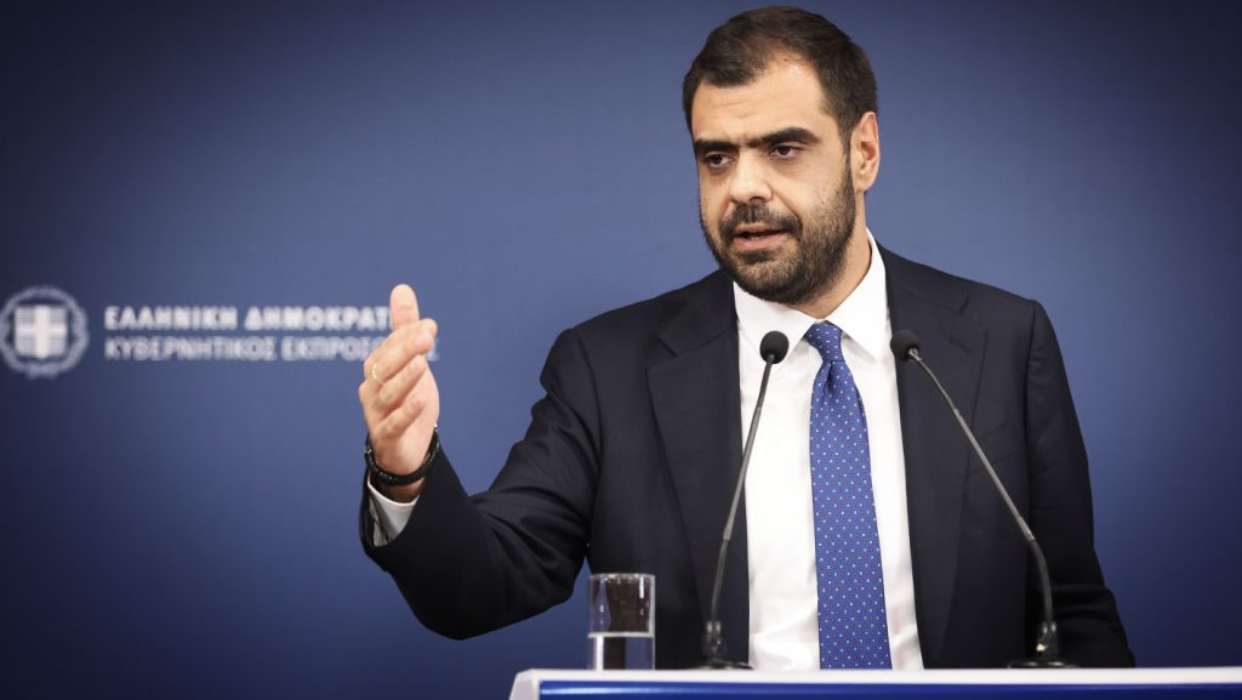
“No permission has been requested from Turkey, nor will any such permission be requested.”
With this categorical statement, Greek government spokesperson Pavlos Marinakis sought to dismiss speculation surrounding a French diplomatic note sent to Ankara in connection with the Greece–Cyprus electricity interconnection project.
The controversy has reopened a sensitive geopolitical debate over maritime jurisdiction in the Eastern Mediterranean, the legal framework governing subsea infrastructure and Turkey’s attempts to assert authority over activities in disputed maritime areas.
Athens maintains that the relevant authorization procedures were completed through the competent Greek and Cypriot authorities, while the French company Nexans, involved in the development of the Great Sea Interconnector (GSI), did not seek Turkish approval.
Marinakis also rejected reports suggesting that Washington had intervened with the Greek government over the project.
The dispute illustrates how a major European energy infrastructure initiative has become intertwined with competing maritime claims, regional security considerations and the strategic relationship between Greece, Cyprus and Turkey.
November 6: The Greek NAVTEX and the sequence of diplomatic developments
During his briefing on November 9, Marinakis outlined the sequence of events that preceded the latest diplomatic controversy.
According to the Greek government, Nexans submitted an application to the competent Greek authorities for survey and cable-laying activities associated with the Great Sea Interconnector.
The application received a favorable assessment from the relevant interministerial committee responsible for authorizing marine research activities.
On November 6, Foreign Minister George Gerapetritis issued the corresponding authorization.
Following a request from the survey vessel, the Hellenic Navy’s Hydrographic Service issued a NAVTEX notifying mariners of the planned operations.
“All the required authorization procedures by the competent Greek authorities have been completed for the execution of survey and cable-laying operations,” Marinakis said.
For Athens, this administrative sequence is central to its argument.
The company applied to Greek authorities, received authorization through the Greek institutional framework and proceeded through the established maritime notification process.
A NAVTEX, or navigational telex, serves a different purpose from a government permit. It informs shipping operators about maritime activities, potential hazards and operational restrictions in a specified area.
It does not, by itself, establish maritime boundaries or resolve disputes over jurisdiction.
The French diplomatic note: Notification or recognition of Turkish authority?
The most politically sensitive aspect of the controversy concerns a French diplomatic note addressed to Turkey.
Reports about the communication raised questions over whether Paris had implicitly acknowledged a Turkish role in authorizing the planned activities.
Marinakis firmly rejected that interpretation.
“Permission is one thing; notification is another,” he said.
According to the Greek government’s explanation, the French communication was a routine diplomatic notification intended to inform Ankara about activities in the region, including considerations relating to maritime safety.
Athens insists that it was neither a request for consent nor an acknowledgment of Turkish jurisdiction.
The distinction is significant.
A diplomatic notification can serve practical purposes, including the prevention of misunderstandings between states operating in geographically sensitive waters.
An application for permission, however, would imply that the recipient state possesses some authority to approve or reject the activity concerned.
The Greek government is determined to prevent the French communication from being interpreted as establishing such a precedent.
Nevertheless, the full text of the French diplomatic note has not been made publicly available in the material discussed at the briefing.
Its precise wording therefore cannot be independently assessed on the basis of the government’s explanation alone.


Turkey’s counter-NAVTEX: A renewed challenge to Greek maritime claims
Ankara responded by issuing a counter-NAVTEX challenging the jurisdiction asserted by the Greek and Cypriot authorities over parts of the operational area.
Turkey maintains that some of the planned activities concern waters it regards as falling within its continental shelf.
The Turkish position refers to maritime coordinates previously submitted to the United Nations and asserts that relevant activities require Turkish consent.
Athens rejects that claim.
According to Marinakis, the Turkish counter-NAVTEX does not alter the applicable legal framework or diminish the rights Greece maintains under international law.
The confrontation reflects a broader and longstanding disagreement over maritime entitlements in the Eastern Mediterranean.
Greece and Turkey have competing positions on continental shelf delimitation and the legal consequences of maritime zones claimed by each country.
These disagreements have repeatedly affected offshore energy exploration, hydrographic activities and the development of subsea infrastructure.
A counter-NAVTEX does not automatically invalidate a navigational warning issued by another state.
However, competing maritime notifications can create operational uncertainty, particularly when research vessels are expected to work in areas subject to conflicting jurisdictional claims.
The immediate question is therefore not only diplomatic but also practical: whether the planned survey operations can proceed without disruption.
International law and the battle over subsea infrastructure
The legal controversy surrounding the Great Sea Interconnector involves several distinct elements of maritime law.
These include sovereignty within territorial waters, sovereign rights over the continental shelf and the legal framework governing the installation of submarine cables.
The United Nations Convention on the Law of the Sea recognizes rights relating to the laying of submarine cables, while also establishing certain rights and responsibilities for coastal states.
Not every marine survey, cable-laying operation or authorization procedure falls under an identical legal regime.
The applicable rules depend on the precise nature of the activity, its location and the maritime zone concerned.
Greece and Cyprus base their positions on international law and the law of the sea, while Turkey advances a different interpretation of its maritime entitlements in the region.
Turkey is not a party to the United Nations Convention on the Law of the Sea, although certain maritime rules are also recognized as customary international law.
For Athens, the essential principle is that a unilateral Turkish notification cannot itself establish maritime jurisdiction or modify the legal rights of other states.
For Ankara, the dispute concerns what it regards as activities affecting its claimed continental shelf.
The competing positions remain unresolved, and the precise legal implications depend on the coordinates and activities involved.
Nexans and France’s strategic position in the Eastern Mediterranean
The participation of French cable manufacturer Nexans adds another European dimension to the dispute.
The company plays a central technical role in developing the subsea cable infrastructure designed to connect Greece and Cyprus.
Its involvement requires coordination across national regulatory systems, maritime authorities and operational jurisdictions.
The fact that a French company is conducting work in a politically sensitive region also creates diplomatic considerations for Paris.
France maintains significant strategic relationships with both Greece and Cyprus, including cooperation in defense and regional security.
Nevertheless, the participation of a French company in a European infrastructure project does not automatically mean that every communication by the French government constitutes an endorsement of all Greek maritime claims.
This distinction helps explain why the diplomatic note has attracted such attention.
The Greek government argues that the decisive administrative actions were the requests submitted to the competent Greek and Cypriot authorities, rather than the subsequent communication with Ankara.
According to Athens, those procedures demonstrate that Turkey was not treated as the licensing authority for the planned operations.
Washington’s role: Athens denies any US intervention
Marinakis also addressed speculation about possible American involvement.
The government spokesperson stated that the United States had not intervened with Greece regarding the project.
According to his account, Athens had received no such pressure from Washington or another third country.
The clarification is significant because the Great Sea Interconnector forms part of a broader discussion about energy security, strategic infrastructure and geopolitical influence in the Eastern Mediterranean.
The United States has longstanding security and energy interests in the region, while Greece and Cyprus are important partners in European energy diversification initiatives.
However, the existence of those broader interests does not establish that Washington has intervened in this particular dispute.
Marinakis clarified that he could not speak about possible American communications with other governments.
His denial therefore concerned intervention directed at Greece, rather than every potential diplomatic exchange involving the United States.
Why the Great Sea Interconnector matters to Europe
The Great Sea Interconnector is far more than an electricity transmission project.
It is intended to connect Cyprus to the wider European electricity network through Greece, addressing the island’s longstanding electricity isolation.
The project is designed to facilitate cross-border electricity exchanges, improve energy system flexibility and support the integration of renewable energy.
For Cyprus, the interconnection could provide access to a larger electricity market and additional options for balancing domestic supply and demand.
It could also reduce dependence on isolated generation capacity and create opportunities for greater renewable electricity penetration.
For Greece, the project would strengthen its potential role as an energy infrastructure hub linking the European Union with the Eastern Mediterranean.
The interconnection also has an important European policy dimension.
Electricity interconnectors can contribute to market integration, energy security and the diversification of supply routes.
However, the project’s ultimate benefits will depend on its completion, regulatory arrangements, financing and the ability of participating countries to manage technical and geopolitical risks.
Marinakis described the interconnector as a project of strategic importance for energy security, regional cooperation and stability.
The Greek government continues to present it as a priority within its broader energy and foreign policy agenda.
The geopolitical stakes for Athens and Ankara
The latest controversy presents Athens with two interconnected challenges.
The first is legal and diplomatic.
Greece seeks to demonstrate that the project can proceed under the authorization procedures it considers applicable, without accepting a Turkish right to approve activities in the disputed area.
The second is operational.
Even when the necessary domestic permits have been issued, research and cable-laying activities can face difficulties if tensions emerge at sea.
Turkey’s counter-NAVTEX illustrates the persistence of the jurisdictional disagreement.
It does not, on its own, establish that the project will be suspended.
Likewise, the issuance of Greek authorizations does not mean that all surveys have been completed or that every remaining obstacle has been removed.
The next meaningful development will be the actual implementation of the planned maritime operations and the response of the relevant authorities during those activities.
This distinction matters because the project’s progress cannot be assessed solely through diplomatic statements or competing navigational warnings.
Greece–Cyprus relations and the wider regional equation
The electricity interconnection also occupies an important place in relations between Athens and Nicosia.
Both governments regard the project as strategically significant, although major cross-border infrastructure requires continued coordination over financing, regulatory responsibilities and implementation schedules.
For Cyprus, electricity connectivity has implications beyond energy prices.
It concerns the resilience of an isolated power system and the country’s ability to participate more fully in European electricity markets.
For Greece, the project intersects with broader efforts to develop regional electricity corridors and expand its position in the European energy system.
The involvement of European institutions and a French industrial contractor reinforces its international dimension.
At the same time, the Turkish objections demonstrate that strategic infrastructure projects in the Eastern Mediterranean cannot be separated entirely from unresolved maritime disputes.
The interconnector has therefore become a test of how energy policy, international law and regional diplomacy interact.
Marinakis: Greece will not seek permission from Turkey
Responding to suggestions that the French diplomatic communication represented a Greek retreat, Marinakis insisted that Athens had not changed its position.
The government spokesperson emphasized that the country continues to exercise the rights it claims under international law and rejects the notion that Ankara has acquired authority over the project through its diplomatic objections.
The Greek government’s argument rests on three developments: authorization by the competent Greek authorities, issuance of the relevant NAVTEX and the distinction between a French diplomatic notification and an application for Turkish consent.
Marinakis also rejected claims that the Turkish response had established a new legal situation.
“Greece is not retreating. Greece is pursuing an active foreign policy,” he said.
He reiterated the government’s central position:
“No permission has been requested from Turkey, nor will any such permission be requested.”
Source: pagenews.gr