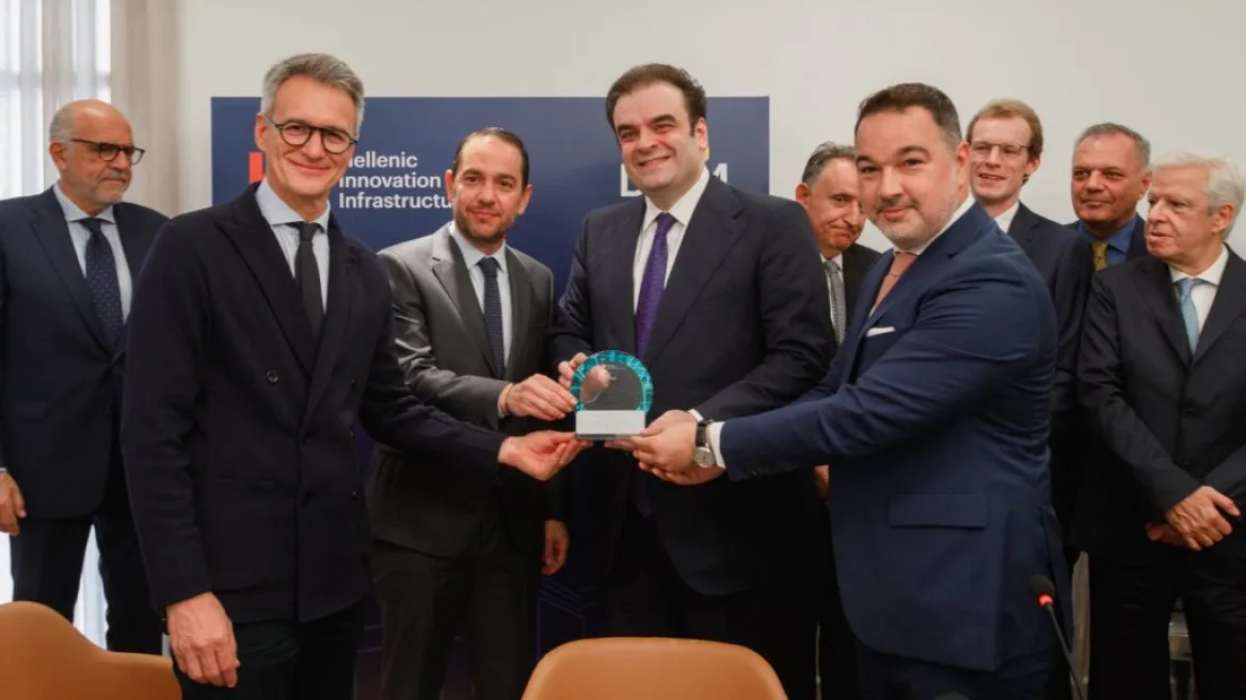
“Greece is no longer simply attracting international investment. We are actively participating in its implementation, securing a share of the value created and strengthening our position in the economy of the future.”
With this declaration, Greek Minister of National Economy and Finance Kyriakos Pierrakakis announced a new investment by the Hellenic Innovation & Infrastructure Fund (HIIF), which is acquiring a 23% minority stake in Data4 Greece, the company developing the first data center at the Athens Campus in Paiania, near Athens.
The agreement marks HIIF’s first investment in digital infrastructure and its second major investment initiative, following a €35 million commitment to Finnish satellite technology company ICEYE.
Two investments, two rapidly expanding sectors and a common objective: strengthening Greece’s participation in industries that will shape the global economy over the coming decades.
For the Greek government, the announcement represents more than another foreign investment project.
It signals an effort to ensure that Greek institutional capital participates directly in the economic value generated by advanced technology infrastructure.
Pierrakakis highlighted the transformation in Greece’s investment position.
“We have moved from an era in which we struggled to earn investors’ trust to an era in which investors themselves seek to participate in Greece’s future.”
A 23% Stake in Data4 Greece: What the Agreement Means
Through the transaction, HIIF, the investment arm of Greece’s National Development Fund, will acquire a minority holding in Data4 Greece.
The company is developing the first data center at the Athens Campus, a project intended to strengthen Greece’s position in the digital infrastructure market.
The investment brings together Greek institutional capital, French data center expertise and the international infrastructure investment experience of Brookfield.
The 23% stake provides the Greek fund with an equity interest in the company, although it does not confer majority control.
The financial consideration for the stake has not been disclosed in the information accompanying the announcement.
Pierrakakis described the transaction as an important step in the development of Greece’s technology economy.
“This is HIIF’s first investment in digital infrastructure. And its significance goes far beyond the size of the stake itself.”
The Athens Campus is expected to support Greece’s ambition to become a digital infrastructure hub for Southeastern Europe.
Data centers provide the physical infrastructure required for cloud computing, enterprise applications, secure data processing and a growing range of artificial intelligence services.
As global demand for computing capacity increases, countries are competing to attract the infrastructure needed to support digital businesses and advanced technologies.


From ICEYE to Data4: Two Strategic Investments in One Week
The Data4 agreement follows HIIF’s €35 million investment in Finnish company ICEYE, announced the previous week.
ICEYE specializes in satellite technology and Earth observation data, while Data4 develops and operates data center infrastructure.
Although the two investments target different industries, both involve technologies with growing economic and strategic importance.
Satellite systems support applications ranging from environmental monitoring and disaster management to security and geospatial intelligence.
Data centers, meanwhile, underpin cloud computing, digital transactions and data-intensive applications.
The investments do not constitute a single integrated technology project. Rather, they represent separate equity commitments in two strategically significant sectors.
Pierrakakis emphasized that Greece must turn its competitive advantages into tangible economic results.
“The challenge now is to transform these advantages into investments that create better jobs and lasting value for our country and our economy.”
The government sees such investments as part of its broader effort to diversify economic activity and strengthen sectors with high technological added value.
Data4, Brookfield and Greece’s Emerging Digital Hub
The participation of Data4 and Brookfield is central to the transaction.
French company Data4 brings experience in developing and operating large-scale data center facilities, while Brookfield is a major international investor in infrastructure.
HIIF’s participation introduces Greek institutional capital into the project.
“Our partnership with France’s Data4 and Brookfield, one of the world’s leading infrastructure investors, combines Greek institutional capital, international experience and technological expertise,” Pierrakakis said.
He added:
“This is the development model we want to promote: partnerships that mobilize capital, strengthen our productive capacity and leave a lasting economic footprint.”
The Athens Campus is intended to reinforce Greece’s position as a potential digital gateway to Southeastern Europe.
The country’s geographical location and international connectivity offer opportunities to serve companies operating across several regional markets.
However, the success of the project will depend on commercial demand, energy availability, connectivity and the ability to attract customers.
The agreement is an important investment milestone, but the project’s long-term economic impact will ultimately depend on its development and operation.
Why Data Centers Matter in the Global AI Race
Artificial intelligence featured prominently in Pierrakakis’s speech.
The minister argued that digital infrastructure will become as important to economic development as traditional transport and energy networks.
“Data centers are fundamental infrastructure for the modern economy.”
He explained:
“Behind every artificial intelligence application, every cloud service and every digital transaction lies the need for computing power, speed and secure data processing.”
AI systems require substantial computing resources, particularly for training and operating advanced models.
Businesses are also expanding their use of cloud services, digital platforms and automated applications, increasing demand for secure and reliable data infrastructure.
Not all data centers, however, are designed for the same purposes.
Facilities supporting advanced AI workloads may require specialized processors, high-density computing equipment, sophisticated cooling systems and significant electricity capacity.
The information released about the Data4 Greece transaction does not specify the computing capacity of the first Paiania facility or confirm that it will be dedicated to training large AI models.
Nevertheless, the project belongs to the broader infrastructure sector that supports the expanding digital economy.
Pierrakakis drew a comparison with previous generations of economic infrastructure.
“Just as roads, ports and energy networks supported economic development in previous decades, digital infrastructure will form the foundation of growth in the decades ahead.”


Pierrakakis: Greece Moved Beyond the European Average in Digital Public Services
The finance minister linked the new investment to Greece’s digital transformation since 2019.
He recalled the country’s previously weak performance in digital public services and highlighted the progress achieved during his tenure as minister of Digital Governance.
“Initially, Greece was not a digital state. It did not even have the ambition to become one.”
He continued:
“Within four years, from being among the last or almost last countries in Europe in terms of digital public services, we managed to exceed the European average.”
Pierrakakis attributed this progress to the establishment of the Ministry of Digital Governance, investments supported by European funding and a regulatory framework designed to encourage technological development.
He also referred to Greece’s adoption of a cloud-first policy for the public sector.
“We have adopted the cloud-first policy in the Greek public administration, which has been established by law and provides for the mandatory use of cloud computing services by the public sector.”
The digital transformation of public services has increased the importance of secure data storage, cloud infrastructure and reliable computing systems.
The Data4 Greece project, however, is a commercial data center investment involving HIIF. It has not been announced as a dedicated hosting facility for Greek government data.
Europe’s Technology Challenge: Infrastructure, Energy and Strategic Autonomy
The investment also has a broader European dimension.
The European Union is seeking to strengthen its competitiveness in a global technology market increasingly dominated by American and Chinese companies.
Access to computing capacity, advanced semiconductors, energy and investment capital is becoming essential to technological competitiveness.
Pierrakakis argued that Europe possesses significant scientific and industrial strengths but needs to invest more rapidly.
“In the global technology competition, the speed at which we invest will largely determine how far we can go.”
He added:
“Europe’s strategic autonomy requires infrastructure, energy, capital and people with the right skills.”
For Greece, expanding data center capacity offers opportunities to attract technology companies and develop advanced digital services.
But large-scale facilities also place demands on electricity networks, telecommunications infrastructure and specialized technical personnel.
Energy consumption, cooling requirements and environmental performance are particularly important considerations.
As a result, the expansion of Greece’s data center industry will need to be accompanied by investment in energy infrastructure, efficient operations and reliable connectivity.
A New Economic Model Built Around Technology and Investment
The government is presenting the Data4 agreement as part of a broader transition toward a more productive, outward-looking and technologically advanced economy.
Developing and operating data centers can generate demand for engineers, network specialists, cybersecurity professionals and technical service providers.
Such projects can also create opportunities for construction companies, equipment suppliers and related businesses.
However, the number of jobs expected from the Paiania project has not been specified in the information released.
The exact financial value of HIIF’s 23% investment has likewise not been disclosed.
Pierrakakis emphasized that technological investment must ultimately deliver measurable benefits.
“This transformation becomes truly meaningful when it translates into productive activity, new expertise and more opportunities for our citizens.”
The government’s ambition is to increase the role of technology-intensive industries in the Greek economy and attract activities with greater added value.
Whether the Data4 investment achieves those objectives will depend on its commercial performance and the broader development of Greece’s digital infrastructure ecosystem.
The National Development Fund Takes a More Active Investment Role
The transaction also illustrates the expanding role of Greece’s National Development Fund.
Through HIIF, the institution is moving beyond conventional financial support and taking equity positions in selected investment projects.
This approach exposes the fund to commercial risk while offering the possibility of financial returns and broader economic benefits.
Pierrakakis stressed the importance of professional investment management.
“Through professional management, commercial investment criteria and international standards of corporate governance, it participates in investments of strategic importance, mobilizing capital and generating value with multiplier benefits for the Greek economy.”
The 23% stake in Data4 Greece represents a concrete example of that approach.
The investment will be judged not only by the strategic importance of the sector but also by the financial performance of the company and the economic value generated over time.
The agreement therefore introduces an important test for the fund’s ability to combine commercial discipline with long-term development objectives.
“The Future Is Not Given to Any Country” — Pierrakakis’s Closing Message
Concluding his speech, the finance minister argued that Greece is now in a position to pursue more ambitious economic objectives.
“Greece is now in a position to set higher goals. To build on the economic progress it has achieved and the international confidence it has earned, creating an economy that is more productive, more outward-looking and more competitive.”
In a separate statement to Greek public broadcaster ERT and the Athens-Macedonian News Agency, Pierrakakis reiterated the purpose of the investment.
“We are using public capital to mobilize investment, create new opportunities and strengthen the country’s technological power.”
He continued:
“Technology is changing the rules of the global economy. Greece is claiming a leading role in this new reality, through investments that create value and infrastructure that opens new paths.”
The Data4 Greece transaction follows the investment in ICEYE and places HIIF in two distinct technology sectors with significant growth potential.
The next milestones will involve the development of the Athens Campus, the expansion of operational infrastructure and the project’s ability to attract commercial activity.
For the Greek government, the investment is another step toward increasing the country’s participation in the global technology economy.
For the National Development Fund, it is an opportunity to demonstrate that institutional investment can deliver both financial returns and long-term economic benefits.
Pierrakakis ended his address with a statement that captured the ambition behind the announcement:
“The future is not given to any country. The future belongs to those who plan it and build it. And that is exactly what Greece is doing.”
Source: pagenews.gr