Gerapetritis–Fidan Meet in Brussels: Greece Draws a Red Line on Energy Links and Maritime Security
 ΧΡΟΝΟΣ ΑΝΑΓΝΩΣΗΣ 11 '
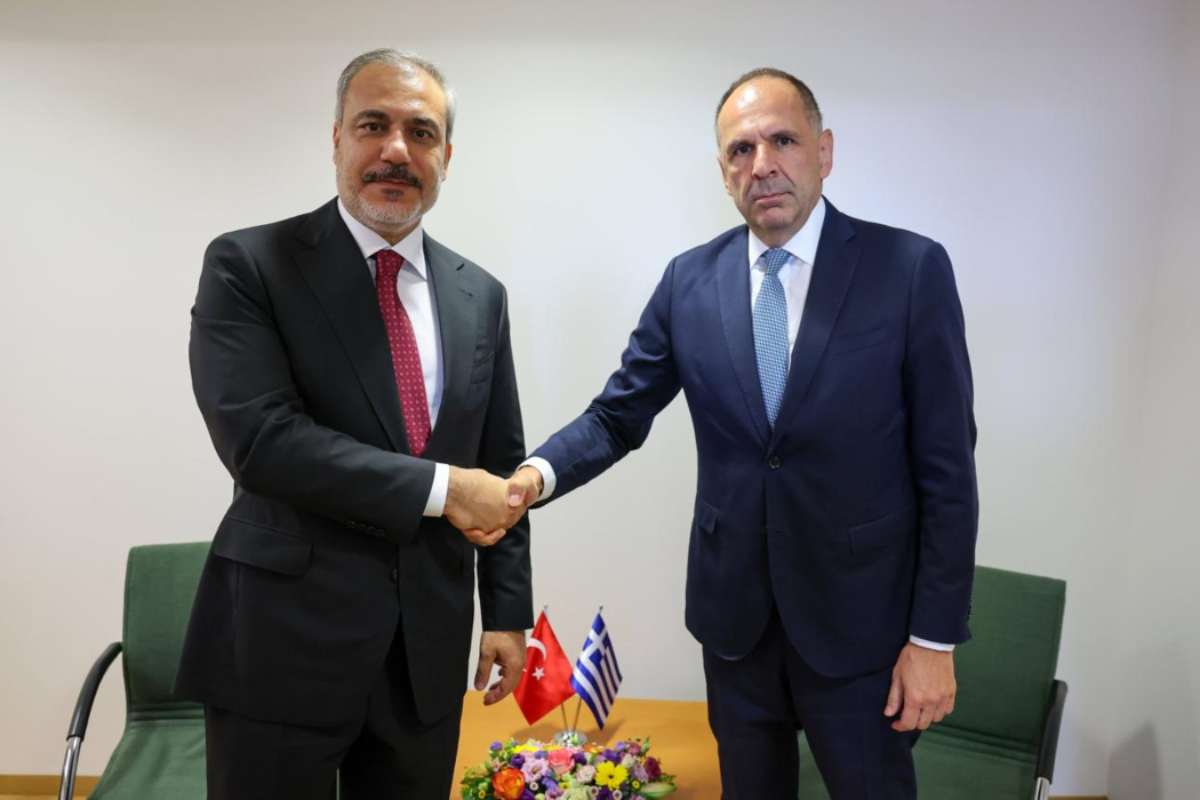
Πηγή Φωτογραφίας: eurokinissi//Gerapetritis–Fidan Meet in Brussels: Greece Draws a Red Line on Energy Links and Maritime Security



“There must be absolutely no deviation from the European acquis and absolutely no obstruction contrary to international law.”
With this unequivocal statement, Greek Foreign Minister George Gerapetritis placed energy security, international law, and the protection of strategic infrastructure at the centre of diplomatic discussions in Brussels on Monday, November 16, 2026.
His remarks came at a particularly sensitive moment for the Great Sea Interconnector (GSI), the ambitious electricity project linking Greece and Cyprus, which has become a focal point of wider tensions in the Eastern Mediterranean.
The diplomatic significance of the day was heightened by a confirmed meeting between Gerapetritis and Turkish Foreign Minister Hakan Fidan on the sidelines of European meetings.
The Greek Ministry of Foreign Affairs officially announced the encounter, although no details were released regarding the subjects discussed or any potential outcomes.
Taken together, the developments illustrate Athens’ approach to a complex regional environment: publicly reaffirming its positions on international law and strategic infrastructure while maintaining diplomatic channels with Ankara.
A clear message on the Great Sea Interconnector
Arriving at the European Union’s Foreign Affairs Council in Brussels, Gerapetritis emphasised that energy connectivity must operate within the framework of international and European law.
His remarks extended beyond the Greece–Cyprus electricity interconnection to include the planned Greece–Egypt electricity link and the Vertical Gas Corridor.
“There must be absolutely no deviation from the European acquis and absolutely no obstruction contrary to international law,” the Greek foreign minister declared.
The statement carried particular weight against the backdrop of Turkish objections to maritime activities associated with energy projects in the Eastern Mediterranean.
Athens maintains that lawful energy infrastructure projects should proceed without interference inconsistent with international law.
By raising the issue at the European level, Gerapetritis placed the protection of energy interconnections within a broader discussion about the EU’s strategic interests.
The underlying question is not simply whether a particular submarine cable can be installed. It is also whether major European infrastructure projects can proceed predictably in regions marked by competing maritime claims and geopolitical tensions.
📍Brussels, 16.11.2026
🇬🇷 FM George Gerapetritis met with his 🇹🇷 counterpart @HakanFidan on the sidelines of the #EU Foreign Affairs Council.
@GreeceInEU @GreeceInTurkiye @MFATurkiye https://t.co/igBdhP1gmT
— Υπουργείο Εξωτερικών (@GreeceMFA) November 16, 2026
Gerapetritis meets Fidan: Diplomacy continues amid regional tensions
The meeting between George Gerapetritis and Hakan Fidan took place on the sidelines of the Foreign Affairs Council and the broader diplomatic discussions on interregional security and connectivity.
The Greek Foreign Ministry confirmed the meeting in an official social media statement:
“FM George Gerapetritis met with his Turkish counterpart Hakan Fidan on the sidelines of the EU Foreign Affairs Council.”
No detailed account of the conversation was published.
Consequently, there is no official confirmation that the Great Sea Interconnector was specifically discussed or that any agreement was reached.
Nevertheless, the encounter was diplomatically significant because it occurred as energy connectivity, maritime security, and the Eastern Mediterranean featured prominently in the wider European agenda.
For Athens, the simultaneous pursuit of diplomatic engagement and the public articulation of legal positions reflects an effort to manage disagreements without allowing them to prevent communication.
The distinction matters: dialogue between Greece and Turkey does not necessarily indicate convergence on disputed issues, just as public disagreements do not automatically signal the suspension of diplomatic engagement.
Why the Greece–Cyprus cable has become a European strategic issue
The Great Sea Interconnector is more than a bilateral energy project.
It is intended to connect Cyprus to the European electricity network through Greece, addressing the island’s longstanding electricity isolation and supporting broader European energy integration.
The project therefore carries strategic implications for both countries and for the European Union.
Its importance extends to electricity market integration, energy security, and the diversification of supply options.
This European dimension helps explain why Gerapetritis chose to refer explicitly to the EU acquis.
From Athens’ perspective, the ability to implement strategic infrastructure in accordance with international law is closely connected to the credibility of Europe’s energy policy.
The diplomatic challenge is particularly delicate because submarine infrastructure projects may involve activities in maritime areas where states disagree over jurisdiction or maritime entitlements.
Such disputes require careful legal and diplomatic management.
Greece’s stated position is that relevant activities must be governed by the applicable international legal framework rather than unilateral interference.
The wider energy picture: Egypt and the Vertical Corridor
Gerapetritis’ intervention also highlighted the broader geographical scope of Greece’s energy strategy.
The planned electricity interconnection between Greece and Egypt aims to establish a route for transporting electricity from North Africa toward European markets.
The Vertical Gas Corridor, meanwhile, concerns gas transportation infrastructure connecting Southeastern Europe with markets farther north.
Although these projects involve different technologies, regulatory arrangements, and commercial considerations, they share a strategic objective: improving energy connectivity and diversifying Europe’s energy routes.
By placing them alongside the Great Sea Interconnector, the Greek foreign minister presented connectivity as a central component of regional security.
Energy infrastructure is no longer viewed exclusively through an economic or technical lens.
It has become increasingly intertwined with foreign policy, strategic autonomy, and geopolitical stability.
For Greece, its geographical position between the Eastern Mediterranean, the Balkans, and the wider European market creates opportunities to participate in several major energy corridors.
Whether those opportunities translate into operational infrastructure depends on financing, regulation, technical execution, and regional conditions.
Athens revives its proposal for a global maritime truce
Beyond energy connectivity, Gerapetritis reiterated Greece’s proposal for a global maritime truce.
The initiative seeks to strengthen the protection of international shipping, seafarers, and maritime transport routes.
For Athens, maritime security is closely linked to energy and food security.
Disruptions to shipping can affect the transportation of oil, natural gas, grain, and other essential commodities, creating economic consequences far beyond the immediate conflict zone.
The Greek initiative therefore seeks to bring maritime safety into the broader international security debate.
Its underlying principle is that civilian maritime activity and international navigation should be protected in accordance with the law of the sea.
The proposal also reflects Greece’s position as a major maritime nation with substantial interests in the uninterrupted functioning of global shipping networks.
The wider significance is clear: maritime insecurity can rapidly become an energy crisis, a food supply crisis, or a broader economic disruption.
Ukraine and the Middle East: A stronger European diplomatic role
The Greek foreign minister also addressed developments in Ukraine and the Middle East.
He called for a more active European Union role in efforts to address ongoing conflicts and regional instability.
The principles highlighted by Athens included respect for international law, territorial integrity, and state sovereignty.
These positions form part of Greece’s wider diplomatic approach, which seeks to apply international legal principles consistently across different regions.
In Ukraine, territorial integrity and sovereignty remain central issues in discussions about any sustainable settlement.
In the Middle East, the challenge involves regional stability, humanitarian concerns, and the search for political arrangements capable of reducing the risk of renewed conflict.
Gerapetritis’ intervention reflected the view that Europe should play a meaningful role in shaping diplomatic responses to crises that directly affect its security and economic interests.
For Greece, this approach also reinforces the importance of international law as a framework for addressing disputes in the Eastern Mediterranean.
Syria: Reconstruction must be Syrian-led and inclusive
Syria was another important subject in the Greek foreign minister’s remarks.
Athens supports the country’s reconstruction, provided that the political and reform process remains Syrian-led and free from external interference.
Gerapetritis also stressed the importance of including all ethnic and religious communities.
The position reflects the broader challenge of rebuilding a state after prolonged conflict while protecting its sovereignty and ensuring that different communities can participate in its future.
For Greece, Syria’s stability has implications for the Eastern Mediterranean, regional security, and migration dynamics.
An inclusive political process is therefore viewed as an important condition for sustainable reconstruction.
The Greek approach places particular emphasis on the principle that decisions about Syria’s political future should ultimately belong to Syrians themselves.
Brussels summit brings together Europe, Turkey and neighbouring regions
The second meeting on Interregional Security and Connectivity brought together foreign ministers from Central Asia, the South Caucasus, and the wider Black Sea region.
Both Gerapetritis and Fidan participated in the broader diplomatic setting.
The gathering reflected the growing strategic importance of transport, energy, and trade corridors connecting Europe with neighbouring regions.
Connectivity has become a major element of international competition and cooperation.
Infrastructure routes can influence trade flows, economic resilience, access to energy, and regional security relationships.
For the European Union, strengthening such connections is part of a wider effort to diversify economic relationships and reduce vulnerabilities.
For Greece, participation in these discussions offers an opportunity to highlight its role as a geographical and infrastructural link between Europe, the Balkans, and the Eastern Mediterranean.
The presence of the Greek and Turkish foreign ministers also underscored the importance of maintaining diplomatic engagement within wider multilateral frameworks.
International law and open diplomatic channels: The Greek approach
Gerapetritis’ visit to Brussels brought together several important elements of Greek foreign policy.
The first was the protection of strategic energy interconnections against interference contrary to international law.
The second was the promotion of maritime security through Greece’s proposal for a global maritime truce.
The third was active participation in European discussions concerning Ukraine, the Middle East, Syria, and regional connectivity.
The meeting with Hakan Fidan added a bilateral diplomatic dimension, although its substantive outcome remains undisclosed.
What emerges is an approach that combines clear public positions with continued diplomatic communication.
Athens is seeking to ensure that energy infrastructure is treated not merely as a commercial undertaking but as a matter of European strategic interest.
At the same time, Greece is advocating broader cooperation on maritime security and regional stability.
The effectiveness of these diplomatic efforts will ultimately be measured by developments on the ground, particularly the implementation of strategic energy projects and the management of regional tensions.
For now, the central message delivered by George Gerapetritis in Brussels remains unmistakable:
“There must be absolutely no deviation from the European acquis and absolutely no obstruction contrary to international law.”
It is a statement that places the Great Sea Interconnector within a much larger geopolitical framework: the relationship between European energy security, maritime rights, regional diplomacy, and the international rules governing strategic infrastructure.
Source: pagenews.gr
Διαβάστε όλες τις τελευταίες Ειδήσεις από την Ελλάδα και τον Κόσμο