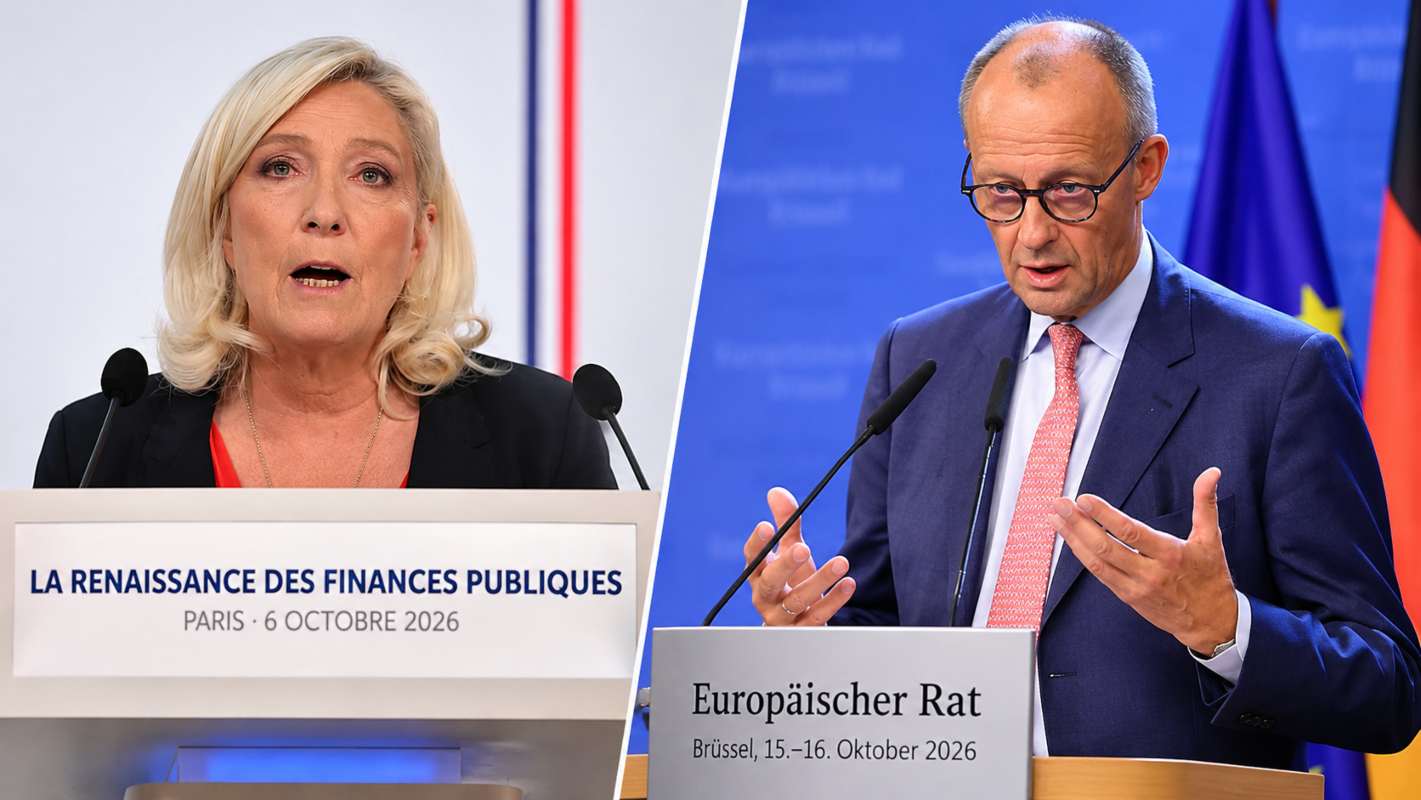
Germany is moving to secure long-term European financial assistance for Ukraine before France’s 2027 presidential election, amid concerns that a potential change of government in Paris could disrupt the EU’s commitments to Kyiv.
According to POLITICO, Berlin is pressing for a financing mechanism within the European Union’s next seven-year budget that would allow future increases in Ukraine assistance without requiring unanimous approval from all 27 member states.
The initiative, championed by German Chancellor Friedrich Merz, reflects growing anxiety over the durability of European support for Ukraine as political divisions deepen across the continent.
At the centre of Berlin’s calculations is Marine Le Pen, whose opposition to continued French financial assistance for Kyiv has raised concerns among European governments supporting Ukraine.
Le Pen has pledged to end French financial support for Ukraine within six months of taking office if elected president in April 2027.
Germany’s proposed solution is to establish the financial and legal framework for future assistance before any potential change in French leadership.
The objective is not simply to approve another aid package. It is to create a structure that could make European financial commitments more resistant to future political disagreements.
Berlin’s Strategy: Finance Ukraine Without Repeated National Vetoes
The European Commission has proposed allocating €100 billion to Ukraine under the EU’s next long-term budget, covering the period from 2028 to 2034.
However, Germany believes Kyiv’s financial requirements could significantly exceed that amount.
Berlin is therefore advocating additional borrowing capacity within the EU budget through a mechanism known as headroom.
In European budgetary terms, headroom represents the difference between the maximum financial resources the EU can legally call upon from member states and the amounts required to finance its existing spending commitments.
That additional capacity can help support borrowing on capital markets.
The German proposal would establish a framework allowing the EU to raise further funds for Ukraine without requiring governments to make immediate, large-scale payments from their national budgets.
Crucially, Berlin wants future borrowing decisions under the agreed framework to be taken by qualified majority voting, rather than unanimity.
If approved in a legally workable form, such an arrangement could prevent a single member state from independently blocking certain future financing decisions.
The proposal would not eliminate national veto powers across the EU budget. Establishing the framework itself would still require the necessary unanimous agreement.
Nevertheless, it would represent an important attempt to make future financial assistance less vulnerable to political deadlock.


‘Ukraine Funding Is More Contested Than Ever’
A senior European official familiar with the negotiations described the growing divisions over financial assistance to Kyiv.
“Ukraine funding is more contested than ever,” the official told POLITICO.
The official warned that disagreements could intensify if Le Pen became France’s next president.
The concern extends beyond France’s direct financial contributions.
As one of the EU’s largest economies, France plays a central role in negotiations over the bloc’s budget, common borrowing arrangements and long-term spending priorities.
A future French government opposed to additional assistance could therefore complicate efforts to maintain European financing for Ukraine.
Another European diplomat familiar with the discussions questioned whether unanimity remained appropriate for decisions of this kind.
The debate reflects a wider disagreement over the balance between national sovereignty and collective European action.
Governments supporting changes to decision-making procedures argue that the EU needs greater flexibility to respond to prolonged geopolitical crises.
Opponents maintain that decisions involving substantial financial commitments should remain subject to national approval.
Marine Le Pen and the Threat to French Financial Support
Le Pen has repeatedly challenged the scale of European financial assistance to Ukraine.
On November 16, she defended her intention to end French financial contributions to Kyiv within the first six months of a potential presidency.
Her position also extends to France’s participation in EU-level financing arrangements.
Le Pen argues that France’s fiscal difficulties require a reassessment of public spending priorities, including international commitments.
However, her position does not necessarily exclude every form of assistance to Ukraine.
She has left open the possibility of continuing certain types of material support and military training.
For Berlin, the distinction is significant but does not resolve the broader financial challenge.
France is an essential participant in the EU’s budget negotiations, and any major change in its position could affect the bloc’s capacity to agree on common financing.
Germany’s initiative seeks to reduce that uncertainty by establishing longer-term commitments before the French presidential election.
The proposal is therefore closely connected to the changing political landscape in Europe, although the outcome of France’s election remains undecided.
Merz Uses the EU’s €2 Trillion Budget as Leverage
Germany has considerable influence over the negotiations because it is the largest net contributor to the EU budget.
The next seven-year financial framework, worth approximately €2 trillion, will determine how European resources are distributed across agriculture, regional development, competitiveness, defence and other priorities.
Merz is seeking to use Germany’s financial position to secure a broader agreement on Ukraine.
According to POLITICO, Berlin has linked its support for the next EU budget to the establishment of additional financing capacity for Kyiv.
Germany also wants member states to share the financial burden rather than allowing individual governments to opt out of common commitments.
That position creates tensions with countries that receive substantial funding from EU regional development programmes.
Berlin’s negotiating approach could connect support for Ukraine to wider discussions over cohesion funds and other budget allocations.
For governments dependent on European financing, the implications are significant.
A dispute over assistance to Kyiv could become part of a much larger negotiation over the distribution of EU resources.

Hungary, Slovakia and the Czech Republic Push Back
Germany’s proposal faces resistance from several Central European governments.
Hungary, Slovakia and the Czech Republic have sought exemptions from certain arrangements for financing Ukraine.
Their objections differ in emphasis, but they include concerns over the scale of financial commitments, the use of common European resources and the extent of national control over spending.
Berlin is reluctant to accept exemptions that could weaken the collective financing mechanism.
German officials are concerned that allowing some member states to opt out could establish a precedent for larger countries to demand similar treatment.
That possibility is particularly relevant to France.
If a future French government sought to withdraw from common financial commitments, the impact could be much greater than exemptions granted to smaller economies.
Germany therefore wants a framework that distributes financial responsibilities across the EU.
The disagreement illustrates the difficulty of maintaining collective financial commitments when member states have increasingly different positions on the war and their domestic spending priorities.
The Additional €45 Billion Loan and Ukraine’s Growing Financial Needs
The immediate financial pressures facing Ukraine add urgency to the negotiations.
The European Commission is considering an additional loan of approximately €45 billion, potentially financed through the common EU budget.
Ukraine faces substantial financing requirements for 2027 as the continuing war places enormous pressure on government expenditure and economic activity.
Russian attacks on energy infrastructure have added to the country’s reconstruction and emergency spending needs.
At the same time, servicing existing borrowing commitments is becoming an increasingly important consideration for European policymakers.
According to estimates cited by POLITICO, more than €40 billion could be required to cover interest payments associated with existing loans.
If those obligations were financed from the proposed €100 billion allocation, the amount available for new direct assistance would be reduced considerably.
That prospect strengthens Germany’s argument for additional borrowing capacity.
Berlin wants the EU to have sufficient financial flexibility to address both Ukraine’s immediate requirements and its longer-term reconstruction and budgetary needs.
Germany’s Domestic Challenge: The AfD and Opposition to Ukraine Spending
Merz is also facing political pressure at home.
Germany’s financial and military support for Ukraine remains a subject of domestic debate, particularly as economic pressures affect households and businesses.
The Alternative for Germany (AfD) has criticised the scale of assistance to Kyiv and argued that the federal government should prioritise domestic economic and social concerns.
The party’s electoral strength, particularly in eastern Germany, has added to the political sensitivity of further spending commitments.
For Merz, a common European financing mechanism offers a way to distribute the financial burden more broadly.
Germany has already committed substantial resources to Ukraine and does not want future assistance to depend disproportionately on a limited number of major contributors.
The chancellor has argued that Ukraine policy should be fully incorporated into the EU’s budgetary framework.
That approach would connect financial assistance to Kyiv more closely with the EU’s long-term security and economic planning.
It would also make Ukraine financing a structural element of European policy rather than a succession of emergency agreements.
The November 26 Summit: A Critical Test for European Unity
The next major stage in the negotiations is expected at the November 26–27 European Council summit.
EU leaders will confront disagreements over Ukraine financing, the next long-term budget and the distribution of financial responsibilities among member states.
The central difficulty is that approving the multiannual financial framework requires unanimity.
That gives governments opposing the German proposal significant negotiating power.
Berlin’s strategy depends on securing agreement now for a mechanism that would allow certain future decisions to be taken more flexibly.
But neither the proposed structure nor its detailed legal arrangements have yet been approved.
The summit will therefore be an important test of whether European governments can reconcile their different financial and political priorities.
Any agreement would need to address concerns about borrowing, national budgetary responsibility and the legal limits of qualified majority voting.
A Different France, a Different Europe?
Germany’s initiative highlights the extent to which European governments are preparing for possible political changes in major member states.
Le Pen’s opposition to continued financial assistance for Ukraine has made France’s 2027 presidential election an important consideration in long-term EU budget planning.
Berlin wants to reduce the consequences of a potential shift in French policy by embedding future financing options in a multiannual European framework.
The dispute reflects two competing approaches to European decision-making.
Germany and other governments supporting continued assistance argue that long-term commitments require predictable financial mechanisms.
Governments opposing common borrowing or mandatory contributions emphasise national budgetary authority and the right to determine their own financial obligations.
The disagreement goes beyond Ukraine.
It concerns the EU’s capacity to finance collective priorities when its member states do not share the same political objectives.
Europe’s Ukraine Commitment Faces a Defining Budget Battle
The German proposal is ultimately an attempt to make European financial assistance more predictable during a period of political uncertainty.
The war in Ukraine has created long-term financial requirements that cannot easily be addressed through short-term emergency packages alone.
At the same time, European governments face competing demands for defence, infrastructure, economic competitiveness and domestic public services.
Merz is seeking an arrangement that would preserve the EU’s ability to support Kyiv even if individual governments change their positions.
Le Pen and other political figures opposed to common financing argue for greater national control over those commitments.
The outcome will depend on negotiations among all 27 member states and the legal structure ultimately agreed.
The central question is whether the European Union can establish durable financial support for Ukraine without making every future increase dependent on unanimous political approval.
For Germany, the priority is to secure the framework before Europe’s political landscape changes further.
For France and other member states, the negotiations raise fundamental questions about fiscal sovereignty.
And for Ukraine, the decisions could determine the scale and reliability of European financial assistance for years to come.
The battle over Ukraine’s future is increasingly being fought not only on the battlefield and at the negotiating table, but also inside the EU’s €2 trillion budget.
Source: pagenews.gr