Germany Issues EU Budget Ultimatum: No Deal Without Long-Term Funding for Ukraine
 ΧΡΟΝΟΣ ΑΝΑΓΝΩΣΗΣ 9 '

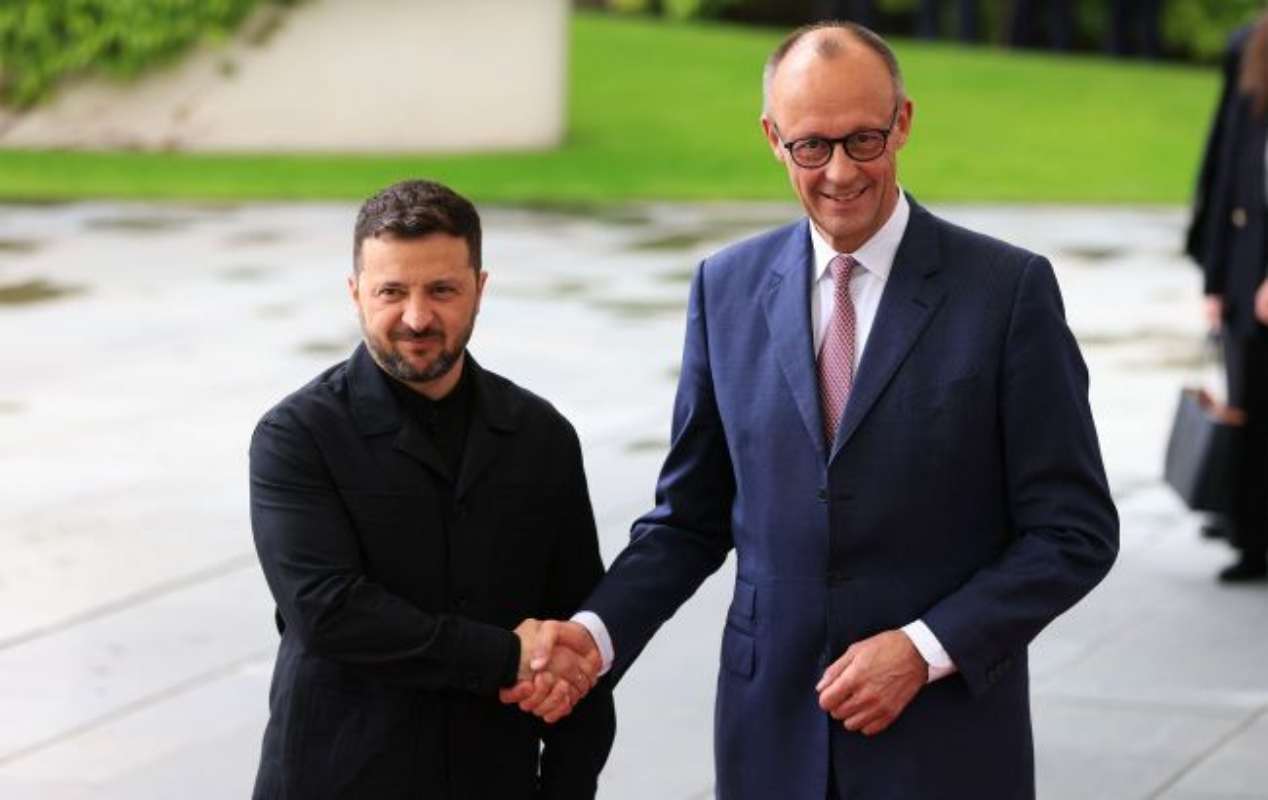
Πηγή Φωτογραφίας: Photo: Volodymyr Zelenskyy and Friedrich Merz (Getty Images)



Germany is intensifying pressure on its European partners, warning that it could block agreement on the European Union’s next long-term budget unless member states secure a sustainable financing arrangement for Ukraine.
Chancellor Friedrich Merz is seeking to tie the EU’s 2028–2034 Multiannual Financial Framework (MFF) to a binding political commitment that would distribute the cost of supporting Kyiv more evenly among member states.
According to the Financial Times, Berlin wants to ensure that Ukraine’s financial needs are no longer addressed through repeated emergency negotiations, with a disproportionate burden falling on a limited number of European governments.
The confrontation comes at a particularly sensitive moment for the EU. Ukraine faces an estimated €70 billion financing gap in 2027, while European leaders are simultaneously negotiating the bloc’s future spending priorities, defence commitments, agricultural subsidies and regional development funding.
Berlin’s Ultimatum: Ukraine Funding Must Become a Shared Responsibility
Germany’s position reflects growing frustration over the uneven distribution of financial commitments to Ukraine.
As the EU’s largest net contributor, Berlin argues that long-term assistance to Kyiv should be embedded in a predictable European financing framework rather than dependent on successive ad hoc arrangements.
The German government wants member states to commit to a mechanism capable of covering Ukraine’s immediate needs in 2027 while also providing financial stability beyond that year.
Such an arrangement could include allocations within the 2028–2034 EU budget and provisions for servicing interest payments associated with European loans to Ukraine.
By linking the two negotiations, Merz is using Germany’s influence over the EU budget to press for a broader agreement on burden-sharing.
The next MFF will determine how the European Union distributes resources across agriculture, regional development, research, infrastructure, defence and competitiveness.
Because the long-term budget requires unanimous approval by member states, Germany’s refusal to endorse a final agreement could create a significant institutional deadlock.
Ukraine’s €70 Billion Gap: Brussels Looks for €45 Billion
The immediate challenge is Ukraine’s projected financing requirement for 2027.
European estimates put the country’s uncovered needs at approximately €70 billion.
The European Union is considering covering roughly €45 billion, equivalent to nearly two-thirds of the total.
The remaining amount would need to come from other international partners, potentially including the United Kingdom, Canada, Norway and Japan.
However, these contributions have not yet been fully secured.
Speaking on November 9, European Commissioner for the Economy Valdis Dombrovskis acknowledged the scale of the challenge and confirmed that the European Commission was examining several financing options.
He expressed confidence that a solution could be found for the EU’s share.
Nevertheless, the proposed €45 billion remains a financing objective rather than a fully approved disbursement package.
Berlin’s proposal faces resistance from several governments unwilling to accept additional financial obligations.
Hungary, Slovakia and the Czech Republic have expressed reservations about participating in new joint financing arrangements, while Bulgaria has also been reluctant to assume commitments on the same terms.
Some countries have previously secured exemptions from specific financial obligations associated with European assistance to Ukraine.
Germany argues that such arrangements risk producing an increasingly unequal distribution of costs.
The disagreement extends beyond the amount of money involved.
It also concerns how the EU should make decisions on financial support for Ukraine and whether individual governments should retain the ability to block certain initiatives.
Berlin would like to reduce the scope for repeated national vetoes.
However, changes to voting procedures cannot simply be introduced through political agreement. The applicable decision-making rules depend on the legal basis established by EU treaties.
The Joint Borrowing Dilemma
One of the most contentious questions concerns whether the European Union should issue additional common debt.
Joint borrowing would allow the EU to raise funds on international capital markets and provide financing to Ukraine backed by guarantees from the European budget.
Several European officials regard this as a practical way to address Kyiv’s immediate needs.
Yet Germany itself has traditionally resisted expanding common European borrowing beyond exceptional circumstances.
On October 21, Germany’s ambassador to the EU, Thomas Hans Ossowski, reiterated Berlin’s opposition to additional joint borrowing as a general mechanism for financing the bloc’s policies.
That creates a difficult negotiating balance.
Germany is demanding broader collective responsibility for Ukraine’s financing while remaining reluctant to support a permanent expansion of EU-wide debt issuance.
European governments must therefore agree not only on the scale of assistance but also on the mechanism used to raise the funds.
Frozen Russian Assets Remain an Option
Another potential source of financing involves frozen Russian sovereign assets.
The European Union has already used revenues generated by immobilised Russian assets to support Ukraine.
A broader arrangement remains under consideration, although legal and financial obstacles continue to complicate negotiations.
The debate involves questions of property rights, sovereign immunity, financial-market confidence and the potential consequences of using Russian assets more extensively.
Dombrovskis confirmed that options involving frozen Russian assets remained under examination.
Some European proposals link the eventual repayment of Ukraine-related loans to future Russian reparations.
However, no comprehensive agreement has resolved all the legal and budgetary questions associated with such a mechanism.
Ireland Seeks a Compromise
Ireland, which holds the rotating presidency of the Council of the European Union, has acknowledged that the Ukraine financing debate and the next EU budget have become politically interconnected.
Irish Finance Minister Simon Harris said on November 9 that it was difficult to conduct meaningful negotiations on the next long-term budget without simultaneously addressing Ukraine’s financing requirements.
He suggested that a possible solution could build on previous EU lending arrangements for Kyiv.
Such a mechanism could involve additional European borrowing backed by the EU budget.
However, this remains one of several options under discussion rather than an agreed policy.
Agricultural Funding and Regional Development Under Pressure
The confrontation has implications beyond Ukraine.
Germany is also calling for substantial reductions to the European Commission’s initial proposals for the 2028–2034 budget.
Berlin wants to redirect more resources towards defence, security, research, innovation and economic competitiveness.
That approach has generated opposition from countries seeking to protect funding for the Common Agricultural Policy and EU cohesion programmes.
Both are central pillars of European spending, particularly for southern and eastern member states.
Countries such as Greece have a substantial interest in maintaining agricultural support, regional development funds and infrastructure investment.
For Athens, the negotiations therefore concern two overlapping priorities: continued European support for Ukraine and the future distribution of EU resources.
No specific reduction in Greece’s funding has been formally agreed as a consequence of Germany’s position.
The Dublin Summit: November 26–27
The next major negotiating milestone is the European leaders’ meeting scheduled for November 26–27, 2026, in Dublin.
The gathering was initially expected to focus primarily on the next seven-year budget.
However, Ukraine’s financial requirements have become an increasingly urgent part of the agenda.
Leaders will need to consider the scale of assistance to Kyiv, possible common borrowing arrangements and the EU’s broader spending priorities for 2028–2034.
The timing adds pressure.
Several European countries, including France, Italy, Poland and Greece, face important electoral contests in 2027.
EU institutions are seeking to narrow their differences before national political campaigns make compromises more difficult.
Slovakia Warns Against Linking the Two Negotiations
Slovak Prime Minister Robert Fico has publicly opposed connecting Ukraine’s financing requirements with the next EU budget.
“It would be very dangerous, and I want to make this absolutely clear, if someone tried to link financing for Ukraine with the budget,” he said.
Fico also expressed scepticism about the prospects for reaching an agreement quickly.
“It would be a miracle if we reached an agreement in December,” he added.
His comments highlight the central difficulty facing Brussels: the need to secure reliable financing for Ukraine is colliding with sharply different national fiscal and political priorities.
For Germany, the issue is one of collective responsibility.
Berlin argues that financial assistance to Kyiv must be predictable, sustainable and shared across the European Union.
For governments resisting new obligations, the concern is whether additional commitments could place unacceptable pressure on national budgets.
The negotiations will determine whether the EU can establish a durable financial framework for Ukraine without jeopardising agreement on its own long-term spending priorities.
Source: pagenews.gr
Διαβάστε όλες τις τελευταίες Ειδήσεις από την Ελλάδα και τον Κόσμο