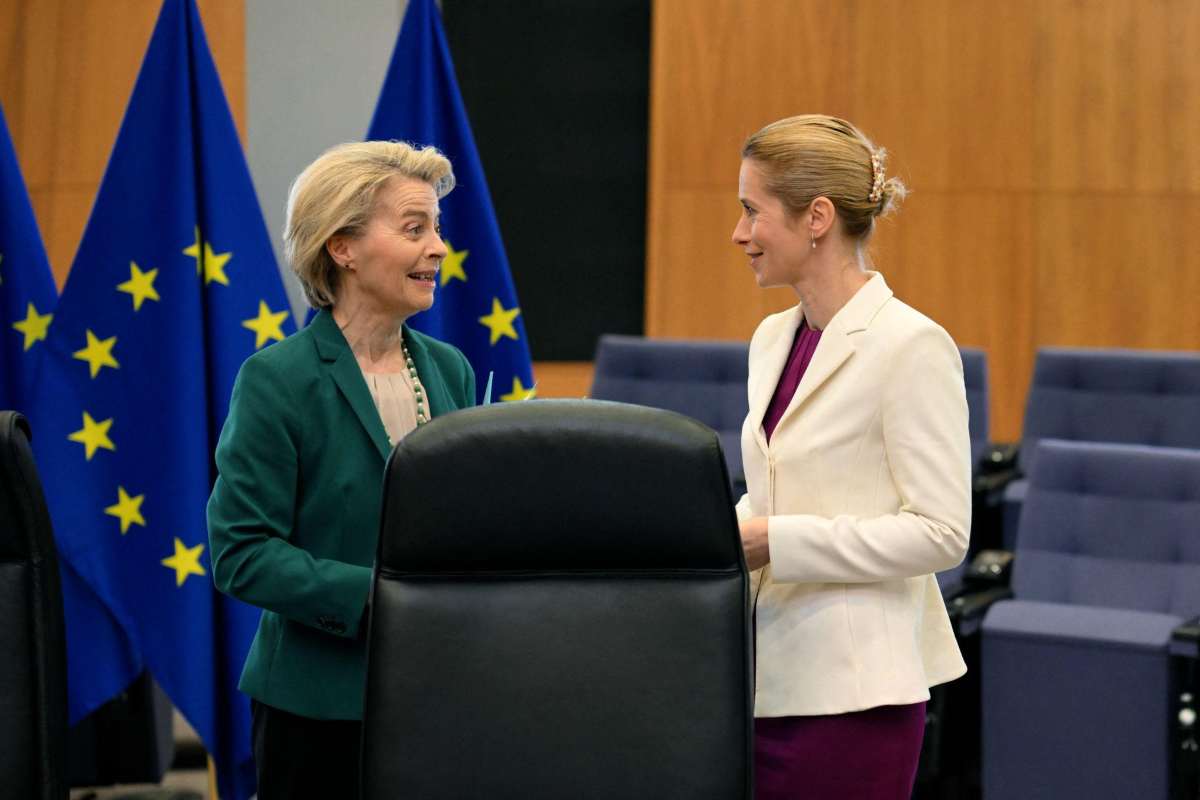
Kaja Kallas arrived in Dublin seeking a mandate to represent the European Union in the US-mediated negotiations to end Russia’s war against Ukraine. She left without a seat at the negotiating table.
On November 13, European leaders agreed on a seven-member representation mechanism that excluded the EU’s High Representative for Foreign Affairs and Security Policy.
The decision has largely been interpreted as a personal political setback for the former Estonian prime minister. Yet it also raises a more fundamental institutional question: who actually speaks for Europe when its security interests are at stake?
European foreign policy appears to be moving in two directions simultaneously — towards national leaders and their security advisers, and towards the European Commission under Ursula von der Leyen.
The office created by the Lisbon Treaty to connect these two centres of power is facing growing pressure from both sides.
Behind Closed Doors in Dublin: Meloni and the Seven Representatives
Kallas arrived at the informal Dublin summit with a specific proposal: to become Europe’s representative in negotiations aimed at ending the war in Ukraine.
She reportedly reminded European leaders that when the bloc’s senior institutional appointments were agreed in June 2024, the possibility of negotiations with Moscow during her five-year mandate was already foreseeable.
According to Euronews, her argument failed to secure sufficient support.
Italian Prime Minister Giorgia Meloni reportedly questioned the institutional weight of Kallas’s candidacy during the closed-door discussions, according to sources familiar with the meeting.
European leaders ultimately agreed on a negotiating structure comprising representatives from:
- France.
- Germany.
- Italy.
- Poland.
- The United Kingdom.
- The European Council.
- The European Commission.
The five national governments constitute the E5 grouping within the Coalition of the Willing supporting Ukraine.
The EU’s institutional representation was entrusted to officials associated with European Council President António Costa and European Commission President Ursula von der Leyen.
The European External Action Service (EEAS), headed by Kallas, was left outside the negotiating framework.


Kallas: Moscow Should Not Choose Europe’s Representative
Kallas had publicly acknowledged Russia’s objections to her potential participation in negotiations, linking Moscow’s position to her longstanding criticism of the Kremlin.
Her argument was that Russia should not be allowed to determine who represents Europe, just as European governments cannot select Moscow’s negotiators.
Kallas has also rejected the suggestion that her personal views determine EU foreign policy, emphasising that the positions she represents are established collectively by the member states.
Nevertheless, the need to coordinate negotiations with countries outside the European Union, particularly the United Kingdom, complicated the selection of a single European envoy.
The resulting arrangement prioritises collective representation over the appointment of one institutional figure.
Ceasefire First, European Security Architecture Later
Speaking in Dublin on November 12, during the European Political Community summit, Kallas outlined a sequence of priorities for negotiations with Russia.
The first objective, she argued, should be a ceasefire and an end to attacks against civilians.
The second should involve negotiations towards a peace agreement.
Only then should discussions address Europe’s future security architecture.
Kallas also pointed to existing international agreements, including the Helsinki Final Act, the Charter of Paris and the Budapest Memorandum.
Her argument centres on ensuring compliance with existing commitments rather than simply negotiating new ones.
On November 13, she again emphasised that European participation should translate into genuine influence over the outcome of negotiations.
Despite her insistence on a substantive European role, leaders opted for a different representation mechanism.

The Lisbon Treaty: What Articles 15, 18 and 27 Actually Say
The institutional significance of the Dublin decision becomes clearer when examined against the provisions of the Treaty on European Union.
The Lisbon Treaty, which entered into force on December 1, 2009, sought to reduce the fragmentation of European diplomacy by connecting the foreign policy responsibilities of national governments with those of the European Commission.
Article 18 establishes that the High Representative conducts the Union’s Common Foreign and Security Policy, contributes to its development and implements it in accordance with the Council’s mandate.
The High Representative also chairs the Foreign Affairs Council and serves as a vice-president of the European Commission.
Article 27 assigns the office responsibility for representing the Union on matters relating to the Common Foreign and Security Policy, conducting political dialogue with third parties and expressing EU positions in international organisations and conferences.
However, Article 15 also grants the president of the European Council external representation responsibilities at their own level, without prejudice to the powers of the High Representative.
Foreign policy remains substantially intergovernmental, with national governments retaining decisive authority over major strategic decisions.
Kallas’s exclusion from a particular negotiating framework therefore does not automatically constitute a violation of the Lisbon Treaty.
It does, however, raise questions about how the treaty’s institutional arrangements operate when Europe faces a major international security crisis.
António Costa and the Return of Intergovernmental Diplomacy
European Council President António Costa has emphasised European unity and coordination in discussions concerning Ukraine’s future.
His position is that European security is inseparable from Ukrainian security and that decisions concerning Ukraine’s sovereignty and territorial integrity must ultimately belong to Ukraine itself.
Costa has also linked future security guarantees to the capabilities of the Coalition of the Willing, in coordination with NATO.
This approach reflects the central role of national governments, which possess the military forces, intelligence capabilities and national security mechanisms that could underpin a future agreement.
Yet it also highlights an important distinction between the common foreign policy of the EU’s 27 member states and the diplomatic initiatives of a smaller group of European powers.
The Dublin arrangement brings that distinction into sharper focus.


Ursula von der Leyen and the Commission’s Expanding Geopolitical Role
The second dimension of Kallas’s exclusion concerns the European Commission’s increasingly prominent role in foreign affairs.
Under Ursula von der Leyen, the Commission has become deeply involved in several areas central to negotiations over Ukraine:
- Financial assistance and long-term economic support.
- Sanctions against Russia.
- Trade policy and economic security.
- Reconstruction financing.
- European defence industrial capacity.
- Ukraine’s prospective EU membership.
These instruments give the Commission substantial influence over both wartime support and any future settlement.
In Dublin, von der Leyen welcomed European participation in discussions concerning Ukraine, stressing the importance of continued support for Kyiv.
The inclusion of a Commission representative in the negotiating framework reflects the significance of these economic and institutional responsibilities.
The question is whether the Commission’s expanding geopolitical role will complement the work of the European External Action Service or gradually diminish its political influence.
The Lisbon Treaty was designed to connect these institutions through the High Representative’s dual responsibilities.
Dublin suggests that this institutional balance is becoming increasingly difficult to maintain.
The Brexit Paradox: Britain at the Table, the EU’s Chief Diplomat Outside
One of the most striking aspects of the Dublin decision is the inclusion of the United Kingdom.
Six years after leaving the European Union, Britain occupies a central position in a European negotiating mechanism that could influence the continent’s security architecture for decades.
The decision reflects Britain’s military capabilities, its nuclear status, its diplomatic influence and its membership of NATO.
Nevertheless, it creates an institutional paradox.
A country outside the European Union has secured direct participation in the negotiating framework, while the official responsible for conducting the bloc’s common foreign and security policy has been excluded.
The development illustrates the growing distinction between European integration and broader European defence cooperation.
The two are closely connected, but they are no longer necessarily conducted through the same institutional structures.
What the E5 Arrangement Means for Greece and Other EU Members
For countries such as Greece, which are not part of the E5 grouping, the new negotiating structure raises questions about how their interests will be represented.
The seven-member arrangement does not remove the rights of other member states within the European Council, nor does it alter the EU’s formal decision-making procedures.
However, direct participation in negotiations differs politically from representation through common European institutions.
For Athens, the issue extends beyond the war in Ukraine.
Greece has a significant interest in the future European security architecture, particularly where questions of national sovereignty, territorial integrity, international law and the protection of maritime interests are concerned.
A negotiating mechanism dominated by a limited number of national governments makes effective institutional coordination particularly important for smaller and medium-sized member states.
No specific Greek government response to Kallas’s exclusion has been established in the reporting available for this article.


Three Centres of Power, One European Foreign Policy
The Dublin decision exposes the tensions between three distinct centres of European political authority.
National governments retain military capabilities, intelligence services and sovereign diplomatic powers.
The European Commission controls important economic, financial and regulatory instruments.
The European External Action Service is responsible for supporting the continuity and coherence of common European diplomacy.
Kaja Kallas occupies the institutional position where these responsibilities are supposed to converge.
Her exclusion does not abolish the office of High Representative or bring the EU’s Common Foreign and Security Policy to an end.
It does, however, illustrate how European leaders may increasingly rely on alternative diplomatic arrangements when confronting major international crises.
Who Ultimately Speaks for Europe?
The significance of Dublin extends beyond the political fortunes of Kaja Kallas.
The decision raises questions about whether the institutional compromise established by the Lisbon Treaty remains sufficient to manage an increasingly complex European security environment.
National capitals are asserting their strategic responsibilities. The European Commission is expanding its geopolitical influence. Smaller coalitions are becoming important mechanisms for coordinating military and diplomatic initiatives.
Meanwhile, the institution specifically designed to connect these different dimensions of European foreign policy faces uncertainty over its practical role.
The real test is not simply whether Europe secures a seat at the negotiating table with Washington and Moscow.
It is whether those occupying that seat possess a common mandate, shared priorities and the political authority to commit Europe to an agreement that could define its security for generations.
Πηγή: pagenews.gr