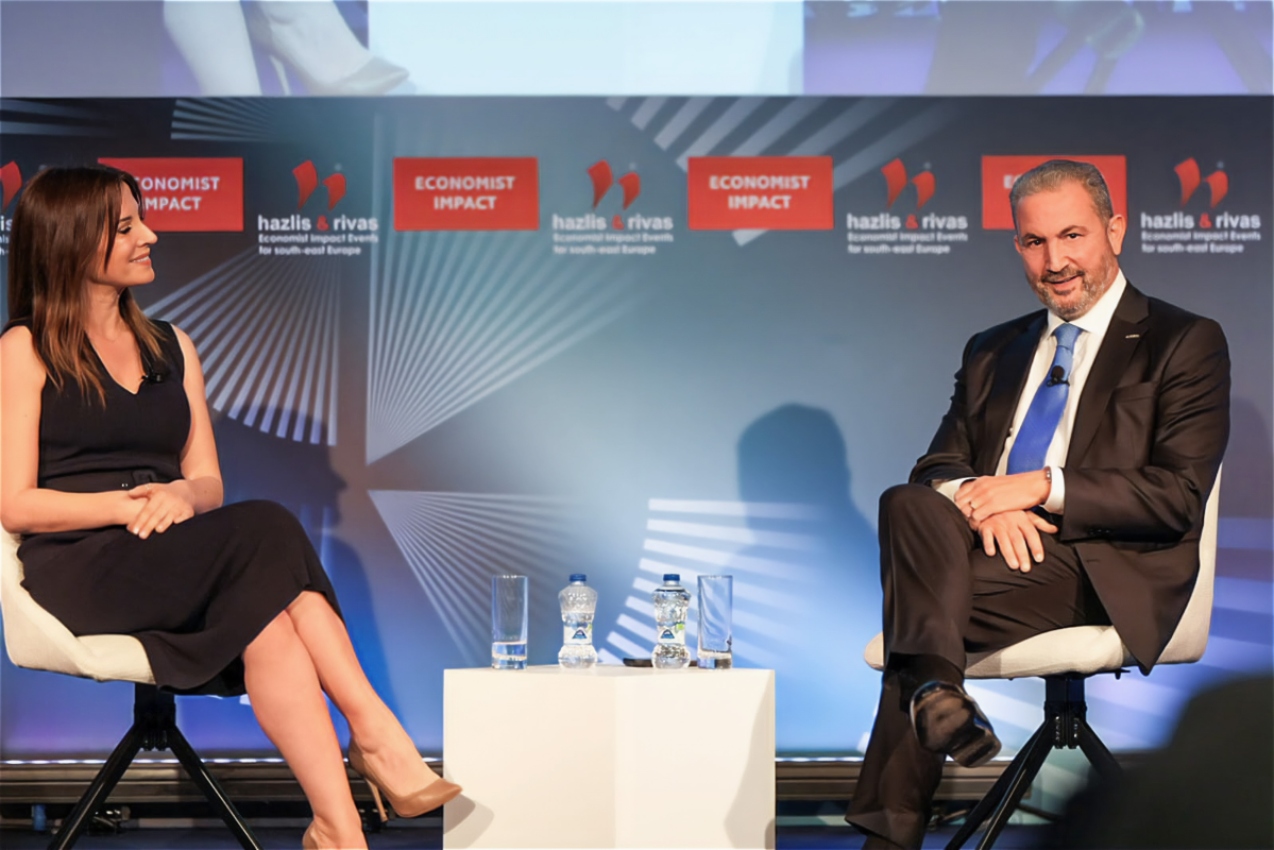
In a sharply geopolitical intervention at the Economist conference “Investing in Change: How Crete is Being Transformed”, AKTOR Group Chairman and CEO Alexandros Exarchou argued that Europe is dangerously underestimating the scale of the energy and inflation pressures that could emerge next winter.
Speaking during a discussion with journalist Niki Lymperaki, Exarchou framed the proposed Vertical Energy Corridor not merely as an infrastructure or commercial initiative, but as a strategic geopolitical project tied directly to Europe’s energy sovereignty, inflation resilience and long-term security architecture.
Europe’s New Energy Battlefield
According to Exarchou, the European Union may soon face a renewed energy squeeze as multiple supply shocks converge simultaneously.
The executive warned that Europe’s attempt to fully decouple from Russian natural gas is colliding with another destabilizing factor: disruptions affecting Qatari gas exports following broader instability linked to the Iran conflict and maritime insecurity in critical shipping lanes.
That combination, he argued, risks reigniting inflationary pressures across the continent.“Europe should not wait passively for the crisis to materialize before reacting,” Exarchou stressed, warning that policymakers must urgently build “structured defensive mechanisms” against another inflationary wave driven by energy scarcity.
The AKTOR chief predicted that EU member states may ultimately be forced to mobilize new fiscal support measures to shield households and businesses from rising energy costs during the winter season.

The Vertical Corridor as Strategic Infrastructure
At the center of Exarchou’s intervention stood the concept of the Vertical Energy Corridor — a network designed to strengthen north-south gas flows across Southeastern Europe and reduce dependency on single suppliers.
Rather than presenting the initiative as a narrow commercial venture, Exarchou described it as a project of strategic national and European importance.
According to him, the corridor reflects a broader geopolitical transition now unfolding across Europe after the 2022 energy shock triggered by the war in Ukraine.
He argued that Europe’s real vulnerability was never dependence on LNG markets in general, but rather excessive reliance on Russian gas specifically — a dependence that Moscow successfully weaponized after the invasion of Ukraine.
“Europe needs balance in its energy sources,” Exarchou said, emphasizing that no serious European policymaker seeks to replace one monopoly dependency with another.
The AKTOR chairman insisted that long-term supply agreements are critical for restoring stability, improving pricing visibility and making large-scale infrastructure projects financially bankable.
Those contracts, he said, are essential if Europe wants to secure the financing needed for future energy corridors, LNG facilities and cross-border transmission infrastructure.
A Political Fight Inside Europe
Exarchou acknowledged that parts of the European establishment remain skeptical about the corridor project.
Several EU member states continue to resist aspects of the initiative, largely because of competing energy interests, divergent industrial strategies and disagreements over future gas dependency.
Yet the AKTOR CEO predicted that economic necessity will eventually override political hesitation.“The corridor will not only succeed commercially — it will ultimately gain European support,” he said.
His comments align with a growing camp within European industry that argues Brussels has underestimated the speed at which deindustrialization risks could accelerate if energy prices remain structurally elevated.
Inflation Is Returning to the Center of the European Debate
Exarchou’s intervention comes as concerns quietly intensify inside European policy circles regarding the return of inflation through the energy channel.
While headline inflation has moderated in many EU economies, energy remains the largest structural vulnerability.
Any renewed spike in natural gas prices could quickly feed into electricity markets, manufacturing costs, food prices and interest-rate expectations.
For governments already burdened by debt, another energy-driven inflation cycle could become politically explosive.
This is particularly important for Southern Europe, where economic growth remains heavily dependent on tourism, infrastructure spending and external financing conditions.
A prolonged energy squeeze could undermine both competitiveness and fiscal stability simultaneously.
AKTOR’s Broader Strategic Positioning
Exarchou’s remarks also reveal AKTOR’s broader ambition to position itself at the center of the region’s next-generation infrastructure and energy map.
The company has increasingly aligned itself with projects linked to:
- energy corridors,
- strategic infrastructure,
- logistics networks,
- LNG connectivity,
- and cross-border transport systems.
In this framework, the Vertical Corridor is not simply an energy pipeline discussion — it becomes part of a larger geopolitical realignment in Southeastern Europe.
Athens increasingly sees Greece as a gateway connecting Mediterranean energy routes with Central and Eastern Europe, particularly as the EU seeks alternatives to Russian supply networks.
Credia Bank and the Return of Greek Risk Appetite
Speaking also as a shareholder of Thrivest Holdings, Exarchou addressed the transformation of Credia Bank, describing its recovery as evidence that investor confidence in Greece has materially improved.
He recalled that only two years ago the predecessor banks — Attica Bank and Pancretan Bank — were struggling with negative equity positions.
Today, according to Exarchou, the merged institution has evolved into a fully recapitalized bank with capital ratios comparable to Greece’s systemic lenders.
He pointed specifically to the acquisition of HSBC Malta operations as a sign of growing confidence and operational expansion.
The AKTOR chairman credited both management execution and political stability for the turnaround.
“Political Stability Creates Investment”
Exarchou repeatedly returned to one core argument: markets invest where they perceive predictability.“The economy would not have developed successfully without political stability,” he said.
According to him, international investors no longer merely explore Greek opportunities theoretically — they are now deploying actual capital into projects, often using their own balance sheets rather than relying exclusively on debt financing.
That shift, he argued, reflects the credibility Greece has gradually rebuilt after years of crisis.
Europe’s Next Test
Behind Exarchou’s intervention lies a broader warning for Europe.
The continent may have survived the first energy shock of the post-Ukraine-war era, but structural vulnerabilities remain unresolved:
- limited gas flexibility,
- fragmented infrastructure,
- geopolitical exposure,
- and persistent industrial competitiveness problems.
If supply disruptions intensify again this winter, Europe could face a renewed collision between energy security, inflation management and fiscal sustainability.
And in that environment, projects once viewed as regional infrastructure may suddenly become strategic pillars of European resilience.
As Exarchou summarized succinctly:“Energy is security — and security has a cost.”
Source: pagenews.gr