National Bank of Greece Sees Greek SMEs Holding Their Nerve: Investment Resilience Meets the AI Revolution
 ΧΡΟΝΟΣ ΑΝΑΓΝΩΣΗΣ 6 '

Πηγή Φωτογραφίας: eurokinissi//National Bank of Greece Sees Greek SMEs Holding Their Nerve: Investment Resilience Meets the AI Revolution



At a time when geopolitical tensions, inflationary pressures and global uncertainty continue to weigh on business confidence, the latest economic survey by the National Bank of Greece (NBG) paints a remarkably resilient picture of the country’s small and medium-sized enterprises (SMEs).
Rather than abandoning investment plans, Greek businesses are adapting them.
Projects are being postponed—not cancelled.
More importantly, companies are increasingly directing investment toward what is rapidly becoming the defining technology of the next decade: Artificial Intelligence (AI).
Uncertainty delays decisions—but not investment
Conducted in April, during one of the most volatile periods of renewed tensions in the Middle East, NBG’s Business Economic Analysis survey found only a marginal decline in investment sentiment.
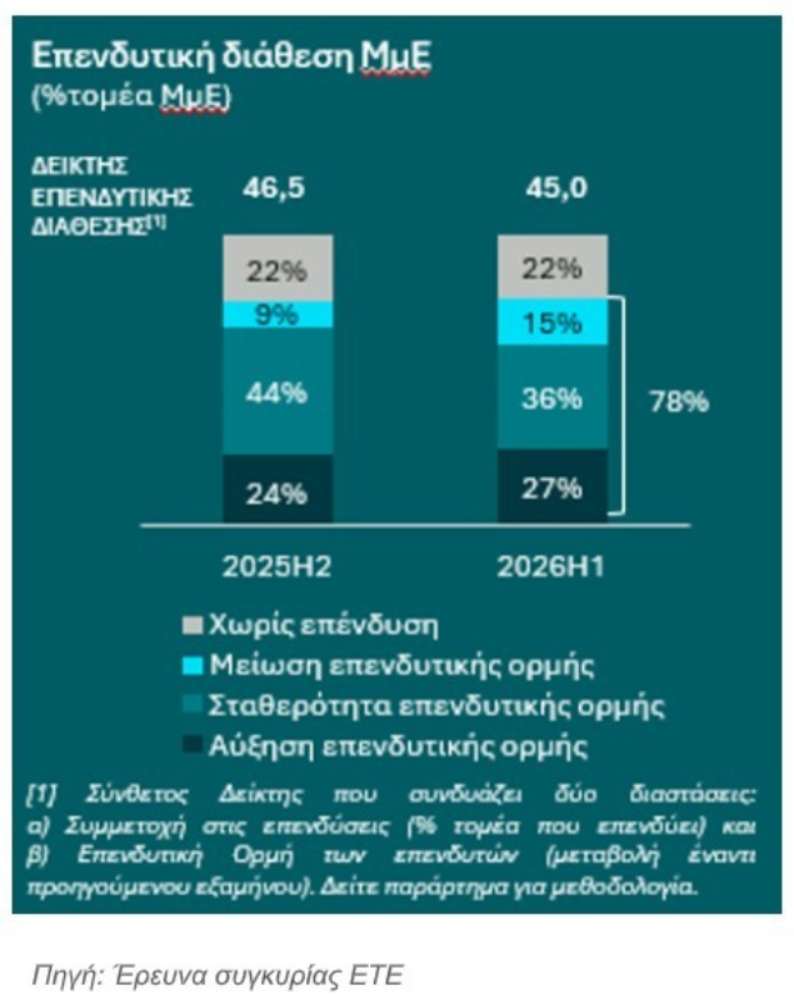
The SME Investment Sentiment Index eased from 46.5 to 45 points, a modest decline considering the challenging international environment.
The most encouraging figure, however, lies elsewhere.
Nearly 78% of Greek SMEs still intend to undertake some form of investment.
The investment base remains broad and remarkably stable.
According to the National Bank, geopolitical uncertainty is primarily influencing the timing of investments rather than their cancellation, suggesting that the underlying fundamentals of Greece’s SME sector remain resilient.
That distinction is particularly significant for an economy where SMEs account for the overwhelming majority of employment and productive activity.
Artificial Intelligence becomes the new investment frontier
The report identifies Artificial Intelligence as the fastest-rising priority in the digital transformation of Greek businesses.
What makes AI particularly significant is that it no longer appears to be a technology reserved for large corporations.
Instead, it has become accessible even to the smallest enterprises.
According to the survey:
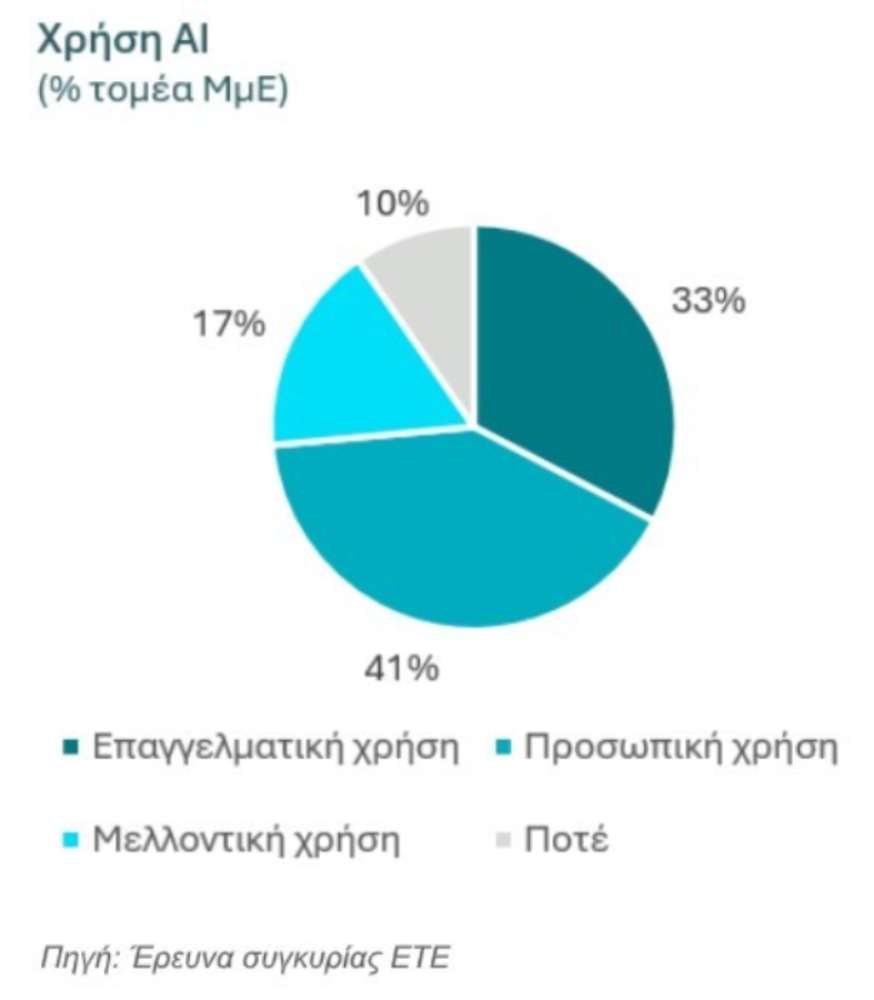
- 33% of Greek SMEs already use AI professionally in their daily operations.
- 41% use AI tools personally, creating a natural pathway toward future business adoption.
- 17% plan to introduce AI into their operations in the near future.
- Only 10% state they have no intention of ever using AI.
The findings suggest that AI adoption in Greece is progressing faster than many analysts expected.

Closing Greece’s traditional digital gap
Perhaps the report’s most strategic conclusion is that Artificial Intelligence is becoming the first digital technology capable of reducing long-standing structural inequalities.
Unlike previous waves of digitalisation, AI adoption appears to be largely independent of company size.
For the first time, small businesses are embracing new technology at rates comparable to much larger enterprises.
Even more striking, Eurostat data cited by NBG indicates that Greece does not display its usual digital lag behind the European average when it comes to AI usage.
Low entry costs and the widespread availability of user-friendly AI applications appear to be allowing Greek companies to close a competitiveness gap that has persisted for years in other technological fields.
Early adopters are already seeing measurable gains
The report moves beyond adoption rates to examine the tangible impact of AI on business performance.
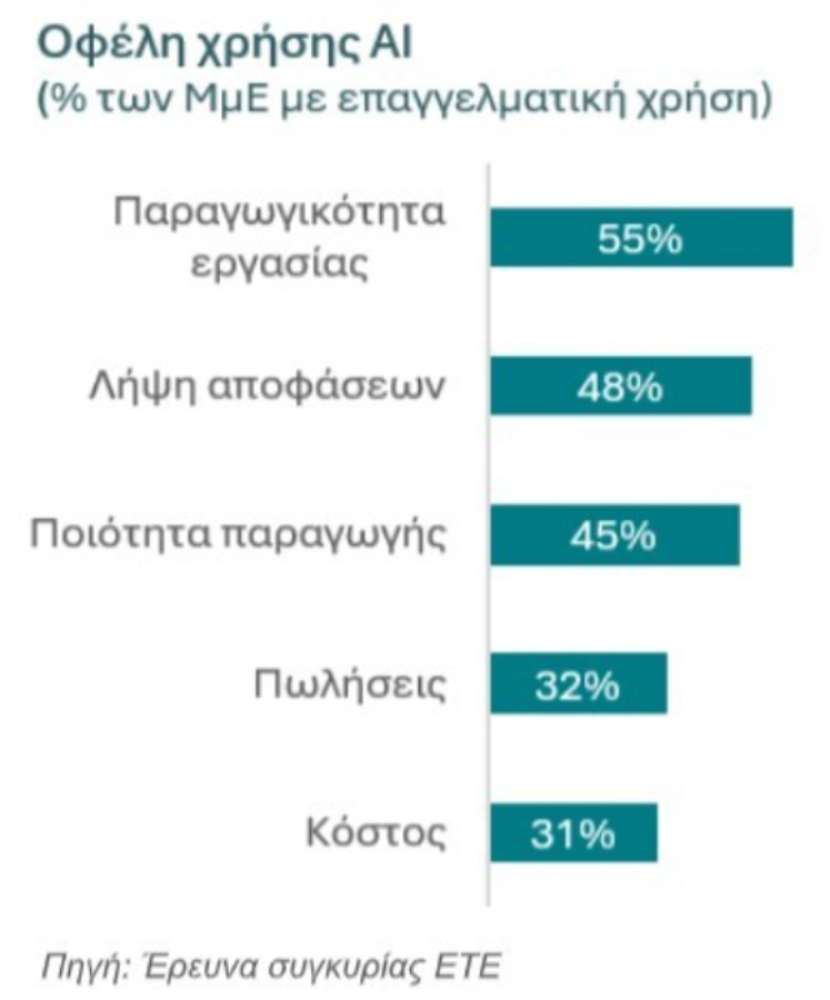
Companies already using Artificial Intelligence report clear operational improvements:
- 55% report higher workforce productivity.
- 48% say AI improves decision-making.
- 45% report better production quality.
- 32% have experienced stronger sales performance.
- 31% report lower operating costs.
The findings indicate that AI is rapidly evolving from an experimental technology into a genuine business productivity tool.
For many SMEs, the return on investment is already becoming visible.
More AI means greater investment ambition
One of the strongest correlations identified by the survey concerns companies’ willingness to invest.
Businesses making extensive use of AI report an Investment Sentiment Index of 63 points.
That compares with:
- 50 points among limited AI users.
- 40 points among companies with no AI usage at all.
The message is clear.
Digital maturity increasingly goes hand in hand with stronger investment confidence.
Companies that embrace technological change appear more willing to expand, innovate and pursue new growth opportunities.
Technology alone is not enough
Despite the encouraging figures, the National Bank cautions against viewing AI simply as another software purchase.
The real competitive advantage will belong to businesses that build the organisational capabilities required to integrate AI effectively.
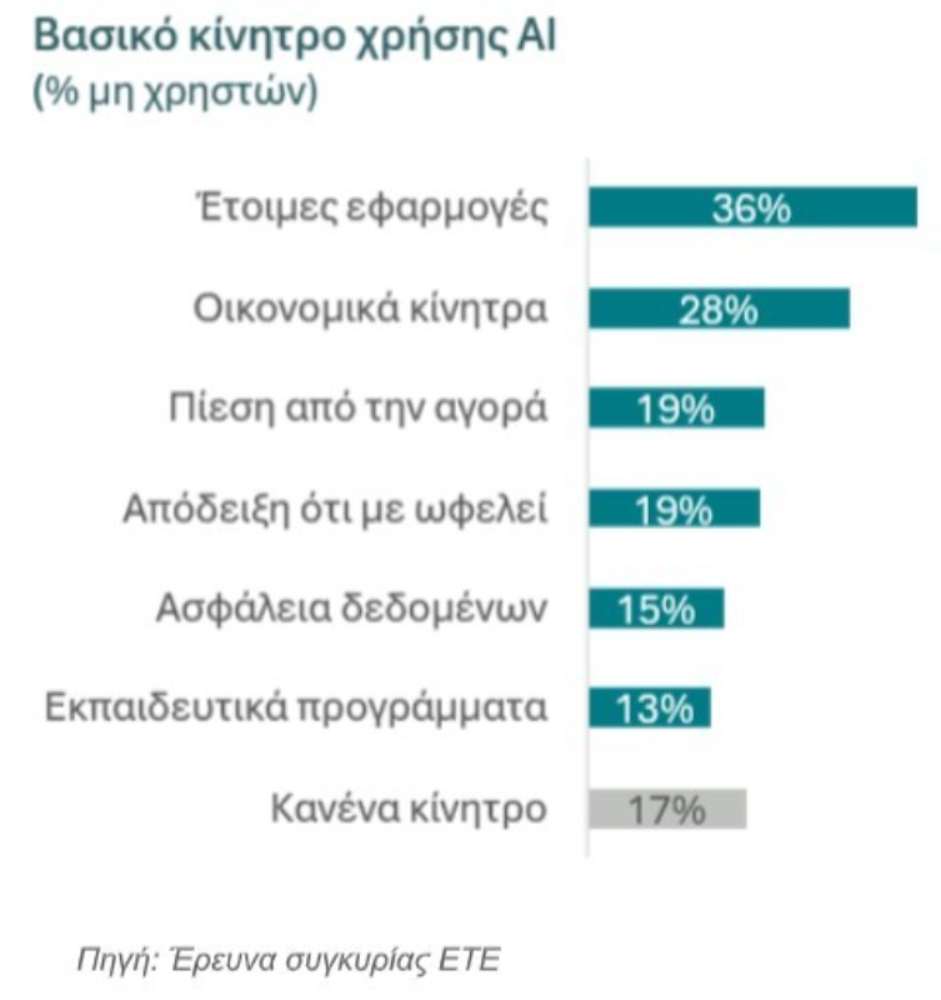
Among non-users:
- 36% say they are waiting for ready-made applications.
- 28% would like stronger financial incentives.
- 19% believe competitive pressure will eventually force adoption.
Yet the report argues that organisational capability cannot simply be bought.
It must be developed gradually through experimentation, employee training, improved internal processes and better use of business data.
In other words, successful AI adoption depends less on the technology itself than on how organisations learn to work alongside it.
A broader economic signal
Beyond technology, the report sends a broader message about the resilience of Greece’s business sector.
Despite heightened geopolitical risks, SMEs continue to plan investments, modernise operations and embrace digital transformation.
Artificial Intelligence is no longer viewed as a futuristic concept.
It is becoming part of everyday business operations.
For the National Bank of Greece, the conclusion is straightforward.
The next competitive advantage will not belong to the companies that simply acquire the most sophisticated AI tools.
It will belong to those that learn first how to integrate them into their business model, decision-making processes and organisational culture.
The survey suggests that a growing share of Greek SMEs has already begun that journey—positioning the country’s business community for a more innovative, resilient and competitive future.
Source: pagenews.gr
Διαβάστε όλες τις τελευταίες Ειδήσεις από την Ελλάδα και τον Κόσμο