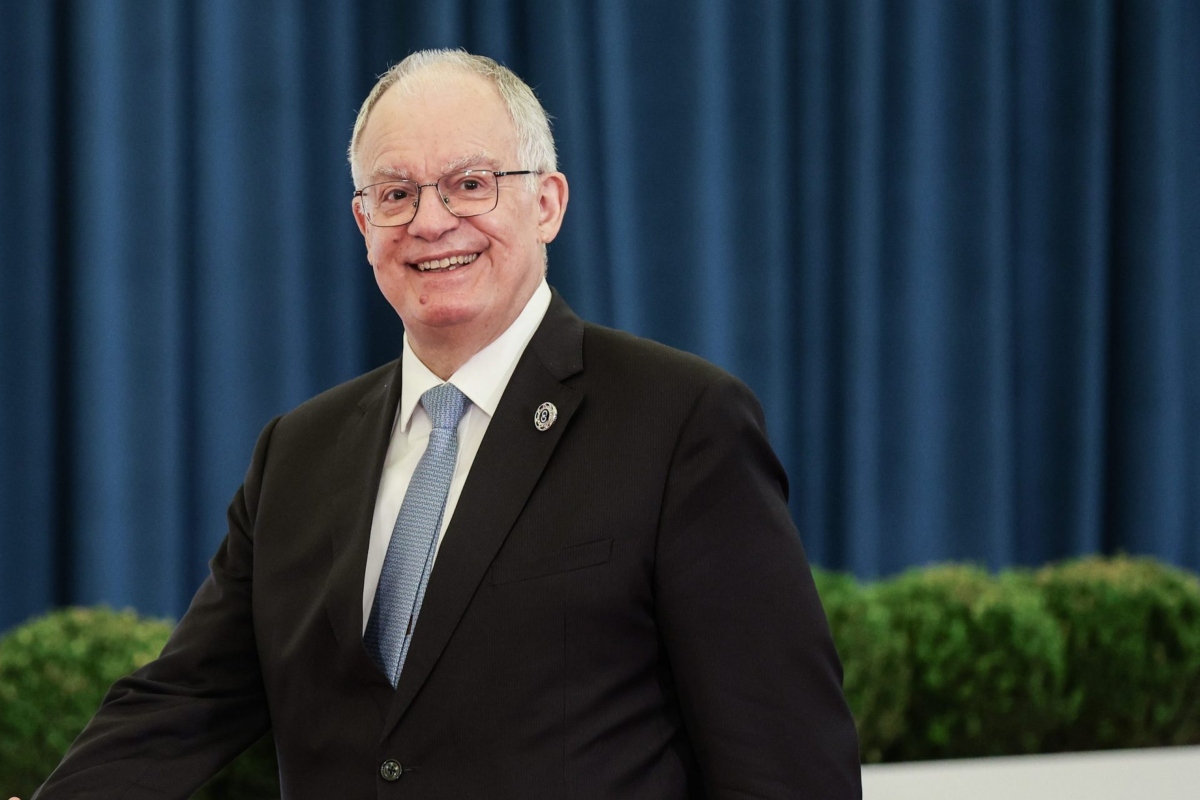
President of the Hellenic Republic Konstantinos Tasoulas marked the 52nd anniversary of the restoration of democracy with a statement combining historical reflection, institutional gravity and a clear political message for the present.
He described Greece’s Third Republic as the longest, most stable and most liberal democratic period in the country’s modern political history, while stressing that democracy must never be treated as a permanent and self-sustaining achievement.
“Over these 52 years, the Third Hellenic Republic, established by its chief architect Konstantinos Karamanlis, evolved into the most stable, liberal, long-lasting and democratic period in the political life of our country.”
The legacy of Konstantinos Karamanlis
Tasoulas placed particular emphasis on the role of Konstantinos Karamanlis, whom he described as the principal architect of the democratic order established after the fall of the military junta.
His reference went beyond historical tribute. It also underlined the importance of the institutional choices made in 1974, when Greece returned to parliamentary democracy, restored constitutional normality and firmly anchored itself in Europe.
Despite periods of economic crisis, political tension and institutional setbacks, the President noted that parliamentary democracy and the country’s institutions proved resilient and capable of responding to changing circumstances.
“Democracy does not only provide rights”
One of the most politically significant parts of Tasoulas’ statement concerned the obligations that accompany democratic life.
“Democracy, the democracy we consolidated 52 years ago, does not only provide rights. It also has demands.”
He identified those demands as the need for a calmer political climate, broader consensus on Greece’s long-standing international orientation and national unity in the face of major domestic and foreign-policy challenges.
The message carries particular weight at a time of intense political polarisation and increasingly confrontational public debate.
Tasoulas’ intervention can therefore also be read as an appeal to the political system to protect the quality of democratic dialogue and to avoid allowing political conflict to erode institutional trust.


A democracy facing a new age of uncertainty
The President said Greece now possesses a democracy that is both experienced and mature enough to confront the challenges of the modern world.
“We now have a democracy that is experienced and mature in the face of the contemporary challenges of conflict, uncertainty and instability that define the international environment.”
The global setting is markedly different from that of 1974. Armed conflicts, geopolitical competition, energy insecurity, climate pressures, migration and rapid technological transformation are creating new strains for European democracies.
In this environment, institutional stability cannot be regarded as automatic. It must be continuously defended through political responsibility, social cohesion and respect for constitutional rules.
The continuing wound of Cyprus
Tasoulas directly linked the restoration of democracy in Greece with the tragedy of Cyprus.
He recalled that on 24 July 1974, while democracy was returning to Athens, Cyprus was suffering the consequences of the coup and the Turkish invasion.
“Democracy was returning to Greece, but Cyprus had fallen into the abyss of the junta’s coup and the Turkish invasion.”
The wording underlined the fact that the democratic transition in Greece cannot be separated from the Cyprus issue, which remains an unresolved historical, national and international question.
The President reiterated Greece’s commitment to a just, viable and functional settlement of the Cyprus problem, reaffirming the continuity of the country’s national position.
The reference to George Seferis
Tasoulas opened his statement with the words of George Seferis, who publicly denounced the dictatorship in 1969:
“I see before me the abyss toward which the oppression that has covered the country is leading us.”
The reference gave the anniversary message a powerful symbolic dimension.
Democracy was presented not merely as a form of government, but as the opposite of repression, arbitrariness and fear. It also connected the memory of resistance to the dictatorship with the present-day duty to protect democratic freedoms.
Greece’s European orientation
The President also stressed that Greece’s security and prosperity remain closely linked to its European environment and to the strategic orientation set after 1974.
The country’s European path, in his view, is not simply a foreign-policy option. It is a core pillar of the stability and progress achieved during the post-junta democratic era.
Maintaining that course requires political maturity, institutional consistency and broad consensus on the country’s place in Europe and the wider international system.
Tribute to Spyros Moustaklis
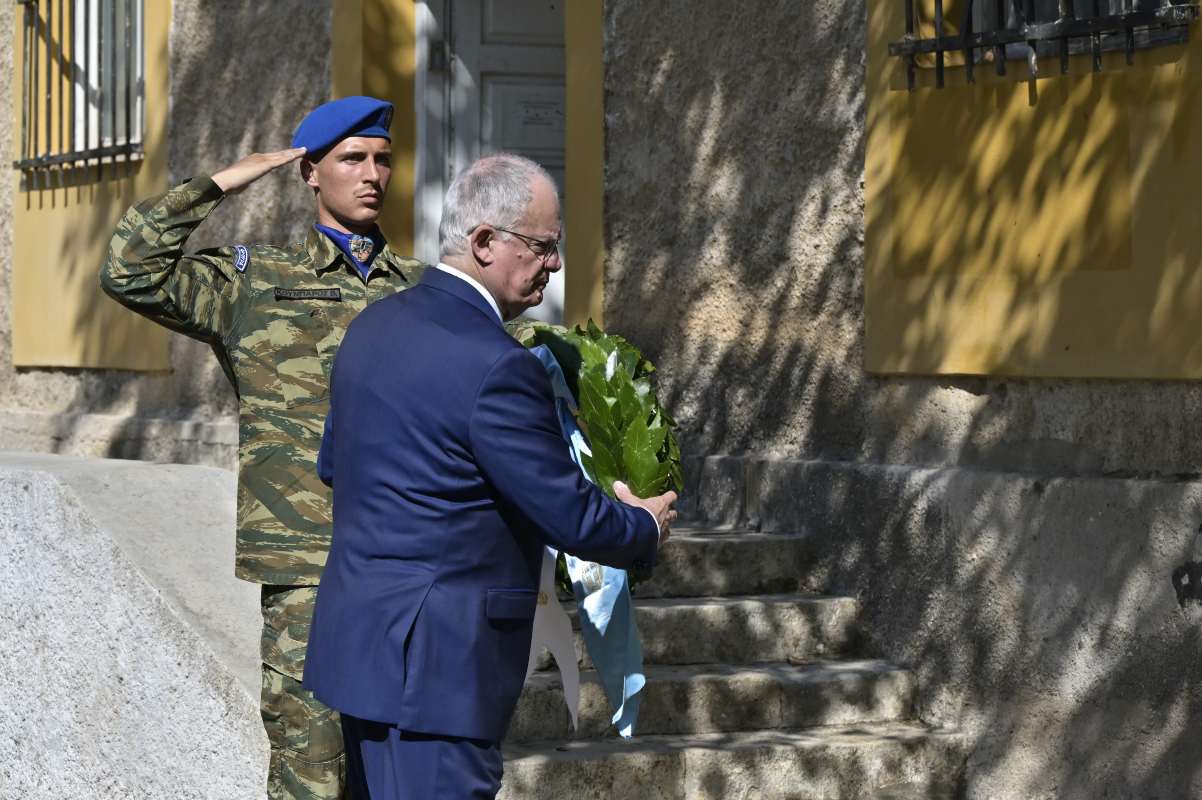
Earlier in the day, Tasoulas visited the former detention facilities of the EAT-ESA military police at Freedom Park in Athens and laid a wreath at the bust of Spyros Moustaklis, one of the most emblematic figures of resistance against the dictatorship.
He was welcomed by Evangelos Giougis, president of the Association of Imprisoned and Exiled Resistance Fighters of 1967-1974, members of the association’s board and Christina Moustaklis.
The visit carried strong symbolic significance. The anniversary of democracy is not only an occasion for official ceremonies, but also a moment of remembrance for those who were imprisoned, tortured and persecuted for resisting authoritarian rule.
A call for unity without complacency
Tasoulas’ statement went beyond the formal language of an anniversary message.
It highlighted the endurance of Greece’s democratic institutions, while warning against complacency. Democracy, he argued, is strong because it has been tested, but it still requires daily protection.
It depends on respect for institutions, restraint in political confrontation, responsibility in public life and unity on major national questions.
Fifty-two years after the fall of the dictatorship, Greece is living through the most stable democratic period in its history. The challenge now is to ensure that this achievement remains dynamic and meaningful, sustained by functioning institutions, active citizens and political forces that understand that democracy demands not only freedom, but responsibility.
Source: pagenews.gr