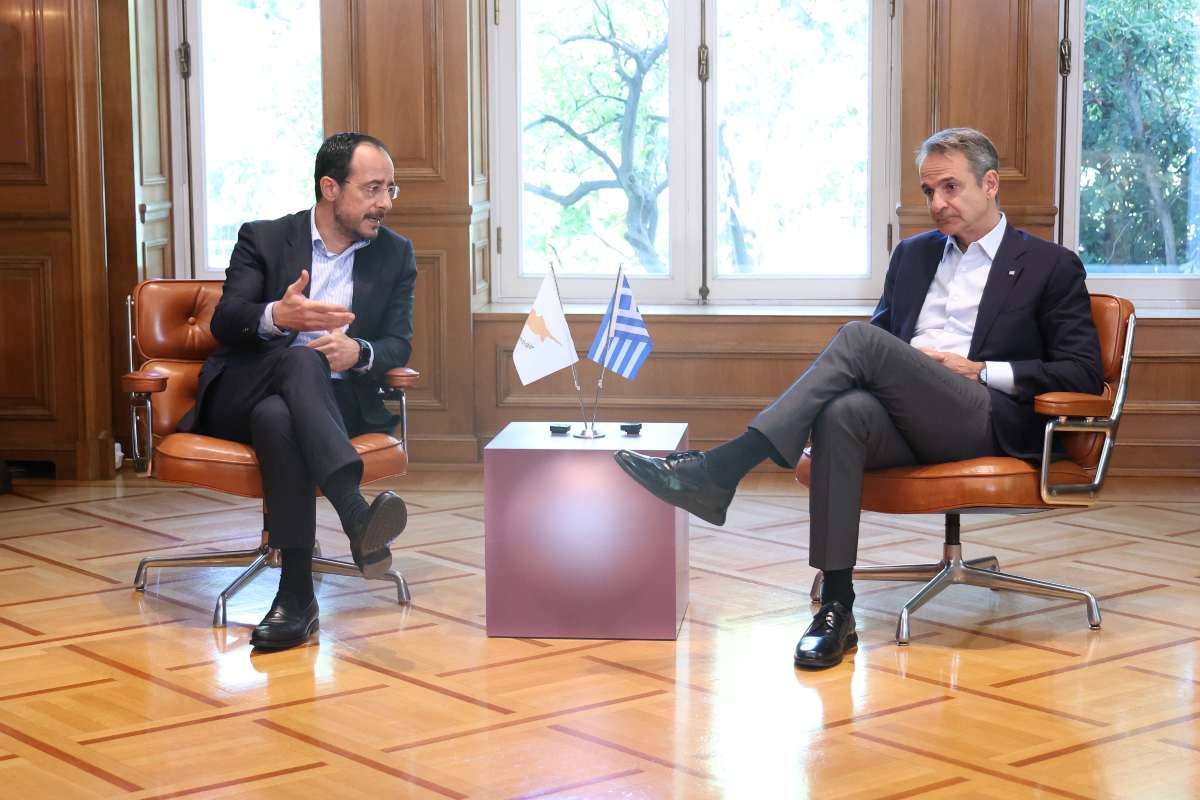
The meeting between Greek Prime Minister Kyriakos Mitsotakis and Cypriot President Nikos Christodoulides at the Maximos Mansion was far more than a routine bilateral consultation. It took place at a time of mounting geopolitical instability across the Eastern Mediterranean and renewed international attention on the Cyprus issue after years of diplomatic stagnation.
The upcoming visit of United Nations Secretary-General António Guterres to Cyprus—the first by a UN chief in nearly two decades—has created cautious optimism that negotiations could finally be revived. At the same time, the European Union’s increasingly active engagement reflects a broader recognition that the Cyprus issue is no longer solely a UN matter but also a strategic European concern.
Cyprus Moves Back to the Center of Europe’s Agenda
Welcoming President Christodoulides to Athens, Prime Minister Mitsotakis reaffirmed Greece’s unwavering support for Cyprus’ diplomatic efforts to restart substantive negotiations.
“We meet at an extremely critical juncture. Greece fully supports your initiatives for a meaningful resumption of negotiations, always within the framework of the United Nations Security Council resolutions. This is a position from which Greece and Cyprus will never deviate,” Mitsotakis declared.
His remarks reaffirm Athens’ long-standing commitment to a bizonal, bicommunal federation, in accordance with UN Security Council resolutions, as the only internationally recognized framework for resolving the Cyprus dispute.


The European Union Takes a More Prominent Role
A key theme of the meeting was the European Union’s growing involvement in the diplomatic process.
President Christodoulides stressed that the Cyprus issue is increasingly viewed as a European challenge, emphasizing that recent diplomatic initiatives have successfully elevated the issue within EU institutions.
“It is now understood by everyone that the Cyprus issue is a European issue,” he said.
This reflects a significant shift in Brussels’ approach. The European Commission has recently strengthened its political engagement, while several member states increasingly link stability in Cyprus to Europe’s broader security, energy diversification, and Eastern Mediterranean strategy.
Regional Instability Adds Urgency
The meeting also unfolded against the backdrop of renewed instability across the Middle East.
Prime Minister Mitsotakis warned that “the drums of war are beating loudly once again,” referring to the deteriorating security situation extending from the Gulf to the Red Sea.
For both Greece and Cyprus, these developments underline the island’s growing strategic importance. Cyprus has become a critical hub for:
- Humanitarian operations,
- European security missions,
- Regional logistics,
- Energy infrastructure,
- Crisis management in the Eastern Mediterranean.
This broader geopolitical environment gives additional weight to efforts aimed at advancing the Cyprus peace process.
A Narrow Diplomatic Window Before the End of Guterres’ Mandate
One of the most significant points raised by Mitsotakis concerned the timing of the current diplomatic momentum.
The Greek Prime Minister noted that Guterres’ initiative coincides with the final phase of his tenure as UN Secretary-General, creating a sense of urgency for all parties involved.
Athens and Nicosia believe that the coming months may represent one of the last realistic opportunities to generate meaningful progress before a new UN leadership transition potentially reshapes international priorities.


Turkey Remains the Key Variable
Despite the renewed diplomatic momentum, both governments acknowledge that meaningful progress ultimately depends on Ankara’s position.
The UN Secretary-General’s Personal Envoy has already held consultations with Turkish Foreign Minister Hakan Fidan, while Greece and Cyprus continue to assess whether Turkey is prepared to resume negotiations within the UN framework or will continue advocating its long-standing proposal for a two-state solution.
This fundamental disagreement remains the principal obstacle to any comprehensive settlement.
Beyond Cyprus: Strengthening Europe’s Civil Protection
The leaders also discussed the devastating wildfires affecting Spain and France, highlighting the need for a stronger European Civil Protection Mechanism.
Mitsotakis pointed to Greece’s contribution of firefighting aircraft to Spain as evidence of growing European solidarity and emphasized the importance of developing a more integrated EU emergency response capability.
The discussion reflects a broader Greek-Cypriot strategy of promoting deeper European cooperation in civil protection, energy security, and regional resilience.
A European Strategy for a Longstanding Conflict
The Athens meeting demonstrated that Greece and Cyprus are pursuing a coordinated effort to reposition the Cyprus issue from a bilateral dispute into a broader question of European security, international law, and regional stability.
The increased engagement of both the European Union and the United Nations creates a more favorable diplomatic environment than in recent years. However, significant political obstacles remain, particularly regarding Turkey’s position on the future constitutional framework of the island.
Whether António Guterres’ visit will lead to the long-awaited resumption of negotiations from where they collapsed in Crans-Montana in 2017 remains uncertain. Nevertheless, the coming weeks could prove decisive in determining whether the current diplomatic momentum evolves into a genuine peace process—or becomes yet another missed opportunity in one of Europe’s longest unresolved conflicts.
Source: pagenews.gr