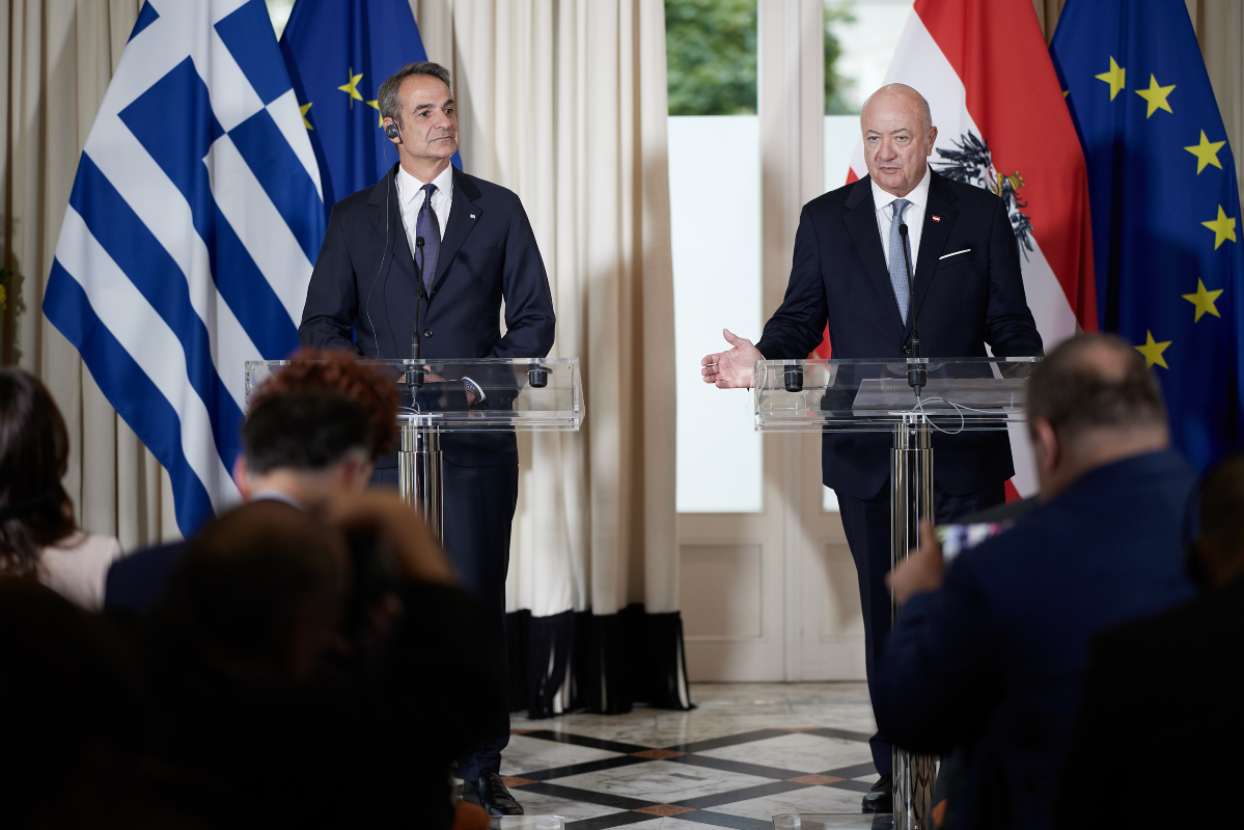
“There Are No Easy or Magic Solutions”
The Greek Prime Minister sought to temper expectations of sweeping government intervention to offset rising fuel prices, arguing that the current inflationary pressures are driven primarily by international geopolitical developments rather than domestic factors.
“There are no easy or magic solutions,” Mitsotakis said, emphasizing that Greece will continue supporting households and businesses within the limits of its fiscal capacity, while prioritizing the most vulnerable sectors of society.
He pointed to the government’s €0.10-per-liter diesel subsidy for August, alongside approximately €800 million in energy support measures already deployed throughout 2026 to cushion the impact of higher energy prices.
Warning Brussels: Europe Must Be Ready for Another Energy Shock
The most significant political message from Salzburg concerned the possibility of renewed turmoil in global energy markets.
While expressing hope that geopolitical tensions will continue to ease, Mitsotakis warned that any renewed escalation could once again send oil and natural gas prices soaring, forcing Europe to consider extraordinary support measures.
“I hope we will not have to meet again at the European Council to discuss emergency support measures for European societies and businesses if the situation deteriorates once more.”
The statement signals Athens’ growing insistence that any future energy crisis should be addressed through collective European action, rather than fragmented national responses.


Political Energy: Greece Pushes for Reform of Europe’s Energy Market
Behind the Prime Minister’s remarks lies a broader strategic objective.
Athens continues to argue that the current design of the European electricity market creates significant distortions, leaving countries that have invested heavily in renewable energy unable to translate lower production costs into cheaper electricity bills for households and businesses.
Mitsotakis stressed that Europe cannot remain globally competitive while both families and industries pay substantially more for energy than their international competitors, highlighting the wide price disparities that still exist across the EU’s supposedly integrated energy market.
Greece Positions Itself as a Strategic Energy Hub
The Prime Minister also highlighted Greece’s expanding geopolitical role in Europe’s energy architecture.
He underlined the country’s ambition to become a major transit corridor for natural gas supplies into the European market, arguing that energy infrastructure is increasingly intertwined with Europe’s broader security interests.
“Energy security is also geopolitical security.”
The message comes as the European Union seeks to diversify its energy supply routes and reduce strategic vulnerabilities amid continuing geopolitical uncertainty.
Austria Praises Greece’s Economic Transformation
Austrian Chancellor Christian Stocker offered unusually strong praise for Greece’s economic performance.
He described Greece as a successful model of structural reforms, citing its sustained economic growth, rapid debt reduction, and strengthened resilience.
Stocker also highlighted Greece’s crucial contribution to protecting the European Union’s external borders.
“Greece plays a decisive role in protecting the EU’s external borders, and we are grateful for that.”


Shared Agenda: Migration, Tourism and Western Balkans
Beyond energy, both leaders reaffirmed their commitment to:
- strengthening cooperation on migration management,
- fully implementing the EU Migration and Asylum Pact,
- establishing return hubs for rejected asylum seekers,
- promoting sustainable tourism,
- enhancing European competitiveness,
- supporting the EU accession prospects of the Western Balkans.

A Broader European Message
The Salzburg meeting extended well beyond a bilateral diplomatic engagement.
It showcased Greece’s ambition to play a leading role in shaping Europe’s future energy strategy, linking energy security with economic competitiveness, fiscal stability, and geopolitical resilience.
At the same time, Austria’s public endorsement of Greece’s reform agenda and its recognition of Athens’ role in protecting Europe’s external borders reinforce the Greek government’s narrative that the country has significantly strengthened both its economic standing and its strategic influence within the European Union.
Source: pagenews.gr