Greece’s New Renewables Map: Which Projects Win — and Which Risk Being Frozen
 ΧΡΟΝΟΣ ΑΝΑΓΝΩΣΗΣ 7 '

Πηγή Φωτογραφίας: pixabay//Greece’s New Renewables Map: Which Projects Win — and Which Risk Being Frozen



Greece’s new Special Spatial Planning Framework for Renewable Energy Sources is now reshaping the investment landscape for billions of euros in green-energy projects.
The key question for the market is no longer what the new framework says on paper, but which projects can actually move forward under the new rules.
For investors, developers and major energy groups, the distinction is crucial.
The framework introduces tougher filters for new investments and expands restrictions in sensitive areas, while at the same time protecting sufficiently mature projects and creating specific openings for investments that can demonstrate strong energy performance.
A new game for billions in renewable investment
The new framework replaces rules designed for a very different era of Greece’s energy market.
Today, the country has substantially more installed renewable capacity, intense investor interest, a large pipeline of grid-connection applications and growing pressure from local communities concerned about the concentration of projects in particular areas.
The government is now seeking to establish clearer rules governing where wind farms, solar parks, small hydroelectric facilities, biomass units and storage projects can be developed.
The official objective is twofold: Greece must continue its energy transition towards 2050, but without uncontrolled development at the expense of the environment, landscape, cultural heritage or local communities.
New barriers for onshore wind
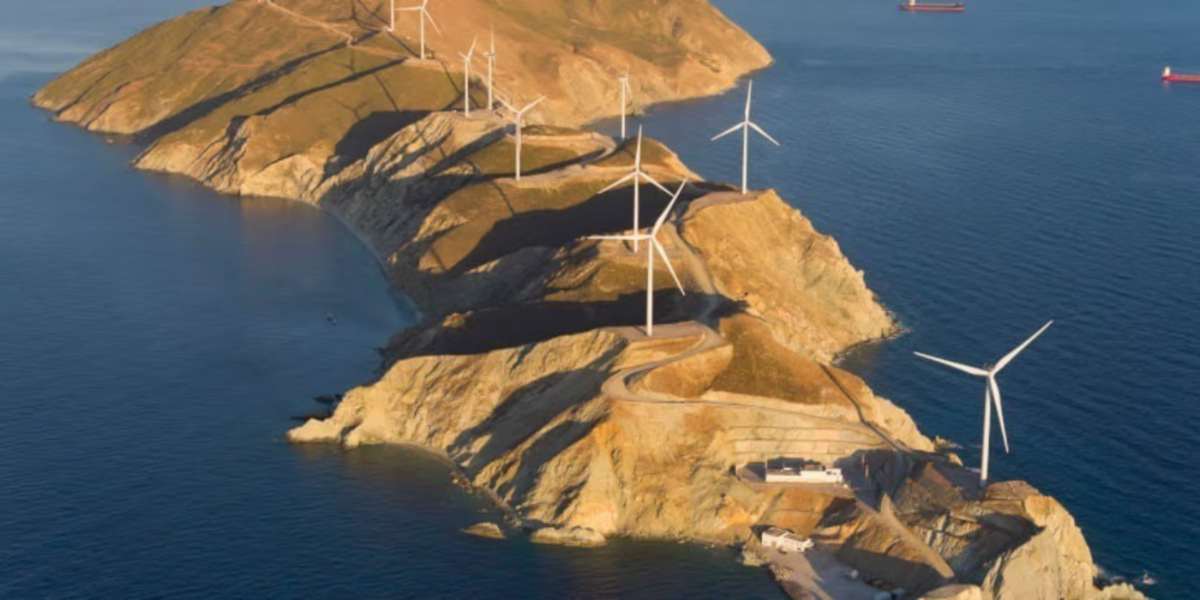
Some of the most significant changes concern onshore wind.
The new framework applies a stricter approach to the carrying capacity of individual areas and maintains important restrictions that had already triggered concerns within the industry during the consultation process.
In practice, having available land and strong wind resources is no longer enough.
A project must simultaneously pass a series of spatial, environmental and technical tests.
For developers, this could materially affect the value of certain portfolios. Permits and producer certificates that previously created expectations of future development do not automatically mean that a project will ultimately reach construction.
The critical 7.5 m/s window
There is, however, an important provision that provides breathing space for certain wind investments.
Under specific conditions, the final framework allows sites with an average annual wind speed of at least 7.5 metres per second to be developed even where the broader Municipal Unit does not satisfy the general criterion.
This is not a blanket exemption.
Certified measurements must be submitted to the Regulatory Authority for Waste, Energy and Water, while eligible projects cannot exceed 1% of the carrying capacity of the relevant Municipal Unit. All other applicable restrictions continue to apply.
For the market, however, the change matters.
A highly productive wind site will no longer necessarily be excluded simply because the average conditions across a much larger geographical area fall below the required threshold.
Which projects are protected
August 19, 2026 is the key date for investors.
Projects that had already secured an installation licence can proceed under the regime through which they were authorised.
Similarly, projects that had already obtained an Environmental Terms Approval Decision can continue towards construction and operation, subject to the applicable conditions, under the previous framework.
There is also an important safeguard for projects that had not yet reached the final environmental approval stage.
Where an Environmental Impact Assessment had already been submitted and formally declared complete before the new framework entered into force, the project may continue to be assessed under the previous rules.
For investors who have already committed significant time and capital to the licensing process, these transitional provisions are particularly important.
The trap for less mature projects
The situation becomes more difficult for projects at an earlier stage of development.
Holding only a Producer Certificate, a Special Projects Certificate or an older Generation Licence does not necessarily guarantee that an investment can continue without reassessment.
Projects that do not fall under the transitional provisions will have to demonstrate compliance with the new spatial-planning framework.
That effectively creates a two-speed renewables market.
On one side are mature projects enjoying greater regulatory certainty.
On the other are portfolios containing large volumes of early-stage permits that may now require reassessment.
The consequences could extend beyond construction timetables and directly affect valuations in future acquisitions and portfolio transactions.
Solar: The end of the “panels everywhere” era
The new rules are not limited to wind energy.
The framework also seeks to impose clearer conditions on solar development, particularly where projects compete with agricultural activity, environmentally sensitive areas or other productive land uses.
The underlying philosophy is that the energy transition cannot be pursued in isolation from agriculture, tourism, landscape protection and broader spatial planning.
For solar investors, therefore, the question is no longer simply whether suitable land is available.
The more important question becomes whether a solar development is compatible with the permitted use of that specific land.
Mature permits could become more valuable
The new framework could also have a significant corporate consequence.
The more difficult it becomes to develop a renewable project from scratch, the more valuable mature projects that have already passed critical licensing stages may become.
For large energy groups, this could strengthen the incentive to acquire ready-to-build or advanced-stage projects rather than develop entire portfolios from the beginning.
The market is therefore starting to distinguish much more sharply between projects protected by the transitional provisions and those that must navigate the new rules.
From a race for permits to a race for buildable projects
This may ultimately prove to be the biggest structural change.
For years, Greece’s renewables market was characterised by a race to accumulate increasingly large development pipelines.
Under the new environment, attention shifts towards quality and genuine deliverability.
A smaller portfolio containing mature, spatially compliant projects could ultimately be worth considerably more than thousands of megawatts of early-stage permits that may never reach construction.
The government’s balancing act
For Greece’s Ministry of Environment and Energy, the challenge is to reconcile two objectives that can often pull in opposite directions.
Greece needs substantial new renewable investment to achieve its energy and climate targets.
At the same time, it needs predictable rules that reduce conflicts with local communities and protect areas of significant environmental, cultural or productive value.
The new spatial framework is designed to strike that balance: clearer rules over where investment can take place, tougher restrictions where genuine constraints exist and safeguards for projects that have already invested heavily in the licensing process.
For the market, however, the new era has already begun.
The decisive question is no longer how many gigawatts an investor has on paper.
It is how many of those gigawatts can actually be built.
Source: pagenews.gr
Διαβάστε όλες τις τελευταίες Ειδήσεις από την Ελλάδα και τον Κόσμο