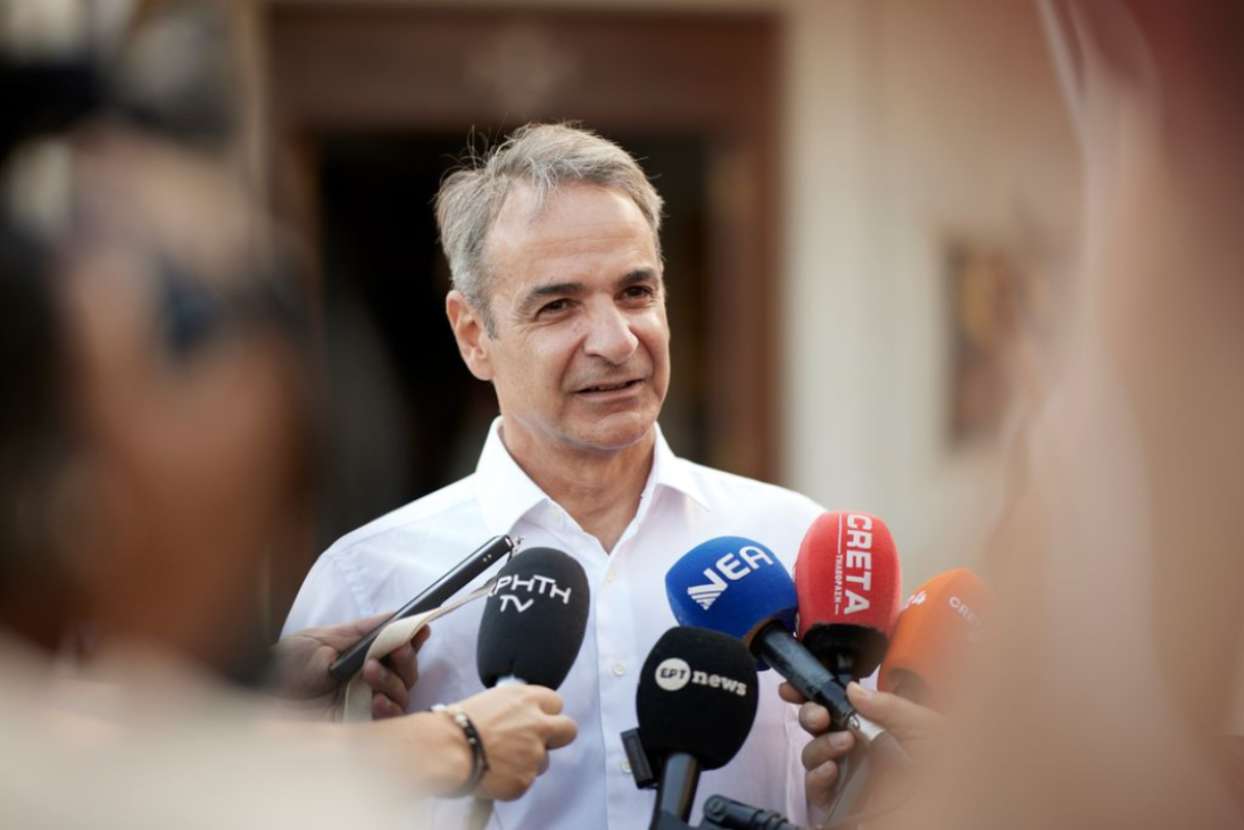
Kyriakos Mitsotakis laid out a much broader political strategy than simply the future of lignite in an exclusive interview with Ptolemaios and journalist Antonis Pougaridis.
The prime minister chose to address head-on the most sensitive issue facing Western Macedonia, acknowledging delays and public skepticism over the transition away from lignite while firmly ruling out any return to the old energy model.
From there, however, he moved directly into the political battle.
PASOK was explicitly targeted for what Mitsotakis described as fighting “rearguard battles,” while he also took aim at those who, in his words, “now aspire to make a political comeback” — an unmistakable reference to the renewed political ambitions of former prime minister Alexis Tsipras.
With the Thessaloniki International Fair approaching, the message is becoming clear: Mitsotakis wants the road to the 2027 election to be fought primarily over delivery, credibility and measurable results rather than promises.
“Anyone who says lignite is competitive is lying”
On energy policy, Mitsotakis was categorical.
“The reality is simple: lignite, given the cost of carbon dioxide emissions, is simply no longer competitive. Anyone who says otherwise is simply lying and misleading the people of Western Macedonia to their faces.”
The prime minister is attempting to dismantle one of the most politically sensitive arguments surrounding the government’s energy transition.
His case is that Greece’s lignite phase-out did not begin in 2019. The decline had effectively been underway since 2010, as lignite’s contribution to the national electricity mix progressively fell.
What changed in 2019, according to Mitsotakis, was the decision to manage what he described as an inevitable transition through a structured plan capable of securing European financing for Western Macedonia’s next economic chapter.


More than €1 billion to replace an entire economic model
This is where the government’s real gamble begins.
More than €1 billion has been secured through the Just Development Transition framework to finance infrastructure and new economic activity in the region.
But Mitsotakis set a considerably more ambitious benchmark:
“The core of this program is ultimately to create more and better-paid jobs than those that will be lost because of the gradual withdrawal from lignite.”
That is ultimately the metric by which the transition will be judged.
Not by how many programs have been approved or how much European funding has been allocated, but by whether new investments can genuinely replace the jobs, income and economic ecosystem that PPC and lignite generated for decades.
Wonderplant: From lignite land to high-tech agriculture
One of the government’s flagship examples is Wonderplant’s major hydroponic greenhouse investment in Ptolemaida.
The project is being developed on roughly 300 stremmas of land and receives €63 million in support from the Just Transition Fund.
Mitsotakis presented it as a symbol of the economic transformation he wants Western Macedonia to undergo: land once identified with lignite production becoming home to technologically advanced agricultural production.
In the interview, the prime minister spoke of hundreds of new jobs and argued that this is only one of several investments now being developed across the region.
The symbolism matters politically.
The government wants Western Macedonia’s story to move from mines and lignite plants to technology, modern agriculture, energy storage and digital infrastructure.


PPC is not leaving Western Macedonia
Mitsotakis also sought to address another deep concern in the region: that the end of lignite will inevitably mean PPC’s withdrawal.
“It is wrong to believe that because most lignite plants have closed, PPC is abandoning Western Macedonia. Exactly the opposite is happening.”
At the former Kardia lignite complex, a new high-efficiency combined heat and power unit is being developed to secure district heating for Kozani, Eordaia and Amyntaio.
The broader plan also includes major pumped-storage capacity, battery storage and infrastructure designed to strengthen grid stability.
The political and economic objective is significant: to transform the infrastructure of the old PPC into the infrastructure of the new PPC.
After lignite comes artificial intelligence
Perhaps the most striking part of Mitsotakis’ vision concerns Agios Dimitrios.
The prime minister referred to plans for a major data center that, he argued, could turn Western Macedonia into “the heart of artificial intelligence infrastructure.”
Combined with PPC’s broader investment program, Mitsotakis said these projects could generate more than 2,000 jobs.
And he placed particular emphasis on their quality.
“I assure you that these will be better-paid jobs than digging in a mine, and certainly the quality of work will not compare with what people working in lignite experienced for so many years.”
This is the most ambitious element of the government’s narrative.
A region that powered Greece for decades through lignite is now being asked to make an extraordinary leap — from coal extraction directly into energy storage, data centers and the AI economy.
“People are right to be skeptical”
Mitsotakis did not, however, avoid acknowledging the difficulties.
“People are right to feel skeptical,” he said, accepting that several parts of the transition could have moved faster.
That admission matters politically.
The government understands that announcing billions of euros in available funding is no longer enough. The transition must become visible in everyday life and, above all, in the local labor market.
The prime minister argued that this is now beginning to happen.
Tottis and Xino Nero: The smaller numbers that matter
Mitsotakis also pointed to smaller business success stories to demonstrate that Western Macedonia’s transformation will not depend exclusively on a handful of mega-projects.
He said Tottis is expected to add around 200 jobs.
He also highlighted the municipally owned Xino Nero company, saying its turnover had increased from €1.5 million to €10 million and its workforce from eight employees to 70, with further expansion possible.
The economic philosophy is important.
The government does not appear to be looking for a single new employer to replace lignite. Instead, it wants multiple sectors and investments to collectively replace the economic ecosystem that grew around coal.
E65: “It will change Western Macedonia’s destiny”
The E65 motorway is another central part of Mitsotakis’ argument.
“The E65 will change Western Macedonia’s destiny,” he said.
The government expects the motorway to dramatically reduce travel times to Athens and improve the region’s attractiveness for tourism, logistics and private investment.
Mitsotakis also reaffirmed plans for the Ptolemaida–Xino Nero road connection, eventually extending toward Florina, while saying the Kleisoura tunnel could open to traffic in less than a year.
On rail, however, he deliberately avoided making grand promises.
He said new railway lines were not currently realistic and made clear that a so-called “Western Railway Egnatia” is not part of the government’s plans.
The demographic challenge: “We do not want villages of pensioners”
The interview then moved to Western Macedonia’s deeper structural problem: population decline.
For Mitsotakis, demographics and economic development are inseparable.
“For people to remain in the regions, there must be jobs.”
He then used one of the interview’s most politically resonant phrases:
“We do not want our villages to be villages only of pensioners. We want them to be villages of dynamic people.”
Livestock farming, dairy production, wineries, mountain tourism, entrepreneurship, healthcare and education therefore become part of the same regional strategy.
Direct attack on PASOK: “They are seriously misleading citizens”
The interview became overtly political when the discussion returned to lignite.
Mitsotakis launched a direct attack on PASOK.
“I am genuinely sorry that PASOK in particular, as a supposedly serious party, continues to issue statements that look backwards rather than forwards.”
He went further, accusing the party of misleading Western Macedonia’s residents about the realities of the new energy landscape.
For the government, this is a crucial political dividing line.
Any proposal to return to or substantially prolong the old lignite model will be framed not simply as a different energy policy, but as an economically unrealistic promise.
From PASOK to Tsipras and the “tarpaulins”
Then came the second political attack.
Mitsotakis used the completion of the Thessaloniki Metro’s Kalamaria extension to contrast his government’s record with the Tsipras era.
“Some others used to inaugurate tarpaulins. We remember that too. Because they are the same people who today aspire to make a political comeback.”
Although Mitsotakis did not name Alexis Tsipras in that particular sentence, the political target was clear.
It also reveals a strategy likely to become increasingly visible as Greece moves toward the 2027 election: compare tangible projects with Tsipras’ governing record while simultaneously putting pressure on PASOK.
The “passport of credibility”
Mitsotakis also used a phrase that could become central to New Democracy’s election strategy.
“For us, every fulfilled electoral commitment is a ‘stamp’ in a ‘passport’ of credibility.”
That narrative connects the E65, the Thessaloniki Metro, healthcare investments, wages and the Just Transition.
The government wants to seek a third term not only by making new promises, but by arguing that it has established a record of delivery.
At the same time, Mitsotakis acknowledged shortcomings:
“I am the first to tell you that I too would have liked some things to move faster. So, yes, I will engage in sincere self-criticism. But we will not cancel out the very significant work we have done.”
Mitsotakis raises the pressure on Androulakis
Toward the end of the interview, the prime minister escalated his criticism of PASOK and its leader Nikos Androulakis.
He accused the opposition — and PASOK in particular — of “incredible confusion, at times benefit-mongering, and incompetence.”
Mitsotakis linked two recent PASOK choices: its stance toward Bank of Greece Governor Yannis Stournaras and its support for Elena Akrita for a vice-presidential position in Parliament.
According to the prime minister, these choices suggest PASOK is moving politically closer to forces associated with the period of confrontation and instability a decade ago.
That attack is not accidental.
The government is attempting to force PASOK into a continuing strategic dilemma: does it want to present itself as an institutional center-left alternative, or move closer to the political space Alexis Tsipras is once again seeking to occupy?
The real message is not lignite — it is the 2027 election
Read in full, the interview is only partly about lignite.
Its deeper message concerns the next national election.
Mitsotakis is constructing an argument with three components:
acknowledge delays and weaknesses;
show projects and investments becoming tangible;
and compare those results with what the opposition is promising.
He also believes political time works in New Democracy’s favor because projects currently under construction will either have been delivered or become substantially more visible by spring 2027.
That is precisely why Western Macedonia matters so much.
It may be the toughest test of the government’s theory that a region can lose an entire economic model and emerge with a better one.
If, by election time, residents can see new businesses, roads, hospitals and real jobs, Mitsotakis will present Western Macedonia as proof of delivery. If the transition still exists more visibly on paper than in people’s everyday lives, the skepticism he himself acknowledges will remain one of the government’s biggest political vulnerabilities.
Source: pagenews.gr