Greece is sending a two-track message to Turkey: dialogue remains necessary, but it does not imply retreat from sovereign rights, strategic infrastructure projects or deterrence.
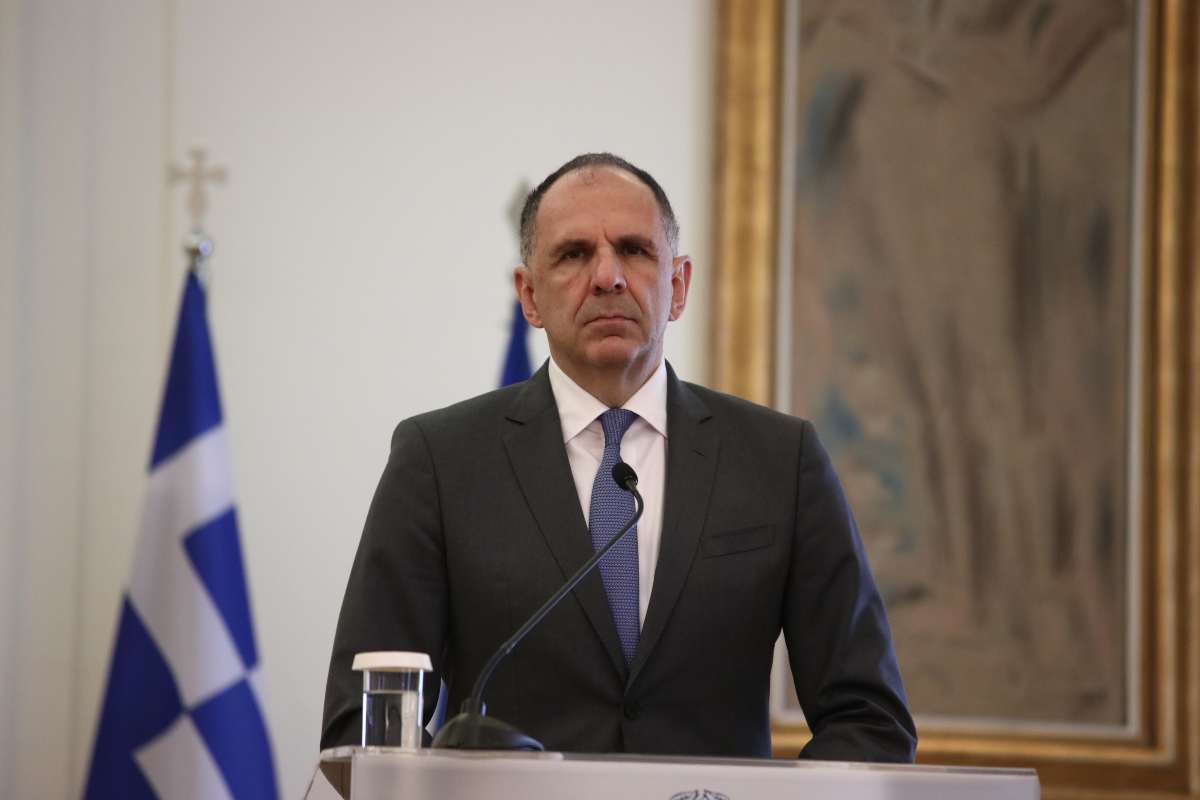
Speaking to Parapolitika 90.1, Foreign Minister Giorgos Gerapetritis said the Athens Declaration continues to serve as a mechanism for de-escalation, while making clear that Ankara has not abandoned its longstanding positions in the Aegean and Eastern Mediterranean.
His strongest message was unequivocal:
“Any possible act of arbitrariness or aggression by Turkey will be met with a response from the Greek state.”
The significance of the statement lies not only in its tone, but in the timing.
Athens is preparing for the next phase of the Greece–Cyprus electricity interconnector, a project that sits at the intersection of energy security, maritime rights, European infrastructure policy and Greek-Turkish relations.
“We Will Not Ask Turkey for Permission”
Gerapetritis was particularly clear on the electricity interconnection between Greece and Cyprus.
He stressed that the project is of common European interest and that, under international law, it does not require authorization from Ankara.
“International law is absolutely clear. Turkey’s permission is not required, nor will any permission from Turkey be requested.”
He also left open the possibility that survey work and cable-laying operations could restart within the coming months.
“My assessment is that this could indeed happen in the coming months, possibly even within 2026.”
The project therefore goes far beyond engineering.
It is a test of whether a European-backed strategic infrastructure project can proceed in an area where Turkey contests maritime jurisdiction.
Athens Says It Is Ready for Every Scenario
Asked about a possible Turkish reaction, the Greek foreign minister said Athens is preparing for all contingencies.
“We are always prepared for any scenario, from the mildest to the most intense. That is our job.”
He linked that readiness directly to the broader strengthening of Greek national power.
“Every day we make sure to reinforce the country’s defensive shielding and expand our diplomatic footprint.”
That is the core of the government’s current doctrine toward Turkey: dialogue backed by military capability and international partnerships.

“Talking Does Not Mean Retreating”
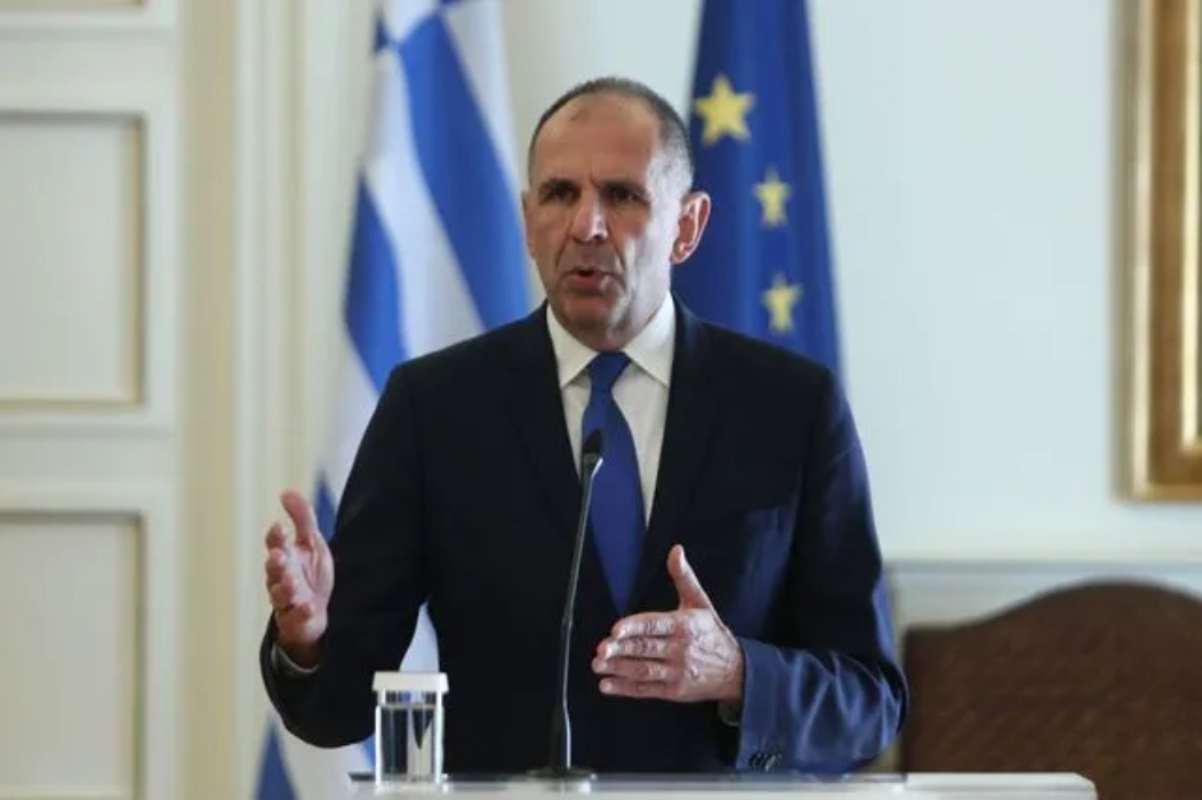
Gerapetritis strongly defended the Athens Declaration and the policy of maintaining open channels with Ankara.
“The fact that you talk does not mean that you retreat from your national positions. Quite the opposite.”
He argued that before 2023, Greece and Turkey had passed through a period of severe tension that could potentially have escalated into direct confrontation.
Since then, Athens says there has been a major reduction in violations, fewer large-scale crises and more effective management of migration pressures.
The government’s political argument is that the so-called “calm waters” policy was not an end in itself.
It created strategic time.
Time to strengthen the Armed Forces.
Time to improve the economy.
Time to deepen alliances.
And time to strengthen Greece’s institutional position inside the EU and international organizations.
“Greece Can Now Speak From a Different Position of Strength”
Gerapetritis said Greece is now significantly stronger than it was in 2023.
“Today we can speak in different terms, to the extent that the superiority we have acquired in the air and at sea gives us that ability.”
He also tied military capability to economic recovery and international influence.
The underlying idea is straightforward: foreign policy cannot be separated from the total power of the state.
Economic strength, defense capabilities, energy infrastructure and alliances form part of the same deterrence architecture.
Blue Homeland: “No External Legal Effect”
The foreign minister also addressed reports that Turkey could move to legislate aspects of its “Blue Homeland” doctrine.
He played down the international legal impact of such a move.
“Such an action by Turkey produces no external effect.”
According to Gerapetritis, a domestic Turkish law cannot by itself create binding maritime rights beyond Turkey’s jurisdiction.
He contrasted that with Greece’s Maritime Spatial Planning framework, which, he argued, is embedded in the European acquis.
And then came one of the most politically significant claims of the interview:
“For the first time, Greece has the absolute initiative in developments.”
“Greece Is No Longer Following — Greece Is Ahead”
Gerapetritis described the current strategy as a reversal of an older pattern in Greek-Turkish relations.
“Greece no longer follows. Greece is ahead and takes initiatives.”
He pointed to Greece’s Maritime Spatial Planning, marine parks, offshore exploration activity south of Crete and the strengthening of the Armed Forces.
The government’s strategic narrative is that Athens is trying to create legal, institutional and European-backed facts based on international law — forcing Ankara to react to Greek initiatives rather than allowing Turkey to set the agenda.
Opposition Criticism: Gerapetritis Fires Back
The foreign minister also sharply criticized opposition parties calling for tougher action against Turkey and stronger EU sanctions.
“The opposition is driven by profound hypocrisy,” he said, arguing that previous governments failed to implement many of the initiatives now in place.
He added:
“Greece has never been stronger. It has never had the alliances it has today.”
That includes a stronger defense relationship with France and the United States, deeper cooperation with Israel and Egypt, and a broader effort to embed Greek priorities inside European strategic policy.
The Samaras Challenge
Gerapetritis also addressed criticism from former prime minister Antonis Samaras.
He acknowledged that the views of a former prime minister deserve respect, but argued that political criticism must also be open to scrutiny.
“He criticizes dialogue with Turkey, when Mr Samaras himself held talks with Turkey.”
Gerapetritis recalled that six rounds of exploratory talks took place during the Samaras government and that Samaras met Recep Tayyip Erdogan and signed a series of bilateral agreements.
He also noted that in 2014 Greece recorded roughly 2,500 violations of national airspace.
His broader point was that dialogue itself cannot be used as proof of weakness.
“Today Greece’s national position has strengthened dramatically. We have a very strong international footprint, a strong defense and a strong economy that allows us to negotiate from a position of strength.”
The Cable Is Becoming a Test of Sovereignty and European Power
The most consequential test still lies ahead.
A restart of survey and cable-laying operations for the Greece–Cyprus electricity interconnector could become a real-world test of the government’s strategic doctrine.
The project carries European significance.
Athens says Turkish permission is unnecessary.
Turkey has repeatedly objected to activity in maritime areas where it asserts competing claims.
That means the next phase will not be decided by rhetoric alone.
It will be tested at sea.
If work proceeds as planned, Athens will seek to demonstrate in practice what Gerapetritis is arguing politically: dialogue with Turkey does not mean freezing Greek or European strategic projects.


From “Calm Waters” to Deterrence Through Infrastructure
The interview also reveals a shift in how the government is defending its Turkey policy.
The argument is no longer simply that dialogue prevented a crisis.
The argument is that the period of de-escalation was used to improve Greece’s position through Rafale fighters, F-16 Vipers, new frigates, stronger alliances and regional energy connectivity.
The Greece–Cyprus electricity interconnector now becomes a symbol of that strategy.
Athens wants to show that it can combine dialogue without retreat, infrastructure without Turkish permission and de-escalation backed by stronger deterrence.
That is why Gerapetritis’ warning carries greater significance than a routine diplomatic statement:
“Any possible arbitrariness or aggression will be met with a response from the Greek state.”
Source: pagenews.gr