Israel Warns Turkey: ‘Distance Will Provide No Immunity’ as Mediterranean Power Balance Shifts
 ΧΡΟΝΟΣ ΑΝΑΓΝΩΣΗΣ 7 '
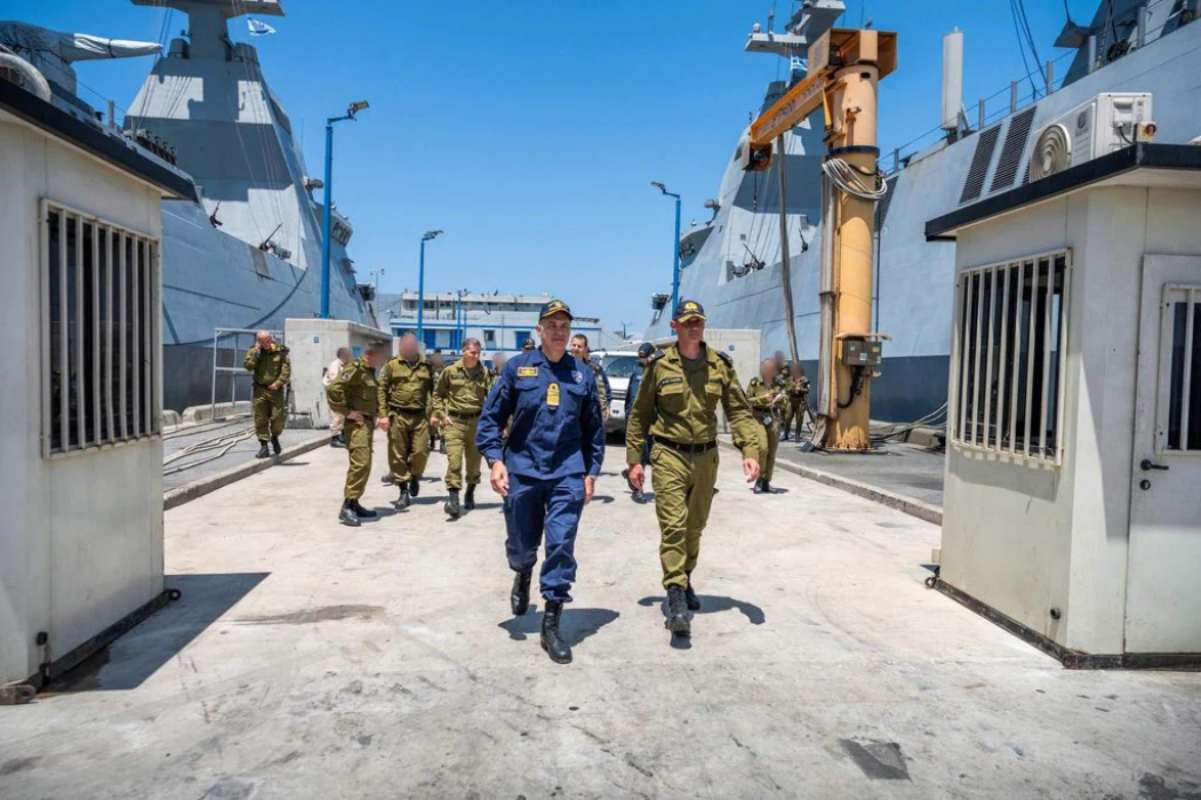
Πηγή Φωτογραφίας: AP Photo//Israel Warns Turkey: ‘Distance Will Provide No Immunity’ as Mediterranean Power Balance Shifts



Israel has delivered one of its strongest recent signals over the emerging naval balance of power in the Eastern Mediterranean.
Speaking at a naval officers’ graduation ceremony in Haifa, Israeli Navy commander Vice Adm. Eyal Harel warned that Israel is closely monitoring attempts to change the strategic equation across the Mediterranean and Red Sea.
“To anyone seeking to change the balance of power in the Mediterranean and the Red Sea, I say: We see the actions, we monitor them and we are preparing for them,” Harel said.
He added that the Israeli Navy would not accept a situation in which Israel’s freedom of action or strategic maritime interests were threatened.
“There is no longer a distant front”
Perhaps the most consequential part of Harel’s message concerned Israel’s ability and willingness to project power far beyond its immediate coastline.
“In the new maritime arena, there is no longer such a thing as a ‘distant front’,” he said.
Harel warned that geographical distance would not protect actors seeking to threaten Israel.
“Distance will provide no immunity to anyone seeking to harm us.”
The Times of Israel described the remarks as an apparent warning aimed at both Turkey and the Houthis. Importantly, Harel himself did not explicitly mention Ankara.
That distinction matters.
But the geopolitical context surrounding his remarks makes the Turkish dimension impossible to ignore.

Turkey increasingly enters Israel’s strategic calculations
The warning comes as Israeli defense planners increasingly focus on Turkey’s expanding military footprint in Syria, the modernization of the Turkish Navy and Ankara’s broader ambitions across the Eastern Mediterranean.
The fall of Bashar al-Assad’s government and the emergence of a new leadership in Damascus have transformed Syria into another arena in which Turkish and Israeli strategic interests could collide.
Turkey has developed close relations with the new Syrian authorities and is seeking deeper military cooperation with Damascus.
For Israel, the prospect of an expanded Turkish military presence in Syria — particularly one involving air bases, air-defense systems or advanced military infrastructure — represents a potentially significant change in the regional balance.
The maritime dimension is becoming equally important.
Turkey has invested heavily in naval power, indigenous warships, drones, missiles and its wider “Blue Homeland” doctrine, seeking a substantially larger strategic footprint across the Mediterranean.
Israel is watching that expansion closely.
Greece enters the equation
This is where Harel’s remarks acquire particular significance for Athens.
Israel’s strategic relationship with Greece has moved far beyond conventional diplomatic cooperation.
The two countries are expanding defense, intelligence and technological cooperation, while Cyprus provides the geographical link connecting the emerging security architecture of the Eastern Mediterranean.
The recently agreed Greek multilayered air-defense architecture, the “Achilles Shield,” reinforces this trajectory.
Athens and Jerusalem are developing increasingly sophisticated defense ties involving air and missile defense, anti-drone capabilities and Israeli military technology.
This does not amount to a formal anti-Turkish alliance.
But it does mean that Greece, Cyprus and Israel increasingly share interests in three strategically crucial areas:
- protecting maritime routes and critical infrastructure;
- preserving freedom of military operations;
- preventing unilateral changes to the balance of power in the Eastern Mediterranean.
A new maritime triangle emerges
For years, the Greece–Cyprus–Israel relationship was largely discussed through the prism of energy.
That picture is changing.
Security, defense technology, intelligence, air defense and maritime surveillance are becoming increasingly important pillars of the trilateral relationship.
At the same time, Turkey is seeking to consolidate its position as the dominant naval power in its surrounding seas.
The result is a fundamentally different Eastern Mediterranean.
The region is moving from diplomatic disputes over maps, exclusive economic zones and energy exploration toward competition involving submarines, missile-defense systems, drones, warships and long-range strike capabilities.
INS Drakon: Israel expands its underwater reach
The ceremony in Haifa carried another major strategic message.
IDF Chief of Staff Lt. Gen. Eyal Zamir announced that Israel’s sixth submarine, INS Drakon, was sailing from Germany toward Israel.
“At this very moment, in the depths of the Mediterranean, INS Drakon, the sixth submarine of the State of Israel, is making its way to Israel,” Zamir said.
He described the submarine as part of the transformation of the Israeli Navy into a powerful strategic arm capable of operating throughout the Middle East and well beyond Israel’s immediate waters.
The Drakon strengthens one of the most sensitive components of Israel’s military power: its ability to operate covertly and at long range.
Additional capabilities are also coming.
Israel plans to introduce new Reshef-class missile vessels alongside autonomous maritime systems capable of operating both above and below the surface.

Israel changes doctrine
The transformation goes beyond new hardware.
Israel’s security doctrine has undergone a profound shift since the October 7, 2023 attack.
The emphasis is increasingly moving away from simply containing threats toward preventing them from developing into existential dangers.
Zamir made that doctrine explicit:
“We will not allow existential threats from radical enemies to develop, nor will we allow terrorist organizations to establish themselves on our borders.”
At sea, that means Israel no longer intends merely to defend Haifa, Ashdod or its offshore infrastructure.
It wants the capability to detect, deter and, if necessary, strike threats thousands of kilometers away.
The Drakon, new missile vessels, autonomous platforms and expanded regional partnerships all fit into this strategy.
The message Ankara cannot ignore
For Turkey, the emerging equation presents a strategic challenge.
Ankara is investing heavily in becoming a major regional naval power.
Yet simultaneously, Israel is strengthening its long-range maritime capabilities while its defense relationship with Greece and Cyprus is becoming increasingly sophisticated.
There is no formal Greece–Cyprus–Israel military bloc directed against Turkey.
But there is an increasingly dense network of overlapping strategic interests.
And this is what makes Harel’s warning significant.
When the commander of the Israeli Navy publicly declares that Israel is watching those seeking to change the balance of power in the Mediterranean — and warns that geographical distance will no longer provide protection — Ankara cannot easily assume that the message is intended for someone else.
The Eastern Mediterranean is entering a new phase.
The competition is no longer only about maritime maps and energy deposits.
It is increasingly about submarines, missile shields, autonomous weapons, naval presence and the ability to project military power across the region.
Source: pagenews.gr
Διαβάστε όλες τις τελευταίες Ειδήσεις από την Ελλάδα και τον Κόσμο