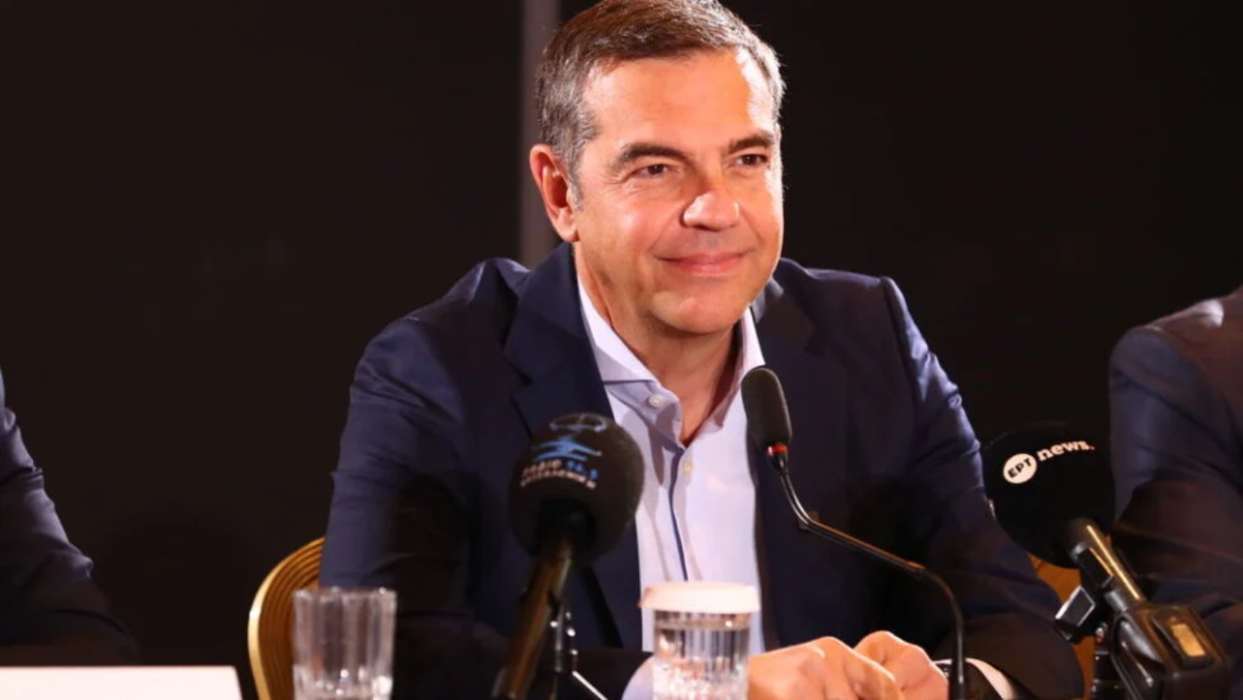
Alexis Tsipras is returning to Thessaloniki with a message designed to be very different from the one that defined his earlier political rise.
This time, the emphasis is not simply on promises.
It is on costing, funding and credibility.
Tsipras is expected to present a four-year economic programme for 2027–2030 with a gross cost of €7.39 billion, alongside a broader plan for productive reconstruction, regional development and redistribution.
According to figures released by his team, the programme includes €1.92 billion in permanent new revenues, bringing the net fiscal cost down to €5.47 billion, against an estimated available fiscal space of €5.60 billion.
On paper, therefore, the equation closes.
Politically, however, the harder equation is elsewhere: can Tsipras convince voters that this is not simply a new version of the old Thessaloniki promises?


€7.39bn — and an effort to answer the credibility question in advance
Tsipras’ economic team appears fully aware of the first criticism the plan will face.
That is why the language of funding discipline sits at the centre of the presentation.
The message from his advisers is straightforward:
“We know what we are promising and where the money will come from.”
The arithmetic they present is:
- Gross cost of measures for 2027–2030: €7.39bn
- Permanent new revenues: €1.92bn
- Net fiscal expenditure: €5.47bn
- Available fiscal space: €5.60bn
The political point is clear.
Tsipras wants to distance himself from the image of unfunded pledges and instead present a programme built around permanent revenue streams, phased implementation and annual evaluation.
That does not automatically settle the debate.
The real scrutiny will focus on the assumptions behind growth, revenue collection and the redistribution of the tax burden.
The “Patriotic Contribution” changes the tax debate
One of the most politically sensitive elements of the programme is the proposed “Patriotic Contribution.”
Tsipras is expected to argue for a redistribution of taxation away from salaried workers and self-employed professionals and towards very high incomes and wealth.
The full details — who pays, at what thresholds and under what tax rates — will be decisive.
There is, however, an important technical point.
According to Tsipras’ team, expected revenues from the “Patriotic Contribution” are not included in the €1.92 billion of permanent new revenues already built into the core fiscal framework.
That allows his camp to argue that the plan potentially contains additional fiscal room.
But it also opens the key political question:
who exactly will be asked to pay more — and where will the line be drawn between “high income” and the middle class?


Back to the middle class
This is where the symbolism becomes particularly sharp.
Tsipras is returning to Thessaloniki with the middle class at the centre of his economic message.
Salaried workers, self-employed professionals and productive middle-income groups are among the constituencies he is trying to win back.
Yet this is also the political ground on which he carries some of his heaviest baggage from the 2015–2019 period.
The tax burden imposed on middle-income households and self-employed professionals became one of the most damaging political liabilities of his government.
Tsipras himself has acknowledged in the past that the middle class was disproportionately burdened.
That means the challenge now is not simply to promise relief.
It is to persuade the same social groups that the lesson has been learned.
Thessaloniki — and the memory of an earlier programme
The choice of Thessaloniki inevitably revives the political memory of Tsipras’ earlier rise.
Not because today’s programme is identical to the 2014 Thessaloniki Programme — it is not.
But because that programme remains one of the defining symbols of his first period in power.
At the time, ambitious pledges were quickly overtaken by fiscal constraints, confrontation with creditors and eventually the third bailout programme.
More than a decade later, Tsipras is returning to the same city and effectively arguing that this time the architecture is different.
The emphasis on costing is therefore not accidental.
It is his answer to the criticism he knows will accompany every new pledge.
The new rule: permanent spending requires permanent revenue
The programme is built around a basic fiscal rule:
“No permanent benefit without a permanent funding source, and no permanent expenditure financed by temporary revenue.”
His team also says each measure will be introduced in phases, evaluated before expansion and reassessed annually.
Another line they are expected to emphasise is:
“Fiscal credibility does not mean social immobility.”
And, perhaps more importantly:
“We will say in advance what fits, when it fits and who pays for it.”
That language is intended to present Tsipras as a politician who has absorbed the lessons of fiscal constraint rather than one promising to bypass them.
A National Convergence Fund for the post-RRF era
A second major pillar of the plan is the proposed National Convergence Fund.
Tsipras wants it to become a vehicle for productive reconstruction and investment after the end of the Recovery and Resilience Facility.
His camp presents the fund as a mechanism for financing productive transformation, regional development and long-term investment.
The proposal also forms part of a broader attack on the Mitsotakis government’s use of EU recovery funds.
But this is another area where detail will matter.
A fund does not create capital by itself.
Its credibility will depend on where the money comes from, how much private investment it can leverage, how projects are selected and whether it can generate measurable productivity gains.
“Produce more, distribute more fairly, live better”
Tsipras’ new economic narrative is condensed into a three-part slogan:
“Produce more. Distribute more fairly. Live better.”
The wording reflects the political repositioning he is attempting.
He does not want to return only with an agenda of redistribution.
He wants to link social policy with production, investment, decentralisation and fiscal credibility.
In that sense, the programme is also an effort to redesign his own economic identity.
A new Thessaloniki — and an old question
The €7.39 billion plan is clearly more numerically structured than a conventional package of campaign promises.
That is a fact.
It is also true that a full judgement will require the final details of the “Patriotic Contribution,” tax reform, the National Convergence Fund and the macroeconomic assumptions behind the revenue forecasts.
But for Tsipras, there is a larger issue than whether the €7.39 billion adds up.
The new Thessaloniki must prove it is not the old Thessaloniki in a new package.
He is effectively asking voters to evaluate not only the programme but also his own political evolution.
And from the middle class in particular, he is asking for something even harder: a second hearing.
The numbers may add up on paper. The political equation will depend on whether Tsipras can make Thessaloniki a symbol of credibility this time — rather than a symbol of promises that reality later overturned.
Source: pagenews.gr