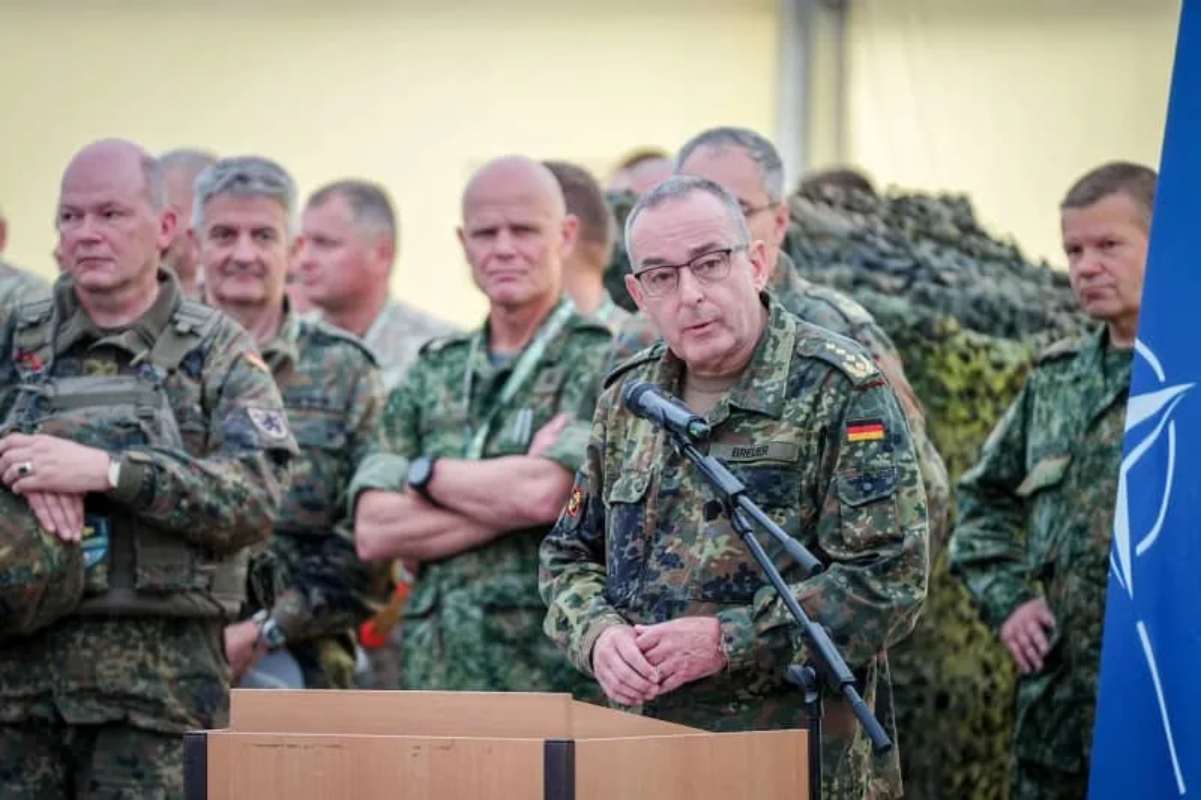
This is more than a routine change at the top of NATO’s military structure.
The election of General Carsten Breuer comes as Germany attempts one of the most consequential transformations in post-war European security: turning Europe’s largest economy into one of the continent’s principal military powers.
NATO’s 32 Chiefs of Defence elected Breuer during the Military Committee Conference in Copenhagen on September 19. He is due to take office in the summer of 2027 for a three-year term, succeeding Italian Admiral Giuseppe Cavo Dragone.
Congratulating his successor, Cavo Dragone said:
“Your operational judgement, deep familiarity with the Alliance, and leadership of the German Armed Forces will serve NATO well.”
He stressed that the Allied Chiefs of Defence had placed their confidence in Breuer at what NATO itself describes as a critical moment for Euro-Atlantic security.
What Breuer Will Actually Control
The Military Committee is NATO’s highest military authority.
It sits beneath the North Atlantic Council and provides the essential link between the Alliance’s political decision-making and its military command structure.
Its Chair serves as NATO Secretary General Mark Rutte’s senior military adviser and represents the collective military assessment of all 32 Allied Chiefs of Defence.
The position should not be confused with that of the Supreme Allied Commander Europe, or SACEUR, who has operational command responsibilities.
Breuer’s role is different but strategically significant: he will sit at the centre of the process through which political decisions are translated into military requirements, force structures, readiness targets and defence plans.


The Timing Says Almost Everything
NATO made clear in Copenhagen what now matters most.
The Chiefs of Defence discussed the implementation of decisions taken at the Ankara Summit, the reinforcement of deterrence and defence, air and missile defence, drones, cyber capabilities, space and the protection of critical infrastructure.
The underlying message was straightforward: the era of simply announcing larger defence budgets is giving way to the much harder task of producing usable military power.
Cavo Dragone described the transition as one from budget commitments toward the delivery of capabilities capable of deterring adversaries and defending the Euro-Atlantic area.
In practical terms, NATO does not simply need more billions on spreadsheets.
It needs ammunition, air-defence systems, drones, personnel, reserves, logistics and combat-ready formations.
Breuer Has Already Put “2029” on the Map
That is where the choice of Breuer becomes particularly significant.
The German general has been among the European military leaders most explicit about the urgency of preparing for a potentially more dangerous Russia.
In presenting the Bundeswehr’s strategic direction, Breuer has warned that Moscow could, by 2029, possess the military capability required to conduct a large-scale attack against NATO territory.
His wording matters.
“I am not saying that this will automatically happen. Certainly not. But the capability will be there. And that is precisely why we must prepare.”
This is an assessment of potential Russian military capability — not a prediction that Russia will attack NATO in 2029.
That distinction is crucial.


“Fight Tonight”: Breuer’s Military Philosophy
Breuer’s strategic thinking operates across three different time horizons.
The first is immediate readiness.
The Bundeswehr, he argues, must be capable of operating under the principle of “fight tonight” if required.
The second horizon is 2029, when German military planners assess that Russia could have rebuilt sufficient capabilities to pose a substantially greater conventional threat to NATO.
The third stretches toward 2039 and focuses on a technologically transformed military built around artificial intelligence, data, drones, integrated air defence and long-range precision weapons.
That tells us something important about the future direction of NATO.
Its next Military Committee Chair does not come from the post-Cold War European tradition of the “peace dividend.”
He comes from a Bundeswehr that is once again planning around the possibility of high-intensity warfare on the European continent.
Germany Is Moving Back to the Military Front Line
There is an even larger political message behind Breuer’s election.
For decades after the Second World War, Germany built its international influence overwhelmingly around economic rather than military power.
Russia’s full-scale invasion of Ukraine in 2022 progressively overturned that model.
Olaf Scholz’s Zeitenwende marked the beginning of the shift. Berlin is now attempting to build much larger conventional forces, expand procurement and assume greater responsibility for NATO’s eastern flank.
Breuer himself has described the expectations he hears from Germany’s allies:
“You in Germany, as the largest economy, have to assume responsibility differently. If you do not do it, who can?”
His elevation to NATO’s highest collective military advisory body reinforces that shift.


Lithuania Shows What the New Germany Looks Like
Breuer is not talking only about abstract German responsibility.
Berlin is moving forward with the permanent deployment of a full brigade in Lithuania — a landmark commitment for the Bundeswehr and a major component of NATO’s reinforced eastern posture.
For Germany, this is intended to demonstrate that its new security policy involves forces on the ground rather than declarations alone.
Breuer has framed the commitment in similarly direct terms:
“We are not just bringing fine words. We are bringing our capabilities to NATO’s eastern flank — and permanently.”
The Baltic region, Poland and the Suwałki corridor have consequently become central to NATO’s collective-defence calculations.
The United States Is Changing the Equation Too
Russia is not the only force reshaping European defence.
Washington is also pressing Europe to assume a substantially greater share of the burden.
President Donald Trump has repeatedly demanded that European allies take more responsibility for defending their own continent after decades in which American military power provided the backbone of NATO deterrence.
Europe therefore faces pressure from two directions.
From the east comes the challenge posed by Russia.
From across the Atlantic comes Washington’s demand that Europeans generate far more of their own military capability.
NATO’s current leadership has presented the objective as a stronger European pillar inside a stronger Alliance, with European allies and Canada assuming a larger share of collective security.
That makes the selection of a German general particularly symbolic.
From Defence Budgets to Weapons
Copenhagen also sent an important message to Europe’s defence industry.
NATO’s Chiefs of Defence said Allies are prepared to procure military equipment at scale and stressed the need for industry to deliver with greater speed, volume and predictability.
This may prove to be the hardest part of Europe’s rearmament.
Governments can approve tens of billions of euros relatively quickly.
They cannot manufacture a new air-defence battery, expand an ammunition plant, build an armoured brigade or train thousands of soldiers overnight.
Europe’s next defence test will therefore be industrial as much as financial.
The question is no longer simply how much Europe spends. It is how much combat power those euros can actually produce.
Drones, AI and Space: Ukraine Is Rewriting NATO Warfare
Breuer has also argued that the war in Ukraine is fundamentally changing the character of modern warfare.
Drones, enormous volumes of battlefield data, artificial intelligence, electronic warfare and precision strikes are increasingly becoming core elements of military operations.
The Copenhagen agenda reflected precisely that transformation.
NATO placed air and missile defence, drones, cyber and space capabilities high on its agenda, alongside the protection of critical infrastructure including energy networks, digital systems and undersea connections.
The Alliance is therefore preparing for something much broader than the traditional battlefield of tanks, aircraft and artillery.
Future deterrence increasingly extends from the seabed to orbit — and from ammunition factories to algorithms.
From the “Chancellor’s General” to NATO
Breuer’s career also helps explain why Germany considers him suited to the role.
He joined the Bundeswehr in 1984, beginning his career in army air defence. He subsequently attended Germany’s General Staff training and the US Army Command and General Staff College at Fort Leavenworth.
He served in Afghanistan and held a series of senior operational and staff positions.
Breuer became much more widely known in Germany when then-Chancellor Olaf Scholz selected him to lead the government’s COVID-19 crisis team, earning him the nickname the “Chancellor’s General.”
Since March 2023, he has served as Germany’s Chief of Defence.
In the summer of 2027, his centre of gravity will shift from Berlin to Brussels.
NATO’s German Moment
Breuer’s election does not mean that Germany now “runs NATO.”
Political decisions remain collective decisions of the 32 Allies, and the Chair of the Military Committee is not NATO’s operational commander.
What it does signify is subtler — and geopolitically more important.
The senior military officer of Europe’s largest economy is moving to the top of NATO’s highest military advisory body precisely as the Alliance demands that Europe convert economic weight into deployable military power.
Breuer has already defined the strategic timeline in unusually clear terms:
readiness today, deterrence against the military capabilities Russia could possess by 2029, and technological transformation for the battlefield of the 2030s.
That is the larger meaning of his election.
This is not simply about a new general taking over NATO’s Military Committee.
It is about a Europe being asked to take far greater responsibility for defending itself — with Germany increasingly expected to stand at the centre of that transformation.
Source: pagenews.gr