For AKTOR, 2026 appears to be the year when its ambitious transformation strategy begins to translate into measurable financial performance.
Acquisitions, a stronger capital base, new strategic partnerships and expansion well beyond traditional construction are creating a fundamentally different business model: a diversified infrastructure group spanning concessions and PPPs, the circular economy, renewable energy, storage, LNG and facility management.
And the first-half figures provide the clearest evidence yet of that transition.
Pro forma EBITDA increased by 85% to €120 million, while pro forma pre-tax profit rose 114% to €37 million. At the same time, the Group maintained a €4.5 billion backlog despite executing approximately €500 million worth of projects in just six months.
AKTOR also reports pro forma cash reserves of €1.1 billion and equity of €1 billion, providing substantial financial capacity for its €3 billion investment programme through 2031.


The Numbers Behind AKTOR’s Acceleration
In the first half of 2026, AKTOR generated revenue of €649 million, while gross profit increased by 11% to €82 million.
EBITDA rose 38% to €91 million.
On a pro forma basis, the increase was significantly stronger, with EBITDA reaching €120 million, up 85% year-on-year.
Another important indicator is profitability.
The EBITDA margin increased from 11% to 15%, suggesting that the transformation is not simply increasing the Group’s scale but is also improving operating efficiency.
Pro forma pre-tax profit reached €37 million, up 114%.
The picture is therefore twofold: stronger operating earnings combined with wider profitability margins.
€1.1bn in Liquidity, Leverage at 1.9x
The balance sheet is the second critical component of AKTOR’s investment story.
Pro forma cash reserves stand at €1.1 billion, while equity has reached €1 billion, an increase of 157%.
Net debt stood at €429 million, with the ratio of net debt to adjusted pro forma EBITDA at 1.9x.
This metric is particularly significant because AKTOR is simultaneously entering a period of major investment expansion.
The challenge is to maintain rapid growth without allowing the financing of that expansion to push leverage excessively higher.
Maintaining a low net-debt-to-EBITDA ratio therefore remains a central pillar of management’s strategy.
€4.5bn Backlog Despite €500m of Project Execution
Visibility from the construction business also remains strong.
Despite completing approximately €500 million worth of projects during the first half, AKTOR’s backlog remained at €4.5 billion.
Of that amount, 67% relates to signed contracts, with the remaining 33% representing contracts pending signature.
The significance lies not only in the absolute size of the backlog.
It also indicates that despite the high pace of project execution, the pipeline of future work remains substantial.
As of September 24, according to the company, AKTOR’s market capitalisation stood at €2.6 billion.
Exarchou: “2026 Has Transformational Characteristics”
Alexandros Exarchou describes 2026 as the year in which the strategic moves of recent years are beginning to converge.
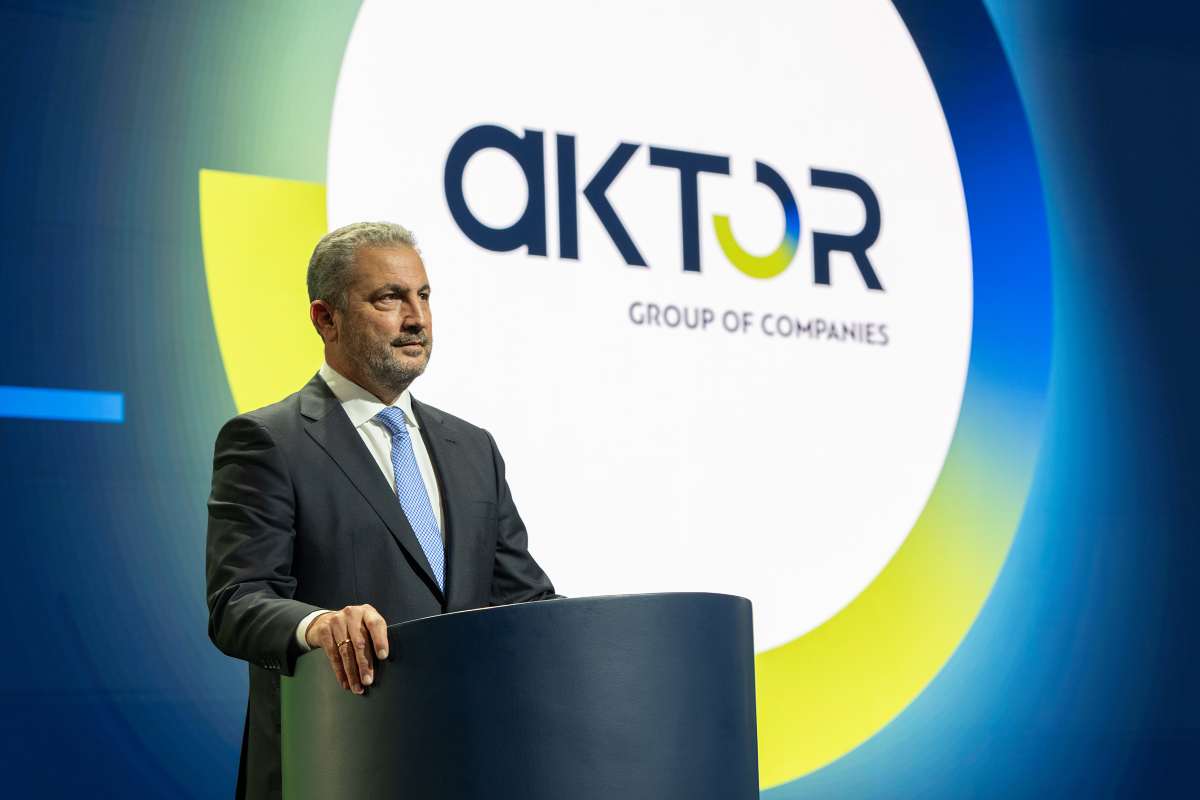
“2026 has transformational characteristics for AKTOR Group. Our recent acquisitions have started to be incorporated into our financial results, providing a very good preview of what is to come and what AKTOR Group’s future will look like,” the Chairman and CEO said.
That is essentially the main business story behind the results.
AKTOR is seeking to gradually reduce its dependence on a single economic cycle — construction — and build a portfolio of businesses generating revenue and cash flow from different sources and over different time horizons.
From Construction Group to a Multi-Engine Infrastructure Platform
The strategy through 2031 has a clear objective: increase the contribution of businesses capable of producing recurring cash flows.
Construction remains the engine.
But around it, four increasingly important pillars are being built:
- PPPs and concessions;
- environmental infrastructure and the circular economy;
- renewables and energy storage;
- LNG and energy infrastructure.
Facility management adds another business line, with operations extending from Greece to the Middle East.
This is what distinguishes AKTOR’s current strategy from simply expanding its construction portfolio.
Construction Remains the Engine — But Becomes More Profitable
AKTOR’s traditional construction business continues to deliver strong results.
On a pro forma basis, pre-tax profit from construction increased by 160%, from €15 million to €39 million, despite a 1% decline in revenue.
The gross profit margin remained high at 14%.
The combination is notable: slightly lower revenue, but substantially higher profitability.
Management attributes this performance to the selection of higher-quality and more profitable projects, lower operating expenses and the use of digital technologies to improve cost control.
In other words, the strategy is not simply to win more projects at any cost, but to improve returns from each project undertaken.
HELECTOR and THALIS: Building a New Major Pillar
One of the most important parts of AKTOR’s transformation lies in the circular economy and water infrastructure.
Upon completion of the transaction, AKTOR is expected to control 75% of HELECTOR and THALIS, while Motor Oil will hold the remaining 25%.
The two companies generated combined EBITDA of €41 million in 2025, have approximately €1 billion in backlog and are currently constructing 10 waste-management facilities.
The timing could prove particularly important.
According to estimates cited by AKTOR, environmental projects worth up to €3 billion are expected to be tendered in Greece over the coming years.
At the same time, the strategic partnership with Suez International in water projects broadens AKTOR’s effort to build an integrated and vertically structured environmental infrastructure platform.
17 PPP and Concession Projects
Concessions represent another major component of the transformation.
AKTOR currently participates as contractor or preferred bidder in 17 PPP and concession projects and is involved in more than 25 related tenders.
Adjusted EBITDA from the PPP and Concessions segment increased by 63% in the first half.
Even more striking is the EBITDA margin, which reached 62%.
The full consolidation of AKTOR Concessions and the performance of operating toll roads contributed to the improvement.
The portfolio is also being expanded through the agreement to acquire a significant interest in the concession for the Northern Road Axis of Crete, or BOAK, currently Greece’s largest road infrastructure project.
This highlights one of the key differences in AKTOR’s evolving business model: concessions do not merely create construction work. They can generate long-term cash flows well beyond the construction phase.
The 1.2GW Energy Ambition
Renewables and storage represent the next major growth area.
In the medium term, AKTOR is targeting a 520MW portfolio, including 100MW of battery storage systems.
By 2031, the target rises to 1.2GW.
Diversification is a key part of the strategy, including expansion into wind power to reduce reliance on a single generation technology and improve the stability of energy revenues.
AKTOR has also entered into a strategic partnership with DEPA Commercial for the joint development of renewable and storage projects with combined capacity exceeding 470MW.
AKTOR will hold 51% and DEPA Commercial 49%.
A €1bn Pumped-Storage Bet in Western Macedonia
The Group’s storage ambitions go even further.
AKTOR is moving into a major pumped-storage project in Western Macedonia with a budget of approximately €1 billion and a targeted capacity of 1GW.
Storage has increasing strategic value because it can reduce renewable generators’ exposure to negative electricity prices and mandatory production curtailments.
For AKTOR, it is therefore more than another energy investment.
It is part of a broader effort to build more resilient and predictable future cash flows.
LNG: Turning the Vertical Corridor Into a Business Platform
The most geo-economic element of AKTOR’s strategy is LNG.
Through Atlantic SEE LNG Trade — 60% owned by AKTOR and 40% by DEPA Commercial — the Group is developing an integrated LNG supply and trading platform centred on the Vertical Gas Corridor and Southeast Europe.
According to AKTOR, contracted LNG volumes from the United States have already doubled.
During the first half of 2026, the Group also signed long-term binding agreements for LNG sales to Albania and Bosnia and Herzegovina, representing a combined annual volume of 1.5 bcm.
Another strategically important move is the agreement to acquire 50% of Dioriga Gas, the company developing Greece’s second FSRU.
If the strategy develops as planned, AKTOR will gain exposure not only to LNG trading but also to critical infrastructure within the LNG value chain.
From Greece to Qatar
Facility management is also expanding.
The segment employs nearly 3,000 people across Greece, Qatar and the United Arab Emirates.
AKTOR recently secured a €130 million contract for facility management services at Hamad International Airport in Qatar, adding another international business with recurring revenue characteristics.
€950m Raised to Finance the Next Chapter
All of this expansion requires substantial capital.
And one of AKTOR’s most significant moves in 2026 was precisely on the financing side.
The Group completed a €650 million capital increase and issued a €300 million bond.
Total capital raised: €950 million.
“They provide us with a strong capital base to implement our major €3 billion investment programme,” Exarchou said.
The investment horizon extends to 2031.
Management’s long-term target is ambitious: EBITDA of more than €600 million generated through a substantially broader and more diversified portfolio of activities.
Why the 85% EBITDA Jump Is Only Part of the Story
Viewed simply as a set of interim results, the headline is straightforward: pro forma EBITDA up 85%.
The more important story, however, is what is being built behind that number.
HELECTOR and THALIS add environmental infrastructure and the circular economy.
AKTOR Concessions strengthens long-duration cash flows.
The 1.2GW target builds a sizeable energy platform.
Storage adds another layer of earnings diversification.
LNG opens a regional market stretching across Southeast Europe.
And construction remains the foundation supporting the entire structure.
That is the central bet behind Exarchou’s strategy: by 2031, AKTOR should no longer depend on a single business engine, but on multiple sources of EBITDA and recurring cash flows.
The first half of 2026 provides the clearest indication yet that this transformation is beginning to move from business plans into the numbers.
Source: pagenews.gr