Europe may have more LNG terminals, new pipelines and a wider range of supply routes than it did only a few years ago.
But there is one thing infrastructure alone cannot guarantee:
that the next LNG tanker will sail to Europe rather than Asia.
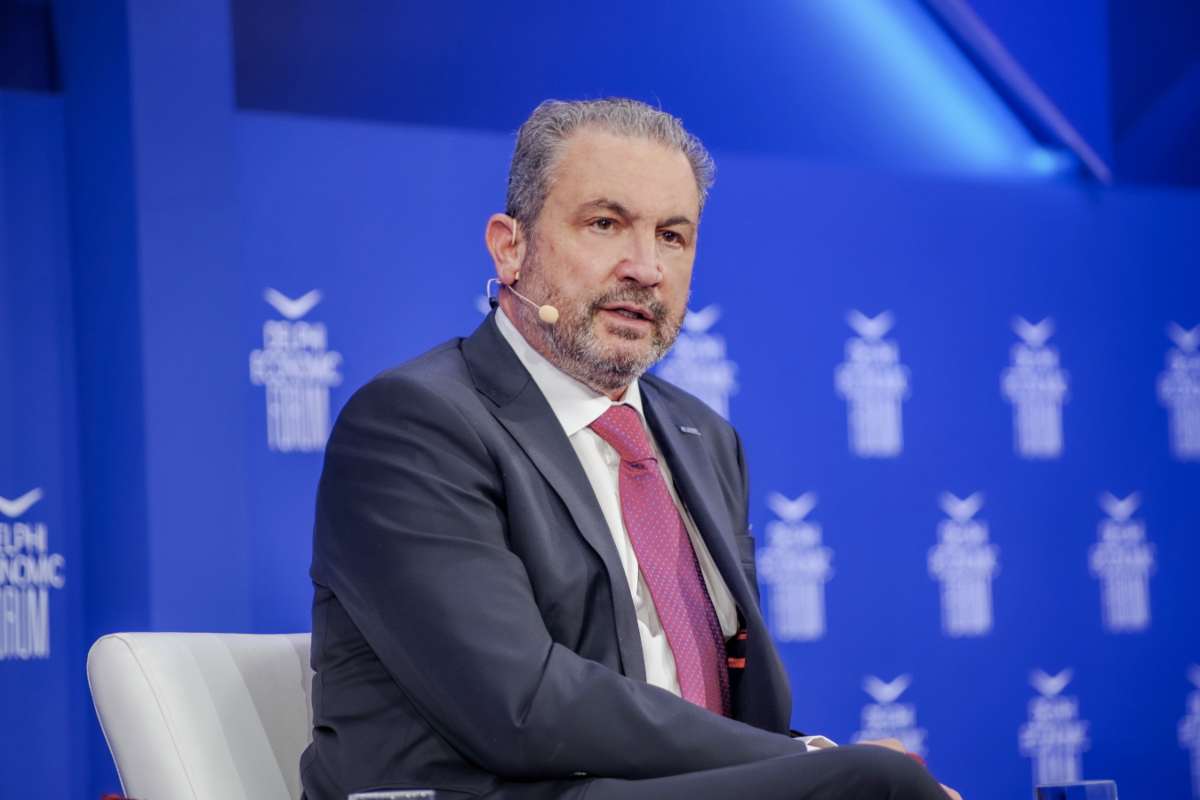
That is the central message behind the intervention of Alexandros Exarchou, Chairman and CEO of the AKTOR Group, in the Financial Times.
And it shifts the debate from the relatively simple question of whether enough natural gas exists to a much harder one:
Who is prepared to pay more to secure it?
Exarchou Focuses on Where the Real Battle Is: The Global LNG Market
Speaking to FT journalist Verity Ratcliffe on September 23, Exarchou focused on international LNG demand ahead of the 2026–27 winter and the pressure the new market environment is placing on the EU’s methane regulatory framework.
His central assessment was that the European Union would be forced to reconsider the timing of some of the new requirements as LNG markets tighten and Europe seeks to preserve access to the broadest possible pool of suppliers.
That debate has now moved directly into the European policy arena.
And that matters because it demonstrates something larger:
the global gas market is beginning to exert pressure on European regulation before winter has even arrived.
The New Battle Is Not Europe vs Russia — It Is Europe vs Asia
The major change in 2026 is that Europe is not buying LNG in isolation.
It is competing for many of the same cargoes sought by China, Japan, South Korea, India, Pakistan and other Asian economies.
And LNG has one defining characteristic that changes the entire game:
the ship can change destination.
If the Asian price rises sufficiently above the European price, flexible cargoes have a strong economic incentive to head east.
That is precisely why the widening gap between the two markets matters.
According to figures cited in the FT report:
- Platts JKM, the main Asian LNG benchmark, has approached $30/MMBtu;
- comparable European deliveries have been trading at just under $25/MMBtu;
- in energy terms, the difference is roughly €90/MWh in Asia versus €75/MWh in Europe.
And if disruption in the Gulf persists, the scenario cited by the FT could push JKM toward $35/MMBtu, equivalent to roughly €105/MWh.
At those levels, LNG becomes more than an energy commodity.
It becomes a bidding contest.
Why Asia May Not Step Aside This Time
One of the FT report’s most important observations concerns the behaviour of emerging Asian buyers.
During the 2022 energy crisis, soaring European prices effectively pushed several developing economies out of the LNG spot market.
They simply could not compete with the prices Europe was willing to pay.
The picture in 2026 is different.
Countries including India and Pakistan have become more accustomed to extreme price volatility and, according to the report, are purchasing multiple cargoes even at today’s elevated levels.
That fundamentally changes the equation.
Europe can no longer assume that a high enough bid will automatically force price-sensitive Asian buyers to withdraw.
This winter, Europe may have to outbid them.
Europe Also Starts From a More Difficult Position
The challenge becomes even greater because of low European gas inventories.
Lower storage levels mean Europe needs additional imports not only to meet current consumption but also to maintain sufficient reserves through the winter.
That increases reliance on the global LNG market at exactly the moment when Asian demand is becoming more competitive.
And this exposes the central vulnerability:
Europe may possess the terminals capable of receiving LNG — but it still has to win the cargo first.
Exarchou’s Warning on the Methane Regulation
This is where Exarchou’s intervention becomes particularly significant.
The EU’s Regulation 2024/1787 on reducing methane emissions is an important part of the bloc’s climate policy.
Its requirements progressively extend to imported oil, gas and coal, creating additional reporting, monitoring and compliance obligations for importers and suppliers.
Under normal market conditions, such requirements can be incorporated into the supply chain over time.
But an exceptionally tight LNG market creates a much harder question:
What happens if additional compliance requirements make some suppliers or cargoes more difficult to access precisely when Europe needs every available source of gas?
That is the practical tension Exarchou highlighted.
Climate Policy Meets Energy-Security Reality
The debate over postponement should not automatically be interpreted as Europe abandoning its methane-reduction objectives.
The more immediate issue is the timing and implementation of particular obligations in a radically different energy environment.
That distinction matters.
Europe still has climate targets.
But governments also have to secure sufficient energy, protect industry and limit another inflationary shock for households.
When markets are comfortable, tighter compliance can dominate the policy agenda.
When gas becomes scarce, the first question changes:
Will Europe have enough — and at what price?
That is why the methane debate has become inseparable from energy security.
The Return of Long-Term LNG Contracts
There is another important lesson emerging from the FT analysis.
Long-term LNG contracts are returning to the centre of energy strategy.
For years, flexibility had enormous value. Spot markets allowed buyers to purchase additional cargoes when needed without locking themselves into decades-long commitments.
But flexibility has a price.
In the spot market, a buyer has freedom.
What it does not have is certainty.
When markets tighten, certainty suddenly becomes extraordinarily valuable.
That helps explain why several Asian buyers are increasingly looking toward long-term LNG supply agreements, securing future volumes rather than relying on the next available spot cargo.
The US Becomes Even More Important
The medium-term outlook is more favourable.
Global LNG production capacity is expected to expand significantly over the coming years, with the United States playing a central role in that new supply.
That expected expansion also helps explain why long-term contract prices have not experienced the same explosion as spot prices.
Buyers know additional production is coming.
The challenge is navigating the period before that capacity fully reaches the market.
And winter 2026–27 sits directly inside that difficult transition window.
Why Exarchou’s Intervention Matters for Greece
For Greece, this is not a distant global-market story.
The country increasingly sits on energy routes capable of moving LNG northwards into Southeast and Central Europe.
That means Greece’s interest is no longer limited to the domestic price of natural gas.
It also concerns whether Greek infrastructure can function as a reliable gateway for LNG entering the wider European market.
And that makes access to secure, competitively priced volumes increasingly important.
A terminal is essential.
A pipeline is essential.
Interconnections are essential.
But infrastructure alone cannot create the gas flowing through it.
The other half of the equation is securing the cargo.
Exarchou Put the Real Winter Question on the Table
For several years, Europe’s energy-security debate revolved around one central question:
How quickly can the continent reduce its dependence on Russian gas?
In 2026, that is no longer enough.
Europe must answer another question:
How much is it prepared to pay to secure LNG when Asia wants the same cargo?
That is the core of Exarchou’s intervention to the Financial Times.
Europe wants three things simultaneously:
security of supply, affordable energy and climate compliance.
Under normal circumstances, those objectives can move broadly in the same direction.
In an exceptionally tight LNG market, however, the trade-offs become much more difficult.
Winter 2026–27 may therefore be decided not only in Brussels or inside Europe’s gas-storage facilities.
It may be decided on global trading desks, where Europe and Asia compete for the same LNG tanker — and where the advantage belongs to the buyer that secured supply early or is prepared to pay the higher price.
Source: pagenews.gr