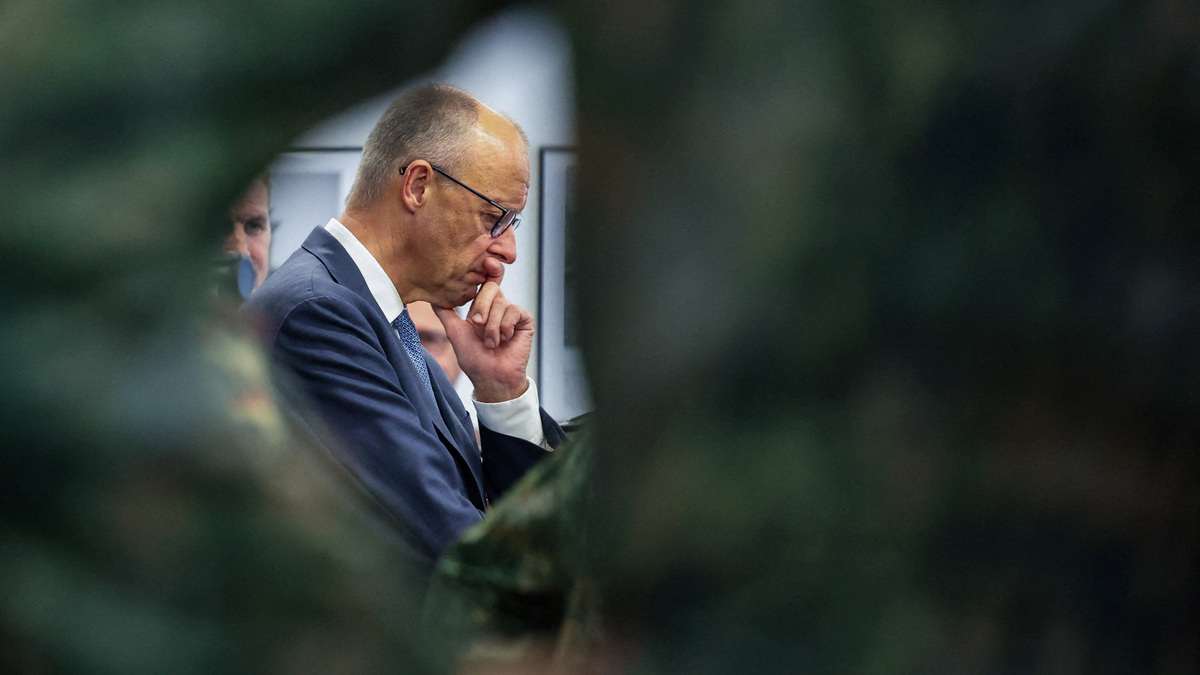
Friedrich Merz is facing a two-front political test.
Abroad, he is trying to reassure allies that Germany will remain firm against Russia and continue supporting Ukraine.
At home, however, he is under mounting pressure from the rise of the AfD, losses for the Christian Democrats in eastern Germany and growing tensions within the governing coalition.
“If we fail to contain Moscow, Russia’s war machine could turn against us”
In a closely watched speech in Münster, where NATO received the Westphalia Peace Prize, Merz used unusually stark language.
He warned that if Europe fails to contain Moscow, Russia’s military threat could eventually be directed at NATO countries themselves.
His core message was blunt:
“If we waver in Germany, Europe wavers. If we remain steady, Europe remains steady.”
“Ukraine must get through this winter”
Merz also said Kyiv must make it through the coming winter with the help of its European partners.
“Ukraine has to get through this winter, and I am convinced it will. It can count on our support,” he said.
The message was aimed not only at Moscow and Kyiv, but also at a German public increasingly divided over the scale of military support.


42% say military aid to Ukraine has gone too far
According to polling cited by Politico, 42% of respondents say Germany’s military support for Ukraine has gone too far, the highest level recorded in that survey series.
The skepticism is especially strong in eastern Germany, where the AfD is also strongest.
That creates a direct political challenge for Merz.
The AfD is tightening the pressure
The AfD has made opposition to Germany’s Ukraine policy a central part of its political message.
The party has repeatedly criticized weapons deliveries to Kyiv and argued for restoring closer economic and energy ties with Russia.
Its recent gains have increased pressure on Merz and sharpened debate inside Germany’s governing camp.
Brussels is no longer treating the problem as theoretical
The second Politico report goes further.
According to officials and diplomats cited by the outlet, European governments have begun considering what could happen if Merz becomes significantly weaker, leaves office or if the coalition collapses.
At least two governments have reportedly held internal discussions about the implications for EU policymaking.
That does not mean Merz is about to fall.
It does mean that political uncertainty in Berlin is now being treated as a European risk factor.
Three scenarios are being discussed
The scenarios reportedly under consideration include:
the collapse of the government,
Merz stepping down or being replaced,
or Merz staying in office but becoming increasingly absorbed by domestic political problems.
The last scenario may be the most disruptive for Brussels because Germany sits at the center of almost every major EU negotiation.
The next EU budget is an immediate test
A weaker Merz could complicate negotiations over the EU’s next seven-year budget.
Germany has emerged as one of the leading voices demanding deep cuts to the European Commission’s spending proposal.
Berlin, together with the Netherlands, Sweden, Denmark, Austria and Finland, has called for hundreds of billions of euros to be cut from the proposed 2028–2034 budget.
The group wants more money redirected toward:
defense,
security,
competitiveness,
innovation,
and migration management.
Domestic weakness could make Merz tougher in Brussels
One of the paradoxes identified by European officials is that political pressure at home may not make Merz more flexible at EU level.
It could have the opposite effect.
A weakened chancellor may feel he needs a visible victory in Brussels to strengthen his domestic standing.
That could make him harder, not softer, in negotiations over spending, Ukraine and industrial policy.
Europe’s bigger fear is paralysis in Berlin
For Brussels, the central concern is not simply who might replace Merz.
It is the risk that Europe’s largest economy could spend months consumed by internal political instability.
A distracted or weakened German government could complicate decisions on:
Ukraine,
defense,
the EU budget,
industrial policy,
and relations with the United States.
That is why other capitals are watching Berlin so closely.
Hendrik Wüst increasingly enters the conversation
North Rhine-Westphalia premier Hendrik Wüst is increasingly mentioned in German political debate as a possible future successor to Merz within the conservative camp.
In Münster, however, Wüst appeared publicly alongside the chancellor and praised his role in strengthening NATO cohesion.
The appearance was widely read as an effort to project unity rather than immediate succession politics.
Merz is turning Russia into an argument for domestic cohesion
The Münster speech therefore had two audiences.
One was Moscow and Europe’s allies.
The other was Germany itself.
Merz is trying to frame support for Ukraine not simply as solidarity with Kyiv, but as a direct question of German and European security.
His argument is that retreat would not bring stability.
It would increase the risk facing Europe.


Warning of more hybrid attacks
Merz also warned that Germany should prepare for further Russian hybrid activity, including cyberattacks, sabotage and other disruptive operations.
Berlin has repeatedly accused Moscow of such actions.
Russia rejects those accusations.
The warning reinforces Merz’s broader case that the conflict with Russia extends far beyond the battlefield in Ukraine.
The wider European equation
Merz’s political position is no longer only a German issue.
His strength matters for:
support for Ukraine,
policy toward Russia,
the next EU budget,
European defense,
and Germany’s ability to broker compromises across the bloc.
That is why the two Politico reports ultimately point in the same direction:
Merz is trying to project strength abroad precisely as questions grow about his strength at home.
The key question for Europe
There is no official process underway to remove Merz, and no confirmed evidence that his government is on the verge of collapse.
But there is clear political pressure and growing concern in European capitals about the consequences of prolonged instability in Berlin.
The question now is whether Merz can stabilize his position domestically while continuing to act as one of Europe’s central decision-makers.
Because, as he put it himself:
“If Germany wavers, Europe wavers.”
Source: pagenews.gr