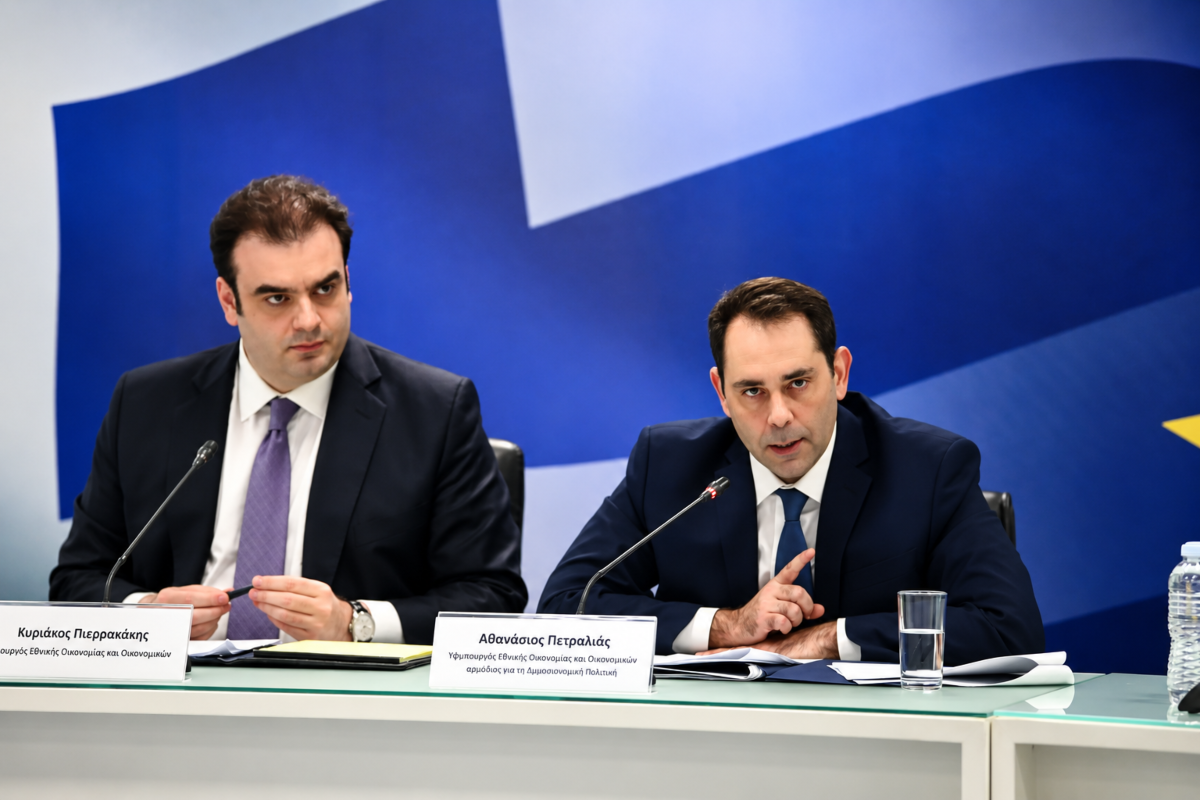
Greece’s economic strategy for 2027 has officially entered Parliament, with Economy and Finance Minister Kyriakos Pierrakakis, accompanied by Deputy Minister Thanos Petralias, submitting the Draft State Budget to Parliament’s Standing Committee on Economic Affairs.
Behind the headline macroeconomic numbers lies a broad package affecting employees, pensioners, public servants, families, farmers, self-employed professionals, homeowners and small and medium-sized businesses.
The political stakes are equally significant. The government is seeking to translate stronger growth and fiscal performance into tangible gains in disposable income, while acknowledging that inflation, energy prices and geopolitical instability remain major risks.
€500 Christmas Bonus for Public-Sector Employees
One of the most politically significant measures is the introduction of a €500 Christmas bonus for all public-sector employees and officials from December 2027.
It forms part of a wider package aimed at supporting household incomes.
From November 2026, the annual payment to pensioners, people with disabilities and uninsured elderly citizens will rise to €400 net, while eligibility will be extended to all pensioners over the age of 65.
Disability benefits will also be indexed to inflation.


Minimum Wage: The €1,000 Target
The draft budget sets another major benchmark for the labor market: a €1,000 minimum wage.
The target is expected to be reached through two successive increases, scheduled for April 2027 and January 2028.
At the same time, social security contributions in the private sector are set to be reduced by a further 0.5 percentage points.
Average compensation per employee is projected to increase by 3.9% in 2027, following an estimated 3.7% rise in 2026.
“My Home III”: €2 Billion for Housing
Housing remains high on the government’s economic and social agenda.
The draft budget provides for a new €2 billion “My Home III” program, while extending a series of existing tax incentives designed to address Greece’s housing affordability challenge.
With housing costs placing increasing pressure on household budgets, the program is set to become one of the government’s key policy instruments for younger households and prospective homeowners.
Zero Tax Rate up to €20,000 for Farmers and Families with Three Children
The tax package is another central pillar of the 2027 plan.
Following the 2026 tax reform, the tax rate on income of up to €20,000 will be reduced to zero for professional farmers and families with three children.
The budget also provides significant tax reductions for compliant self-employed professionals.
Additional measures include accelerated depreciation for investment in machinery and equipment, the abolition of the business levy beginning in Greece’s regions and Thessaloniki, and a gradual reduction in advance tax payments.
The package effectively carries forward measures announced at the 90th Thessaloniki International Fair, incorporating them into the government’s broader fiscal strategy.
A New Investment Account for Children
The government is also introducing a new long-term savings instrument for the younger generation.
A special investment account with matching state contributions will be created, under which the government will match the amount deposited annually by parents, up to €1,200 per year.
The measure introduces a new model for building long-term capital for children, combining family savings with direct state participation.
€1.5 Billion Financing Push for SMEs
Investment and business financing also feature prominently in the budget.
A new €1.5 billion lending and guarantee program for small and medium-sized enterprises will be financed through the loan component of the Recovery and Resilience Facility.
The national and co-financed components of Greece’s Public Investment Budget are also set to be strengthened.
Investment is projected to increase by 7.9% in 2027, compared with 1.7% in the euro area, while the investment-to-GDP ratio is expected to rise from 17.8% in 2026 to 18.6% in 2027.
Greece Targets 2.3% Growth – Outpacing the Euro Area
The Finance Ministry expects the Greek economy to continue expanding significantly faster than the euro-area average for a seventh consecutive year.
GDP growth is projected at:
2% in 2026 and 2.3% in 2027.
By comparison, the European Commission’s spring forecasts cited in the draft put euro-area growth at 0.9% in 2026 and 1.2% in 2027.
Nominal Greek GDP is expected to rise from €262 billion in 2026 to €274.6 billion in 2027.
Inflation Expected to Fall to 2.6%
The cost-of-living crisis nevertheless remains a crucial part of the equation.
Domestic inflation is projected to ease from 3.8% in 2026 to 2.6% in 2027.
That forecast will be critical for the government’s economic strategy, particularly as energy prices remain vulnerable to geopolitical shocks.
The draft budget itself acknowledges that it is being prepared against a backdrop of heightened geopolitical uncertainty, disruptions in energy markets and growing restrictions on international trade.
The conflicts in Ukraine and the Middle East continue to affect global energy markets and maritime trade flows, particularly through the Strait of Hormuz.
Unemployment Seen at 7.9% – Lowest Since 2008
The unemployment rate is projected to decline further, from 8.4% in 2026 to 7.9% in 2027.
According to the draft budget, that would represent Greece’s lowest unemployment rate since 2008.
Together with wage growth and investment, employment performance is set to be one of the central indicators by which the government’s 2027 economic strategy will be judged.
Debt to Fall Sharply to 128.8% of GDP
The fiscal numbers are another key component of the government’s message.
The primary balance is projected at 3.6% of GDP in 2026 and 3.3% in 2027, while the general government overall balance is forecast at 0.6% and 0.3%, respectively.
Public debt is expected to fall from 136.7% of GDP in 2026 to 128.8% in 2027.
According to the Finance Ministry, this would mark the seventh consecutive year in which Greece records the largest debt-to-GDP reduction in the European Union.


The Political Bet Behind the Numbers
The 2027 budget is about much more than headline growth figures.
It represents the framework through which the government intends to combine fiscal discipline, stronger investment and higher disposable incomes at a time when the cost of living continues to weigh heavily on households.
But the budget itself also identifies significant external risks: geopolitical conflict, energy-market disruption, restrictions on global trade, climate change, rapid advances in artificial intelligence and mounting fiscal pressures across several European economies.
Behind the €500 bonus, the €1,000 minimum-wage target, the €2 billion housing program and the new tax cuts, therefore, lies the real economic and political test for 2027: whether strong headline growth and improving public finances can translate into a tangible improvement in living standards amid an unusually volatile international environment.
Source: pagenews.gr