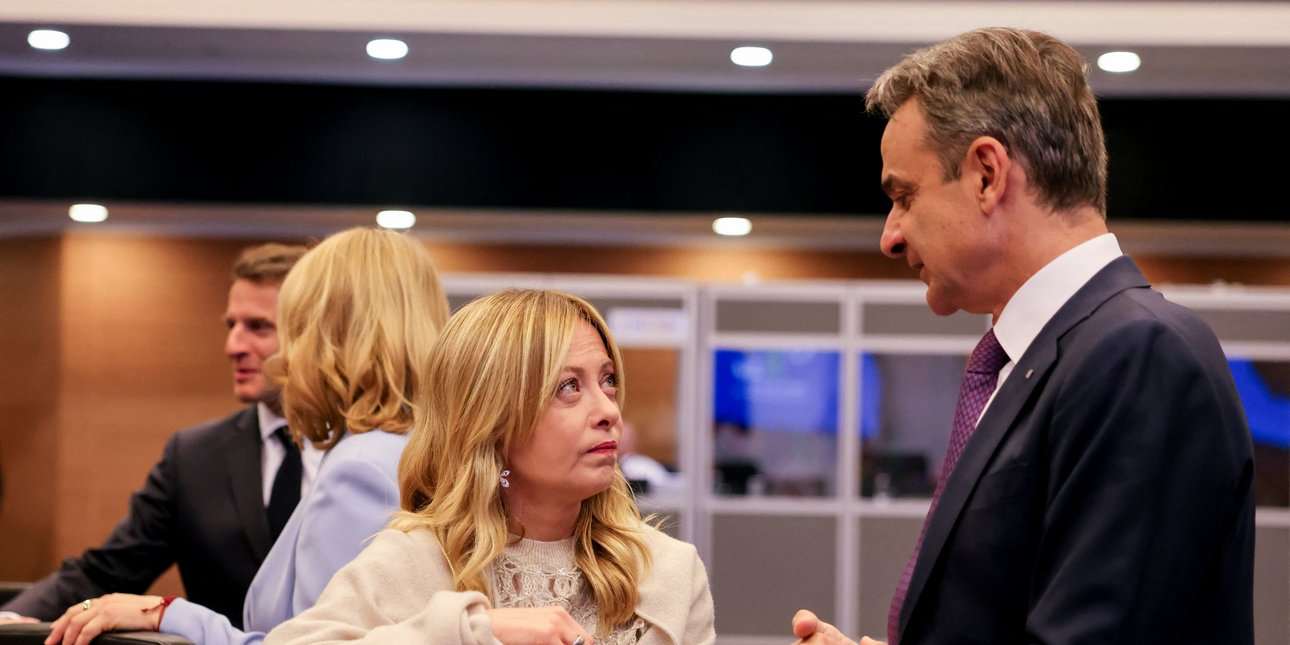
Greece and Italy are entering a critical phase of negotiations with the European Commission, seeking additional fiscal room to address the energy crisis without having emergency support measures count against national spending limits in the usual way.
The debate is moving beyond the Eurogroup meeting in Luxembourg toward broader European discussions, with the EU summit on October 15–16 emerging as an important political milestone.
The European Commission has signaled its willingness to examine the Greek and Italian proposals more closely, although it has not committed to approving new exemptions.
The issue has become particularly important as the eurozone faces a complex economic environment characterized by elevated energy prices, renewed inflationary pressure, rising sovereign bond yields and growing demands for government intervention.
The Greek government is seeking greater flexibility to implement targeted support measures, arguing that exceptional economic circumstances require temporary fiscal responses.
Brussels, however, maintains that protecting households and businesses must remain compatible with sound public finances and investor confidence.
Dombrovskis: Brussels Will Examine the Proposals, but Fiscal Discipline Remains Essential
European Commissioner for Economy and Productivity Valdis Dombrovskis confirmed following the Eurogroup meeting on Thursday, October 8, that the Commission would examine the proposals submitted by Greece and Italy in greater detail.
He held discussions with Eurogroup President Kyriakos Pierrakakis and Italian Economy Minister Giancarlo Giorgetti.
However, Dombrovskis remained cautious about introducing additional exemptions to the European fiscal framework.
He warned that repeatedly expanding the list of exceptions could undermine confidence in member states’ commitment to fiscal sustainability.
The warning carries particular weight given recent turbulence in European sovereign bond markets.
Investors are paying increasing attention to the fiscal outlook of major European economies, especially France, where political uncertainty and concerns about public debt have pushed borrowing costs higher.
Against this backdrop, the Commission is attempting to strike a delicate balance between the need for emergency economic support and the credibility of the European Union’s fiscal rules.
What Greece Is Asking Brussels to Approve
The Greek proposal focuses on excluding certain exceptional and temporary support measures from the calculation of net public expenditure.
Net expenditure is a central indicator used to monitor compliance with the European Union’s revised fiscal governance framework.
Athens argues that temporary measures designed to address an external energy shock should not disproportionately restrict a government’s ability to protect households and businesses.
The objective is to create a limited amount of additional fiscal room, subject to clearly defined conditions, for targeted interventions.
The proposal does not amount to a request to abandon European fiscal discipline altogether.
Instead, Greece is seeking special treatment for temporary emergency measures so that governments can respond more quickly if the energy crisis intensifies.
The underlying argument is that exceptional energy-related expenditure should be assessed differently from permanent increases in government spending.
Whether Brussels accepts that distinction within the existing framework remains to be determined.


The €950 Million VAT Argument: Athens Seeks Room to Return Revenue to the Economy
One of the most significant elements of the Greek position concerns additional tax revenues generated by higher prices.
According to government estimates cited in reporting on the negotiations, additional VAT revenues amount to approximately €950 million.
Athens wants greater scope to use part of such revenues to provide relief to households and businesses.
When the price of a product rises, the VAT collected per unit can also increase, assuming other conditions remain unchanged.
Fuel prices provide a particularly relevant example.
However, the overall impact on tax revenue also depends on changes in consumption.
Higher prices may reduce demand, potentially offsetting part of the increase in VAT receipts.
For that reason, the €950 million estimate should not be interpreted as an automatically available fund for new subsidies.
The Greek government’s objective is to establish greater flexibility for targeted interventions if energy prices remain elevated.
Any actual measures would still require separate policy decisions, fiscal assessment and implementation arrangements.
Italy Wants Inflation Taken Into Account
Prime Minister Giorgia Meloni’s government has submitted a different but complementary proposal.
Rome is seeking greater recognition of inflation when assessing compliance with European fiscal rules.
The Italian argument is that rising prices affect both nominal public expenditure and government tax revenues.
Italy also wants more freedom to use additional inflation-related revenues for temporary measures aimed at reducing energy costs.
The Meloni government is facing pressure to protect households and businesses from expensive fuel and energy.
Its proposal, however, raises questions about how to ensure that additional fiscal flexibility remains temporary.
European policymakers are particularly concerned that short-term emergency measures could eventually become permanent spending commitments.
That concern helps explain the Commission’s cautious approach.
Mitsotakis and Meloni Find Common Ground, but Their Proposals Differ
The governments of Kyriakos Mitsotakis and Giorgia Meloni share the objective of securing greater European fiscal flexibility in response to the energy crisis.
However, their proposals are not identical.
Greece is primarily focused on excluding specific temporary measures from net expenditure calculations.
Italy is placing greater emphasis on how inflation affects fiscal assessments and the use of additional tax revenues.
The convergence between Athens and Rome nevertheless carries political significance.
It demonstrates that two major southern European economies are seeking to shift the debate from strict adherence to spending limits toward greater adaptability during exceptional economic circumstances.
The outcome will depend not only on the Commission’s technical assessment but also on the positions adopted by other EU member states.
Pierrakakis: Protect Citizens Without Undermining Fiscal Stability
Eurogroup President Kyriakos Pierrakakis emphasized the importance of protecting European citizens and businesses from the energy shock following the meeting in Luxembourg.
At the same time, he stressed the need to maintain fiscal credibility.
The Eurogroup discussions examined the measures introduced by member states to address energy-related pressures.
Particular attention was given to ensuring that support measures remain temporary, targeted and proportionate to actual needs.
This approach aims to limit excessive pressure on public finances.
It also recognizes that a prolonged energy crisis could have significant economic and social consequences.
Pierrakakis’s position therefore connects short-term economic protection with long-term fiscal stability.
The challenge is to provide meaningful relief without creating permanent budgetary obligations that governments may struggle to finance.
France’s Debt Turmoil Complicates the Negotiations
The debate over fiscal flexibility is taking place against a backdrop of growing anxiety in European sovereign bond markets.
France has emerged as a particular source of concern because of its fiscal position and the political difficulties surrounding its budget.
Higher government borrowing costs are creating additional pressure across Europe.
For the European Commission, the credibility of fiscal rules has therefore become an especially sensitive issue.
Any decision perceived as a broad relaxation of fiscal discipline could encounter resistance from governments that prioritize strict budgetary controls.
Conversely, countries facing substantial energy pressures argue that insufficient flexibility could weaken economic activity and leave vulnerable households exposed.
The disagreement is not simply about the level of public spending.
It also concerns how European fiscal rules should respond to external economic shocks.
North Versus South: An Old European Debate Returns
The negotiations revive a familiar division in European economic policymaking.
Some governments emphasize the importance of maintaining strict fiscal commitments and preventing excessive debt accumulation.
Others argue that the rules must allow sufficient flexibility when economies face exceptional external shocks.
Greece and Italy are seeking to strengthen the latter approach.
However, the current environment differs from previous debates over fiscal easing.
Rising sovereign bond yields have increased scrutiny of debt sustainability.
At the same time, high energy prices are creating political and economic pressure for additional government support.
The European Union must therefore address two potentially competing priorities: protecting economic activity and preserving confidence in public finances.
Finding a workable balance will be central to the next stage of negotiations.
Existing Escape Clauses Have Limits
The European fiscal framework already provides certain mechanisms for temporary flexibility under specific conditions, including provisions relevant to defense expenditure.
Energy-related investments and support measures may also receive particular treatment where existing rules allow it.
Greece and Italy have sought to make use of the available mechanisms.
Their new proposals, however, seek additional room for maneuver.
This distinction is important.
The existence of certain exemptions does not mean that every new energy subsidy can automatically be excluded from fiscal calculations.
Nor does the Commission’s willingness to examine the Greek and Italian proposals amount to approval.
Brussels must assess their legal basis, fiscal implications and compatibility with the European governance framework.
The outcome will depend on whether a solution can be developed without weakening the broader system of fiscal oversight.
What the Negotiations Could Mean for Fuel, Heating and Businesses
For Greece, the significance of the European negotiations is practical.
If additional flexibility is approved, the government could gain more room to design temporary measures addressing elevated energy costs.
Depending on subsequent policy decisions, such measures could potentially concern fuel consumption, heating costs or the energy expenses of businesses.
However, the Eurogroup has not approved a specific new support package.
There is also no automatic link between possible European fiscal flexibility and the introduction of additional subsidies.
Any measure would require separate government decisions, detailed costing and the necessary legal and administrative procedures.
For households, the immediate concern remains the evolution of energy prices.
For businesses, the ability to limit operating costs without creating permanent fiscal commitments is particularly important.
Energy-intensive industries and smaller enterprises can be especially sensitive to sustained increases in electricity and fuel prices.
Energy Independence as Europe’s Longer-Term Response
Beyond emergency subsidies, the Eurogroup also discussed the importance of strengthening Europe’s energy independence.
Pierrakakis highlighted investment in clean energy, electrification, stronger electricity grids and cross-border interconnections.
This approach links energy security with economic competitiveness.
Reducing dependence on imported fossil fuels could, over time, make European economies less vulnerable to fluctuations in international energy prices.
However, these investments require time and substantial financing.
They cannot fully replace short-term support when an acute energy crisis places immediate pressure on households and businesses.
European policymakers are therefore confronting two interconnected challenges.
The first is how to provide effective relief now.
The second is how to build a more resilient energy system capable of reducing exposure to future shocks.
What Happens After the Eurogroup Meeting?
The process did not conclude with Thursday’s Eurogroup meeting.
Discussions continue at the ECOFIN meeting on Friday, October 9, involving finance ministers from across the European Union.
The next major political milestone is the EU summit scheduled for October 15–16.
Broader questions of energy policy and the economic response to the crisis are expected to feature in European discussions surrounding the summit.
The meeting could help establish political direction for subsequent decisions.
However, there is no guarantee that a final agreement on the Greek and Italian fiscal proposals will emerge immediately.
The European Commission will continue evaluating the requests, while the positions of individual member states will influence the scope of any potential compromise.
The preparation and assessment of national budgets for 2027 add further urgency to the debate.
Governments need clarity about their spending commitments and the fiscal treatment of any new measures.
The Bigger Economic Calculation for Mitsotakis and Meloni
For Kyriakos Mitsotakis and Giorgia Meloni, the negotiations are closely connected to the challenge of managing the economic consequences of the energy crisis.
Both governments want greater capacity to intervene without breaching European fiscal commitments.
The outcome, however, will not depend solely on their political arguments.
Developments in sovereign bond markets, the inflation outlook and the Commission’s assessment will also play important roles.
Brussels has not rejected the proposals outright.
Nevertheless, it has made clear that exceptional flexibility must not become a permanent weakening of fiscal discipline.
This leaves Athens and Rome facing a complex negotiation in which economic necessity must be reconciled with institutional constraints.
The October Summit: A Test of Europe’s Economic Response
The central question for the European Union is whether it can develop a common approach that protects citizens from high energy costs while preserving the fiscal credibility of its member states.
For Greece, the outcome could influence the government’s ability to finance additional temporary support measures.
For Italy, it could affect the treatment of inflation-related fiscal pressures and the use of additional tax revenues.
For the eurozone as a whole, the negotiations will test the adaptability of the revised fiscal framework during a period of renewed economic uncertainty.
The European Commission has agreed to examine the Greek and Italian proposals, but additional fiscal flexibility has not yet been approved.
That distinction remains crucial.
The October 15–16 summit may provide an important political opportunity to advance the discussion, but the final outcome will depend on further negotiations and institutional decisions.
For Athens and Rome, the objective is clear: secure enough flexibility to respond to the energy crisis without undermining the financial stability that European fiscal rules are designed to protect.
Source: pagenews.gr