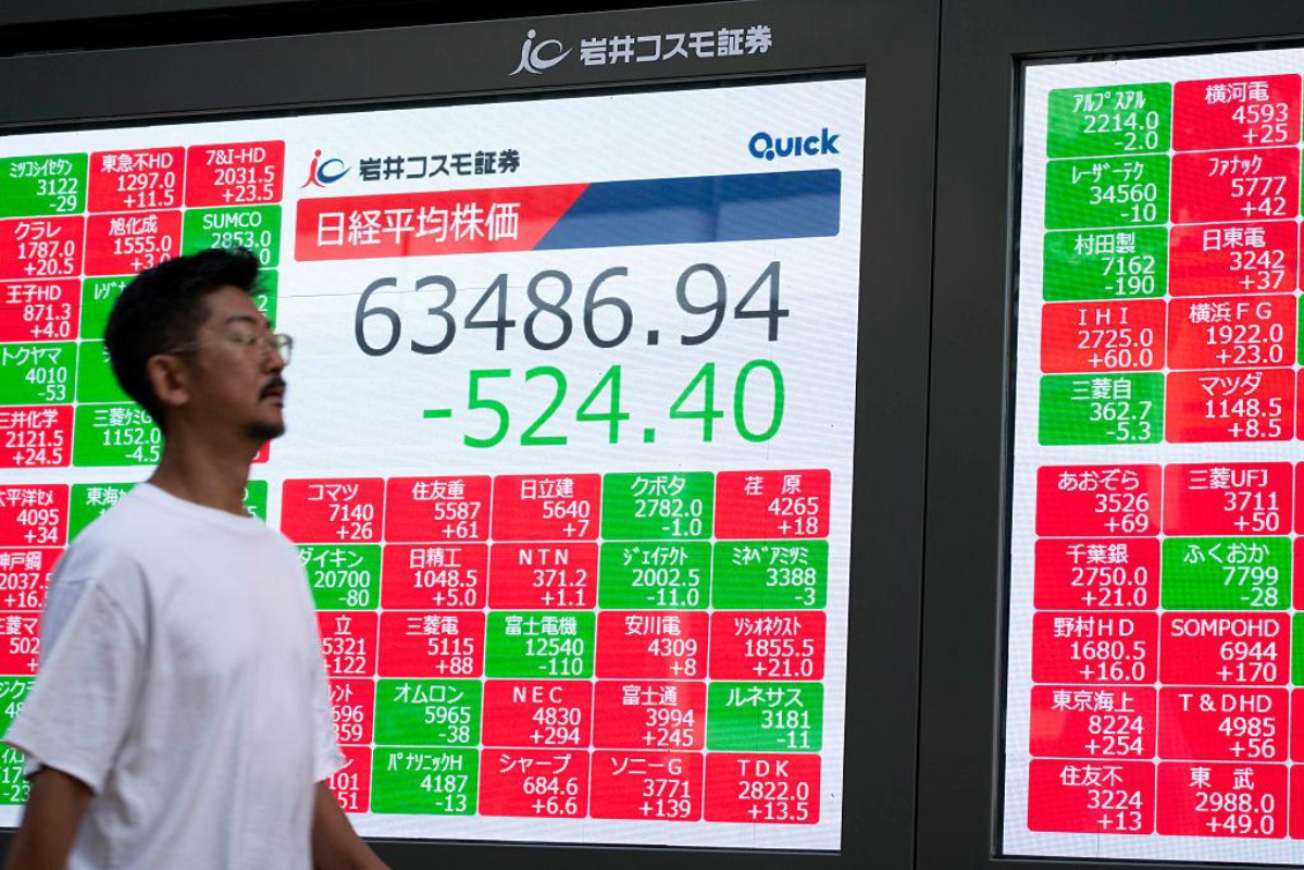
The global economy is entering a period of extraordinary financial and geopolitical uncertainty. Wall Street has suffered a multitrillion-dollar market rout, artificial intelligence is losing its status as the unquestioned engine of stock market growth, and the political balance of power in Washington has shifted dramatically following the Democrats’ midterm election victories.
At the same time, energy inflation is threatening to accelerate, central banks face increasingly difficult monetary policy choices, and conflicts in Ukraine and the Middle East continue to disrupt international trade, shipping and energy markets.
What makes this moment particularly dangerous is not any single crisis, but the possibility that several crises could reinforce one another.
For months, abundant liquidity and expectations of sustained technological growth helped financial markets absorb political shocks, geopolitical uncertainty and rising costs.
That protective cushion is now being tested.
Investors are reassessing the valuations of technology companies, the direction of American economic policy, the outlook for interest rates and the resilience of global financial markets.
The result is a potentially destabilizing combination of falling asset prices, weakening confidence and increasingly constrained monetary policy.
Wall Street’s $3 Trillion Shock: The AI Boom Faces Its Biggest Test
Thursday, November 5, exposed the vulnerability of US equity markets after years of extraordinary investment concentration in artificial intelligence.
According to market capitalization estimates cited in the financial reporting, the S&P 500 lost approximately $2.9 trillion in value, while the Nasdaq 100 plunged 6.4%, wiping out roughly $2.3 trillion.
The US semiconductor sector suffered particularly severe losses, with its benchmark index falling more than 12%.
Shares associated with the AI infrastructure boom, including Nvidia, AMD and Micron, were among the hardest hit.
The sell-off reflects a fundamental reassessment of expectations that had supported the technology sector’s extraordinary expansion.
For years, investors treated spending on AI processors, data centers, cloud infrastructure and energy systems as an almost unlimited source of future growth.
Technology companies committed enormous amounts of capital to infrastructure projects, while financial markets assigned increasingly ambitious valuations to the businesses expected to benefit.
Yet questions persisted over how quickly those investments would translate into sustainable revenues, cash flows and profits.
The political transformation in Washington has now accelerated those concerns.
The Democratic Victory Changes the Investment Equation
The Democrats’ success in the US midterm elections has altered the political environment facing President Donald Trump.
With Republicans losing control of Congress, investors are preparing for greater confrontation between the White House and lawmakers over fiscal policy, government spending, technology regulation and federal debt management.
One of the most immediate concerns involves the future expansion of data centers.
These facilities require enormous amounts of electricity, water, advanced semiconductors and supporting infrastructure.
Their rapid development has already triggered opposition in several American communities over environmental consequences, energy consumption and pressure on local resources.
A Democratic-controlled Congress could strengthen oversight of the sector and create additional obstacles for large-scale infrastructure projects.
That does not mean an immediate suspension of AI investment is inevitable.
However, financial markets price political risks before legislation is enacted.
The possibility of slower approvals, higher compliance costs and greater regulatory scrutiny is enough to challenge the assumptions underpinning technology valuations.
The result is a shift from expectations of virtually uninterrupted AI expansion toward a more uncertain investment environment.


Japan Suffers Its Worst Week Since the Pandemic
The turmoil has spread rapidly across Asia, demonstrating the global reach of the AI investment cycle.
Japan’s Nikkei 225 fell 5.96% on Friday, November 6, closing at approximately 57,435 points.
Weekly losses exceeded 9%, marking the index’s worst performance since the pandemic-driven market collapse of March 2020, according to the supplied market data.
Technology companies with significant exposure to AI infrastructure suffered particularly heavy losses.
Kioxia Holdings declined 36.8% over the week, Advantest lost 19.6%, Tokyo Electron fell 13.2%, and SoftBank Group dropped 20.8%.
South Korea’s KOSPI also came under severe pressure, declining approximately 6% as investors reduced their exposure to semiconductor and technology stocks.
Japan faces an additional source of financial uncertainty.
Strong nominal wage growth has reinforced expectations that the Bank of Japan could raise interest rates again in December.
Higher Japanese borrowing costs could trigger the unwinding of yen carry trades, investment strategies in which investors borrow in relatively low-interest-rate yen to finance positions in higher-yielding assets elsewhere.
If the yen strengthens sharply while borrowing costs rise, investors may be forced to unwind these positions.
That process could amplify selling pressure across American, European and emerging markets.
Asia is therefore not merely experiencing the consequences of Wall Street’s decline. It could become an additional source of global financial instability.
Five Crises Converging Into a Perfect Storm
The current market turmoil is especially concerning because five separate pressures are interacting.
1. The unwinding of the AI trade. Falling technology valuations are triggering portfolio adjustments and threatening to slow hundreds of billions of dollars in planned infrastructure investment.
2. Political uncertainty in Washington. The shift in congressional control creates new risks surrounding technology regulation, fiscal policy, government spending and the management of US debt.
3. The energy crisis. Prolonged conflict in the Middle East and disruptions to international transportation threaten to keep energy prices elevated, increasing costs for businesses and households.
4. The central bank dilemma. Renewed inflationary pressures restrict the ability of monetary authorities to cut interest rates, even if financial markets weaken and economic growth slows.
5. Financial contagion through leverage. Forced selling and margin calls can transmit losses from technology stocks into unrelated sectors, bonds and international markets.
The danger lies in the interaction between these forces.
Higher energy prices fuel inflation. Inflation limits monetary easing. Higher interest rates pressure valuations and financing conditions. Falling asset prices weaken confidence and investment.
If these developments reinforce one another, a market correction could evolve into a broader financial and economic crisis.
The Bank of England’s Warning: Inflation Is Back in Focus
The Bank of England’s reported decision on November 5 to raise its benchmark interest rate by 25 basis points to 4% illustrates the difficult choices facing monetary policymakers.
Projections suggesting that British inflation could approach 5% by mid-2027 highlight the risk of a prolonged period of elevated borrowing costs.
In a conventional financial downturn accompanied by falling inflation, central banks can cut interest rates to support economic activity and stabilize financial markets.
The current environment is more complicated.
Cutting rates too aggressively could intensify inflationary pressures, particularly if energy prices remain elevated.
Maintaining restrictive monetary policy, however, risks worsening economic weakness and increasing financial stress.
This conflict between inflation control and economic stabilization is one of the defining features of the potential perfect storm.
It also means that investors cannot automatically assume central banks will respond to every sharp market decline with immediate monetary support.


Ukraine, Iran and Global Shipping: Geopolitical Risk Multiplies
The financial turmoil is unfolding against a fragile international security backdrop.
The wars involving Ukraine and Iran continue to affect energy markets, maritime transportation and global supply chains.
Disruptions to shipping routes can increase freight costs, insurance premiums and delivery times, adding further pressure to businesses already struggling with elevated operating expenses.
Meanwhile, a wave of bomb threats targeting commercial aircraft across Europe has prompted emergency security operations and significant aviation disruption.
European authorities have activated an information-sharing mechanism, while the European Union Aviation Safety Agency is assessing the implications for flight safety.
No confirmed evidence currently links those aviation threats to the conflicts in Ukraine or the Middle East, or establishes that they form part of a coordinated hybrid warfare operation.
Nevertheless, the simultaneous presence of multiple security risks adds another layer of uncertainty to the international economic environment.
Even without further military escalation, persistent geopolitical instability can affect investment decisions, transportation costs and business confidence.
Europe Becomes the Next Front
European stock markets have demonstrated greater resilience than American technology shares during earlier stages of the sell-off.
The difference partly reflects the composition of European equity indices.
Banks, industrial companies, energy producers, materials businesses and defense contractors account for a larger share of European markets than they do of the technology-heavy Nasdaq.
This offers some protection against a correction concentrated in AI-related companies.
However, sector diversification cannot fully protect European markets from a global liquidity shock.
If investors shift from selling overvalued technology stocks to reducing overall equity exposure, European shares could experience much broader losses.
The continent also faces structural economic challenges.
High energy costs, weak industrial growth, fiscal constraints and substantial investment requirements leave European economies vulnerable to a prolonged period of international financial instability.
A sustained market downturn could make those challenges more difficult to manage.
Greece: Why a Global Sell-Off Could Reach Athens
Greece enters this period with a stronger fiscal and growth position than during previous major crises.
Nevertheless, it remains a relatively small, open economy that is highly sensitive to external financial conditions and developments in energy markets.
The first effects of a global financial shock could emerge through the Athens Stock Exchange.
International investment funds reducing their overall exposure to equities may sell Greek assets regardless of the underlying performance of individual companies.
If uncertainty persists, the consequences could extend beyond financial markets.
Higher financing costs, weaker investment sentiment, reduced consumption and pressure on export-oriented sectors could affect economic activity.
Tourism, shipping and energy are particularly exposed to changes in global demand, transportation costs and geopolitical conditions.
For smaller markets, prolonged investor hesitation can sometimes prove almost as damaging as an abrupt wave of selling.
The Real Danger: When Selling Triggers More Selling
The most serious threat is not necessarily the initial decline in stock prices.
It is the possibility that market losses create a self-reinforcing cycle of forced liquidation.
When asset prices fall sharply, leveraged investment portfolios may face demands for additional collateral, commonly known as margin calls.
To meet those demands, fund managers may be forced to sell assets, including securities that were not directly involved in the original decline.
Those sales place additional pressure on prices, creating further collateral requirements and potentially triggering another round of liquidation.
The reported surge of almost 70% in the VIX volatility index during Thursday’s session illustrates the intensity of the market’s repricing of risk.
Greg Taylor, chief investment officer at PenderFund Capital Management, compared the market environment with periods of severe financial turbulence, including 2001 and 2008.
The comparison does not mean that today’s conditions are identical to the dot-com collapse or the global financial crisis.
It does, however, highlight a recurring vulnerability: excessive concentration of capital and expectations around a dominant investment narrative.
When confidence in that narrative deteriorates, the resulting market adjustment can become disproportionately severe.
Three Scenarios for What Happens Next
The direction of global markets will depend largely on liquidity conditions and whether the sell-off remains concentrated in technology.
The first scenario is a controlled rotation. Investors reduce their exposure to AI-related companies and shift capital toward businesses with more stable earnings and cash flows. Markets remain volatile, but the correction does not become a systemic financial crisis.
The second scenario is widespread deleveraging. Forced liquidations extend across sectors and asset classes, tightening financing conditions and increasing the risk of financial contagion.
The third and most dangerous scenario combines financial stress with renewed inflation. Energy prices rise further, central banks maintain or tighten restrictive monetary policies, and economic activity slows.
Under those conditions, companies could face declining earnings expectations and higher capital costs simultaneously.
Such a combination would place additional pressure on equity valuations and increase the risk of a prolonged downturn.
The Next Critical Test: Global Liquidity
The immediate question is whether financial markets can absorb the current shock without triggering a wider liquidity crisis.
The strength of corporate balance sheets, the resilience of financial institutions, the behavior of government bond markets and the policy responses of central banks will all be crucial.
A decline in technology valuations does not automatically produce a systemic financial crisis.
Nor does the current evidence establish that the world is entering another 2008-style collapse.
But the convergence of political uncertainty, energy inflation, geopolitical instability, restrictive monetary conditions and leveraged investment positions has created an unusually fragile environment.
The ingredients of a perfect storm are already present. What remains uncertain is whether financial markets can absorb the shocks or whether their interaction will turn a global stock market rout into a deeper financial and economic crisis.
Source: pagenews.gr