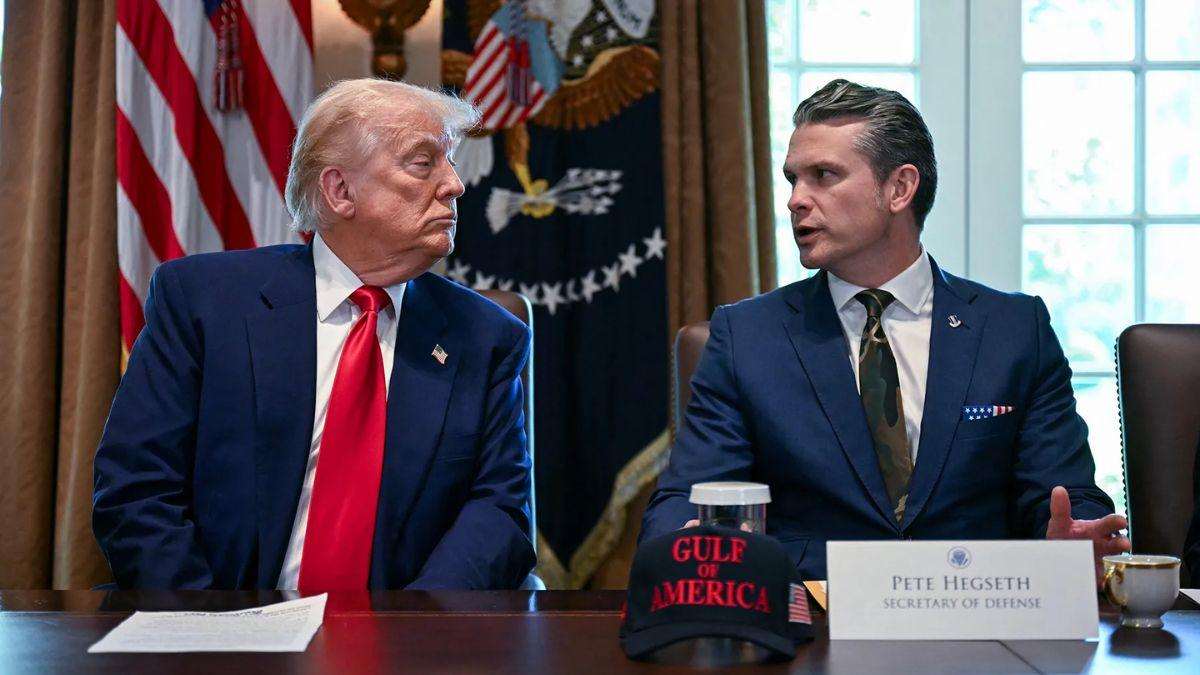
“We won two wars, and we’ve made the world a lot safer place.”
With those words, US President Donald Trump delivered an unequivocal defense of Defense Secretary Pete Hegseth, dismissing a Republican-led effort to impeach him and portraying the initiative as an attack on an administration official he credits with major military successes.
Speaking during a White House press conference, Trump made clear that he would continue backing Hegseth even if the House of Representatives voted to impeach him.
The impeachment resolution, introduced by Republican Congressman Thomas Massie of Kentucky, has opened a new political confrontation in Washington, with a procedural vote potentially taking place as early as Tuesday or Wednesday.
At the center of the dispute is the administration’s military campaign against Iran, along with broader questions about executive authority, the conduct of military operations and congressional oversight.
“Massie’s a Stone-Cold Loser”: Trump Lashes Out at Republican Critic
The confrontation escalated when a CNN reporter asked Trump whether he would retain Hegseth as defense secretary even if the House impeached him.
“He won two wars. He was in charge. We all won. I had great people,” Trump responded.
When the reporter pointed out that Massie had accused Hegseth of illegal actions, the president turned his criticism toward both the congressman and CNN.
“Massie’s a loser, just like you’re a loser at CNN, just like your ratings are a loser. Massie is a loser, stone-cold loser. Massie has a lot of hatred in his heart.”
Trump continued:
“I watched, I heard what Massie did, and I don’t want to waste my time watching him. We won two wars. We won two wars, and we’ve made the world a lot safer place.”
The president’s assertions about winning two wars reflect his administration’s characterization of its military record rather than an independently established assessment of the conflicts’ outcomes.
The exchange illustrated the increasingly personal nature of Trump’s dispute with Massie, a Republican who has repeatedly challenged the president on questions of executive power and military intervention.


Iran War Becomes the Central Flashpoint
The impeachment effort has intensified scrutiny of the Trump administration’s military decisions, particularly its campaign against Iran.
Massie has argued that Hegseth should face accountability for actions he considers unlawful, while the White House maintains that its military operations have strengthened American national security.
Hegseth himself has defended the administration’s decision to launch the war against Iran, indicating that he agrees with Trump that he would make the same decision again.
The disagreement reflects a broader debate over the constitutional balance between presidential authority and Congress’s responsibility to oversee military action.
It is also politically significant because the impeachment initiative originated within Trump’s own party rather than from Democratic lawmakers.
Massie Predicts Hegseth Will Be Gone by December 31
Massie has publicly predicted that Hegseth will no longer lead the Pentagon by the end of 2026.
“I still believe Pete Hegseth will not be in that position by December 31 of this year,” Massie told CNN.
The Kentucky Republican described his impeachment initiative as relatively restrained compared with the congressional investigations he believes could follow.
“I’m not proposing that he be sent to prison. I’m simply saying that he needs to be removed from office now,” Massie said.
He also suggested that Democrats could pursue a more extensive investigation if they take control of the House in January.
“They will hold hearings in the House. They will call people who have served under Hegseth, people who know things that have not yet come to light.”
Those remarks represent Massie’s expectations about potential future congressional action, not an announced Democratic investigative program.

A Republican Divide Ahead of the House Vote
Massie believes that other Republicans could break with the White House over Hegseth, particularly lawmakers leaving Congress or those facing political pressure following the November 3 elections.
He argued that the election results had exposed vulnerabilities within the Republican Party.
“I think they’re afraid, and they realize that in two years things could get even worse for President Trump and the war with Iran,” Massie said.
The impeachment resolution could therefore become an important test of Republican unity, even if it does not ultimately result in Hegseth’s removal.
Under the US Constitution, impeachment by the House of Representatives does not automatically remove a federal official from office.
Removal requires conviction by a two-thirds majority of senators present following a Senate trial.
The House could also refer the resolution to a committee or dispose of it through a procedural vote without directly approving impeachment.
Trump Invokes Biden’s Defense Secretary Lloyd Austin
Seeking to challenge the rationale behind the impeachment effort, Trump drew comparisons with former Defense Secretary Lloyd Austin, who served under President Joe Biden.
The president referred to the controversy surrounding Austin’s hospitalization in late 2023 and early 2024, when senior administration officials were not promptly informed of his medical condition.
“What about impeaching that Biden guy who disappeared for two weeks and nobody had any idea where he was?” Trump asked.
He also questioned why former officials associated with US military operations in Iraq and Afghanistan had not faced comparable impeachment efforts.
The comparison was intended to reinforce Trump’s argument that Hegseth was being subjected to unfair political scrutiny despite what the president regards as his military accomplishments.
“The Soldiers Love Pete Hegseth”
Trump also defended Hegseth’s leadership by emphasizing what he described as strong support for the defense secretary among American service members.
“The soldiers, the actual soldiers, the great people that do the work, the great patriots, they love Pete Hegseth,” the president declared.
He then pointed to military recruitment as evidence of improvements under his administration.
“If you go back two years ago, before I got into office, we could not recruit people. The Army was way behind everybody. Now we have waiting lists of people trying to get in.”
These claims about recruitment and military sentiment were presented by Trump as evidence of Hegseth’s performance, although the remarks did not include supporting figures.
“He’s done a very good job,” Trump concluded.
Beyond Hegseth: A Test of Trump’s Authority in Washington
The impeachment dispute extends beyond the future of a single cabinet secretary.
It raises questions about the political consequences of the Iran war, the limits of presidential military authority and the willingness of Republican lawmakers to challenge their own administration.
For Trump, defending Hegseth has become part of a broader effort to protect his administration’s military record and maintain political support for its national security strategy.
For Massie, the impeachment resolution represents an attempt to force congressional accountability over decisions he believes require closer scrutiny.
The immediate question is whether the House will allow the resolution to advance, refer it to a committee or reject it.
The longer-term implications could depend on the balance of power in Congress and whether lawmakers pursue further investigations into the Pentagon’s conduct.
As Washington prepares for the next stage of the confrontation, Trump’s message remains unmistakable: he is standing behind Pete Hegseth, even as the defense secretary faces a challenge from within the president’s own party.
Source: pagenews.gr